
На цій сторінці
Про цей альбом
The Price of Light починається до приходу води. У безіменній вигаданій долині британського нагір’я ще є діючі ферми, кам’яні будинки, вузька дорога, церква й цвинтар. Чотирьох геодезичних кілків достатньо, щоб розділити знайому землю на те, що може залишитися, і те, що мусить зникнути.
Гідроенергетичний проєкт вдається. Його електрика задовольняє справжні потреби, а будівельників не зводять до ролі лиходіїв. Альбом простежує вимоги цього успіху: оцінювання майна, роз’єднані збори, прощання з домом, бетонування та дбайливе перенесення речей, оточення яких не врятувати.
Перша половина залишається поруч із мешканцями. Згодом робочі ритми й гідравлічні системи виходять на передній план, аж поки в «Sluice» людське мовлення стає рідкісним. Остання пісня залишає долину заради кімнат, освітлених її електрикою. Ні користь, ні руйнування не скасовують одне одного.
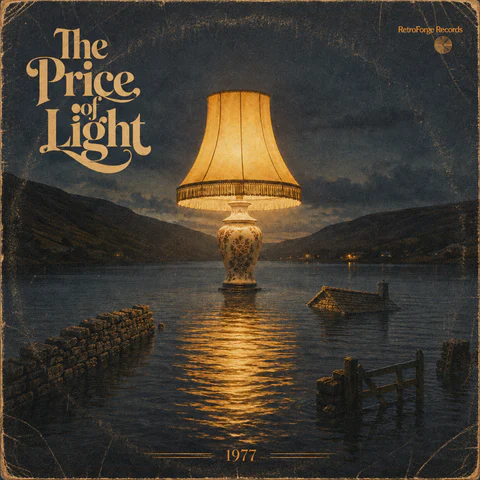
1977 рік позначає вигадану архівну рамку та звукову естетику, а не історичну дату запису. Це самостійний вигаданий альбом, не розповідь про документально підтверджену катастрофу на водосховищі.
Список композицій
- 1Pegs in the Lower Field05:02
- 2Compensation Day04:42
- 3Against the Motion05:17
- 4Rooms Without Curtains03:52
- 5Aggregate04:09
- 6Below the Red Line05:19
- 7Sluice05:04
- 8Lights Beyond the Ridge04:48
Загальна тривалість музики: 38:13. Усі вісім композицій мають вокал; у «Sluice» переважає інструментальна частина.
Композиція за композицією
1. Pegs in the Lower Field
Чотири червоні кілки віщують зміну, яка ще не торкнулася краєвиду. Машинописне повідомлення правильно подає ім’я мешканця, проте описує поле лише числами. Наказ не чіпати кілки переходить від очікування інформації до усвідомлення її значення.
2. Compensation Day
Канцелярська мова зустрічає незручні запитання: чи враховується сад, що означають двадцять років оренди та хто перевезе піаніно. Бланки зберігають незворушність, поки в кімнаті наростає тривога. Гроші потрібні, але оцінка не описує всього, з чим доведеться розпрощатися.
3. Against the Motion
Громадські збори виявляють різні інтереси під закликом до єдності. Мешканці вище майбутньої лінії води можуть дозволити собі опір, недоступний тим, хто вже пакує речі. Питання про могили ненадовго зупиняє суперечку; голосування фіксує результат, але не усуває розбіжностей.
4. Rooms Without Curtains
Погляд звужується до майже порожнього будинку. Голі стіни, знайомі звуки та надщерблена чашка несуть смуток, якого не вмістили таблиці компенсацій. Довгі розмовні речення затримують від’їзд, а останній поворот ключа є звичкою не меншою мірою, ніж рішенням.
5. Aggregate
Найважчий фізично момент альбому дає будівництву власний робочий словник. Бункери, опалубка, бетономішалки й жести замінюють мову зборів. Робітники — фахові люди, що працюють зі справжніми матеріалами; непокоїть те, що уможливлює їхня ефективна праця.
6. Below the Red Line
Вивезення охоплює худобу, інструменти, церковне начиння та надгробки. У незворотному рішенні залишається практична турбота: тріснутий камінь зберігають, бо ім’я ще читається. Дзвін можна підняти; громаду, яка надавала йому сенсу, не завантажиш у вантажівку.
7. Sluice
Рідкісний документальний вокал залишає простір великій архітектурній кульмінації. Затвори, тиск і прилади визначають послідовність, поки вода забирає дорогу, мур і сад. Споруда не виходить із ладу: остання червона позначка зникає, бо система робить саме те, для чого її збудували.
8. Lights Beyond the Ridge
Завершальна пісня потрапляє до кухонь, майстерень і звичайних вулиць, які отримують електрику. Їхніх мешканців не звинувачують і не роблять свідками долини, якої вони не знали. Лампа допомагає комусь завершити справу; за хребтом залишається втрата. Корисність струму не розв’язує питання його ціни.
Звукова палітра
Пасторальний прогресивний рок створює сільську близькість, а симфонічний прог надає будівництву й затопленню масштабу. Непарні розміри та зміни темпу слідують за дією, а не стають безперервним показом техніки.
Фортепіано є повторюваною сполучною ланкою. Орган Hammond переходить від стриманих акцентів до широких архітектурних епізодів; Mellotron дозовано додає холодніших барв. Аналоговий синтезатор використано ощадливо. Віолончель і нечисленні відтінки кларнета чи саксофона доповнюють клавішну палітру ще одним людським регістром.
Акустична гітара з пальцевою технікою та дванадцятиструнна гітара сусідять із чистими електричними фігурами, кутастим контрапунктом, витриманими нотами й важчою грою з вибірковою сатурацією. Бас залишається мелодійним і чутним у середньому регістрі, переходячи від лірики до ритмів будівництва. Природні акустичні барабани зберігають динаміку й характер приміщення.
Головний чоловічий вокал змінюється залежно від обставин: спостереження, суха процедура, сперечання ансамблю, майже розмова та впевнений будівельний спів. Аналогове тепло в дусі кінця 1970-х, сатурація, вибірковий дилей і пластинчаста чи камерна реверберація поєднують ці підходи, не стираючи розділення інструментів.
Архівні нотатки
Лінія спершу з’являється як стрічка між кілками. Вона стає адміністративною межею, наказом про вивезення й нарешті затопленою позначкою. Краєвид ще не змінився, коли його вперше описали числами; наприкінці ці числа допомагають визначити, що залишиться видимим.
Камінь також змінює функцію. Мури й будинки стають оцінюваним майном, а заповнювач і бетон набувають сили стримувати річку. Надгробки переносять особливо дбайливо. Читабельні імена зберігають щось конкретне, навіть якщо місце довкола не може вціліти.
«Rooms Without Curtains» — інтимне звуження перед «Aggregate». Чашка важлива тому, що її залишають, а не тому, що вона коштовна. «Aggregate» додає фізичної ваги; «Sluice» перетворює її на архітектуру. Вода стає панівним образом лише пізно, як світло прибережене для фіналу.
Обкладинка стискає цей зв’язок у величезну домашню лампу, що світиться посеред водосховища. Попереду — затоплені мури, ворота й лінія даху, за хребтами — далекі вогні. Потерте матове оформлення належить до уявного видання 1970-х; велетенська лампа — символ обкладинки, а не надприродна подія сюжету.
Тексти пісень
Оригінальні англійські тексти без доданих позначень куплетів чи виконавських указівок.
01 · Pegs in the Lower Field
There are four red pegs in the lower field,
two by the ditch and two beyond the gate.
I nearly pulled the first one with my boot
before I saw the tape stretched through the grass
and the tripod standing where the cattle turn.

They have chalk on their sleeves and mud on their knees.
One of them asks which fence is ours.
I point to the wall, then farther down
where the hedge has grown through the wire,
and he writes something without looking up.

Leave them where they stand.
Leave them there until we know.

By dinner the men have crossed to the far side.
A white card is tied beneath the gate latch.
My name is typed correctly.
The field is described in numbers,
though nothing in it has moved.

I walk the line again before dark,
past the patch where the ground stays wet,
past the broken post we keep meaning to mend,
past the place the river shows between the alders.

Leave them where they stand.
Now we know enough.
02 · Compensation Day
Property to be acquired.
Access to be retained.
Fixtures by separate schedule.
Outbuildings subject to inspection.

A hand turns the page.
From the second row: does the orchard count?
At the back, twenty years of rent
is placed on the table as if it ought to count for something.

Reasonable costs of removal.
Alternative accommodation where applicable.
Livestock transport to be assessed.
Existing rights to be extinguished.

A chair scrapes back.
A man beside the window says,
“If you mean the house, say house.”
Nobody writes that sentence down.

Sign here.
Initial there.
Take a copy home.

Market value at the appointed date.
No allowance for attachment.
No allowance for expectation.
No allowance for inconvenience beyond the terms stated.

One family whispers over debts.
Another folds the paper twice.
Across the aisle comes the remark
that accepting early makes it easier for them.

Property to be acquired.
Access to be retained.
The same words return,
but the room has changed around them.

A woman asks who moves the piano.
Laughter breaks too loudly near the door.
Another form slides across the table.

Sign here.
Keep your copy.

Next.
03 · Against the Motion
Put it to the room, then.
Put the paper down where everyone can see it.
You say refusal keeps the road open.
He says refusal only changes the date.
From the back comes: the churchyard first,
and three people answer before the chair can call order.

We came here together.
That lasted ten minutes.

You call it surrender.
I call it knowing what comes next.
You have land above the line.
We do not.
You can wait another winter.
We have already packed the upstairs rooms.

No, that is not what I said.
No, don't tidy it for me.
If the offer stands, I take it.
If you want to hate me for that,
use my name when you do it.

The chairman asks for order.
The chairman asks again.

A hand rises slowly near the wall:
What happens to the graves?

For once,
nobody answers at once.

Against the motion.
For the motion.
Abstain if you must.

A vote is a useful thing
when the question fits inside it.

This one does not.

From the left: we should stand as one.
From the doorway: we stopped doing that
the moment the first figure arrived.

Count the hands.
Count them twice.
Record the result.

Then meet your neighbor's eyes.
04 · Rooms Without Curtains
The curtains went yesterday, and without them the front room looks taller than it ever did when the table was under the window and the kettle could be heard from the hall.

There are pale squares above the mantel where the pictures hung,
and two clean strips on the floor where the cabinet stood,
and one bent hook by the door that I leave in place because removing it would be more deliberate than I can manage today.

We carry the last boxes down the stairs slowly, not because they are heavy but because there is no reason to hurry anymore, and the sound of our shoes travels farther through the house than it used to.

In the kitchen a cup has been left behind.
Not the good one.
Not anyone's favorite.
Just a chipped brown cup at the back of the shelf.

I put it in a box anyway.

You have the keys in your coat pocket, and I still reach for mine when I come through the passage, which makes us both laugh once, briefly, before neither of us knows what to say after it.

The bedroom door catches at the same place.
The third stair still complains.
There is dust under the bedstead and a nail in the wall we never used.

Everything is exactly where the house left it.

Except us.

At the gate I turn the key until the lock takes,
then try the handle twice from habit.

We walk to the road.

I do not look back again.
05 · Aggregate
Stone through the hopper.
Dust whitening the road.
A loaded lorry crawls
where the sheep track ran.

Check the grade.
Brace the shuttering.
Wave the mixer forward.
The chute swings over the timber.

Crush it.
Grade it.
Pour it.
Hold.

Boots on wet boards.
Cable drawn taut.
A banksman lifts one arm
through the engine noise.

The drum turns.
The barrows queue.
A shovel works the corners
before the mix can stiffen.

By noon the forms are full.
Cement dries grey across the gloves.
A man knocks each board with his hammer,
listens,
then moves to the next.

Another lorry backs into place.

Crush it.
Grade it.
Pour it.

Hold.
06 · Below the Red Line
The cattle go first to the upper farm.
Tools are tagged and loaded by the shed.
Two pews leave through the vestry door.
The brass cross travels wrapped in blankets.
A crate is marked for books,
another for the kitchen things no one has claimed.

Take what can be carried.
Leave the rest below the red line.

The gate comes off its hinges.
Useful timber is stacked by the road.
A stone trough takes four men and a chain.
The old mower will not start,
so they drain it, curse it,
and winch it onto the lorry anyway.

Move what can be moved.
Mark the rest below the red line.

Names are copied from the grave markers.
Numbers are checked against a list.
Soil is lifted carefully.
Families stand farther back than they expected to.
The small stones travel with the large ones.
The cracked one is kept because the name can still be read.

At the church door
someone asks whether the bell is coming.

It is.

Raise what can be raised.
Close the road below the red line.

By evening there are fewer reasons to return.
One crate waits without a label.
One gate stands open.
One room still has a broom against the wall.

Nobody needs it.

Take what can be carried.
The line has already decided the rest.
07 · Sluice
The gate is checked.
The channel is clear.
Pressure holds where the concrete joins.
A hand signal passes down the platform.

Close.

The current turns.
The intake takes it.
Levels climb past marks
painted months before.

By noon the lower road
ends in brown water.

Road below.
Wall below.
Orchard below.

The gauge moves.

Water finds the contour.
Concrete holds.
At the spillway the needles settle.
Beyond the wall,
the river runs narrow.

One level.
Then another.

The last red mark
goes under.
08 · Lights Beyond the Ridge
Lights beyond the ridge,
warm in rooms we never see.
A hand finds the switch,
and evening changes quietly.

A kettle starts in a kitchen.
A workshop keeps one bench alive.
Street lamps take the corner one by one.
Pages turn beneath a shaded bulb.
At closing time a sign stays burning
above a door on the high street.

Nothing in those rooms is extraordinary.

Lights beyond the ridge,
steady along the road.
Current through the wire,
ordinary as being home.

You do not know the lower field.
You have no reason to.
You do not know which house had curtains
or who carried the bell uphill.

You turn the lamp toward the table.
You finish what you were doing.
Outside, the line runs over the ridge
and disappears from view.

Lights beyond the ridge,
small and warm and clear.
The wire drops behind the hill.
Work goes on till late.
Досліджуйте далі
Для слухачів британського прогу 1970-х, сюжетних концептуальних альбомів, пасторальних аранжувань і аналогового року з провідною роллю клавішних.
Інші прогресив-рок-альбоми RetroForge для подальшого прослуховування, без припущення про спільний сюжет.