
Nesta página
Sobre este álbum
The Price of Light começa antes da água. Num vale britânico de altitude, fictício e sem nome, ainda há fazendas ativas, casas de pedra, uma estrada estreita, uma igreja e um cemitério. Quatro estacas de levantamento bastam para dividir aquele chão familiar entre o que pode ficar e o que terá de sair.
O projeto hidrelétrico dá certo. Sua eletricidade atende a necessidades reais, e seus construtores não são reduzidos a vilões. O álbum acompanha o que esse sucesso exige: avaliações, reuniões divididas, despedidas de casa, concretagem e a remoção cuidadosa de objetos cujo entorno não pode ser salvo.
A primeira metade fica próxima dos moradores. Depois, ritmos de trabalho e sistemas hidráulicos ganham destaque, até a fala humana se tornar rara em “Sluice”. A última canção deixa o vale por cômodos iluminados por sua eletricidade. Nem o benefício nem a destruição anulam um ao outro.
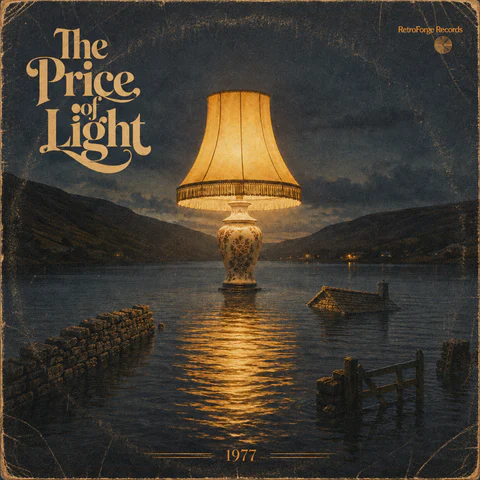
1977 indica o cenário de arquivo fictício e a estética sonora, não uma data histórica de gravação. Este é um álbum de ficção independente, não um relato de desastre documentado em um reservatório.
Lista de faixas
- 1Pegs in the Lower Field05:02
- 2Compensation Day04:42
- 3Against the Motion05:17
- 4Rooms Without Curtains03:52
- 5Aggregate04:09
- 6Below the Red Line05:19
- 7Sluice05:04
- 8Lights Beyond the Ridge04:48
Duração musical total: 38:13. As oito faixas têm vocais; “Sluice” é fortemente instrumental.
Faixa a faixa
1. Pegs in the Lower Field
Quatro estacas vermelhas anunciam uma mudança que ainda não alterou a paisagem. O aviso datilografado acerta o nome do morador, mas descreve o campo apenas em números. A ordem de deixar as estacas onde estão passa da espera por informações à percepção do que elas significam.
2. Compensation Day
A linguagem burocrática encontra perguntas que não consegue acomodar: se o pomar entra na conta, o que representam vinte anos de aluguel e quem vai transportar um piano. Os formulários mantêm a compostura enquanto a sala fica inquieta. O dinheiro é necessário, mas uma avaliação não descreve tudo de que se abre mão.
3. Against the Motion
A reunião pública expõe interesses diferentes sob o apelo à união. Quem mora acima da futura linha d’água pode se permitir uma resistência inacessível a quem já faz as malas. A pergunta sobre os túmulos interrompe a discussão por um instante; a votação registra um resultado sem resolver o desacordo.
4. Rooms Without Curtains
O olhar se fecha numa casa quase vazia. Paredes nuas, ruídos conhecidos e uma xícara lascada carregam o luto que as tabelas de indenização não comportavam. As frases longas e coloquiais adiam a partida; a última volta da chave é tanto hábito quanto decisão.
5. Aggregate
O momento de maior peso físico do álbum dá à construção um vocabulário próprio. Tremonhas, formas, betoneiras e sinais de mão substituem a linguagem da reunião. Os trabalhadores são pessoas qualificadas lidando com materiais reais; o desconforto vem do que seu trabalho eficiente torna possível.
6. Below the Red Line
A remoção passa por animais, ferramentas, móveis da igreja e lápides. O cuidado prático persiste dentro de uma decisão irreversível: a pedra rachada é guardada porque o nome continua legível. O sino pode ser erguido; a comunidade que lhe dava contexto não cabe num caminhão.
7. Sluice
Vocais esparsos e documentais deixam espaço para o grande clímax arquitetônico. Comportas, pressão e medidores regem a sequência enquanto a água toma estrada, muro e pomar. Não há falha na obra: a última marca vermelha desaparece porque o sistema faz o que foi construído para fazer.
8. Lights Beyond the Ridge
A canção final chega a cozinhas, oficinas e ruas comuns que recebem eletricidade. Seus ocupantes não são acusados nem transformados em testemunhas de um vale que nunca conheceram. Uma lâmpada ajuda alguém a terminar uma tarefa; além da serra, a perda permanece. A utilidade da corrente não resolve seu preço.
Paleta sonora
O rock progressivo pastoral traz intimidade rural, enquanto o prog sinfônico dá escala à construção e à inundação. Compassos ímpares e mudanças de andamento acompanham a ação, em vez de servirem à exibição contínua de técnica.
O piano é o elo recorrente. O órgão Hammond vai de acentos contidos a grandes passagens arquitetônicas; o Mellotron traz uma cor mais fria em aparições dosadas. O sintetizador analógico é econômico. Violoncelo e pequenos toques de clarinete ou saxofone acrescentam outro registro humano às teclas.
Violões dedilhados e de doze cordas convivem com figuras limpas de guitarra, contraponto anguloso, notas sustentadas e trechos mais pesados de saturação seletiva. O baixo segue melódico e audível nos médios, passando do lirismo aos ritmos de trabalho da construção. A bateria acústica natural preserva dinâmica e caráter de sala.
A voz masculina principal muda com as circunstâncias: observação, procedimento seco, conjuntos em discussão, quase conversa e canto de obra firme. Calor analógico inspirado no fim dos anos 1970, saturação, delay pontual e reverberação de placa ou câmara conectam essas abordagens sem apagar a separação dos instrumentos.
Notas de arquivo
Uma linha aparece primeiro como fita entre estacas. Vira limite administrativo, ordem de remoção e, por fim, marca submersa. A paisagem ainda não se moveu quando é descrita em números; ao final, esses números ajudam a definir o que continua visível.
A pedra também muda de função. Muros e casas viram propriedades avaliadas, enquanto agregados e concreto ganham força para conter o rio. As lápides são removidas com especial cuidado. Seus nomes legíveis preservam algo específico, mesmo quando o lugar ao redor não pode sobreviver.
“Rooms Without Curtains” é o recolhimento íntimo antes de “Aggregate”. Uma xícara importa por ficar para trás, não por ser valiosa. “Aggregate” traz peso físico; “Sluice” transforma esse peso em arquitetura. A água só se torna imagem dominante nesse estágio tardio, assim como a luz fica reservada para o fim.
A capa condensa essa relação num enorme abajur doméstico aceso na água do reservatório. Muros submersos, um portão e a linha de um telhado ocupam o primeiro plano, com luzes distantes além das serras. A aparência fosca e gasta pertence à apresentação imaginária dos anos 1970; o abajur gigante é um símbolo visual, não um evento sobrenatural da narrativa.
Letras
Letras originais em inglês, reproduzidas sem indicações adicionais de estrofes ou interpretação.
01 · Pegs in the Lower Field
There are four red pegs in the lower field,
two by the ditch and two beyond the gate.
I nearly pulled the first one with my boot
before I saw the tape stretched through the grass
and the tripod standing where the cattle turn.

They have chalk on their sleeves and mud on their knees.
One of them asks which fence is ours.
I point to the wall, then farther down
where the hedge has grown through the wire,
and he writes something without looking up.

Leave them where they stand.
Leave them there until we know.

By dinner the men have crossed to the far side.
A white card is tied beneath the gate latch.
My name is typed correctly.
The field is described in numbers,
though nothing in it has moved.

I walk the line again before dark,
past the patch where the ground stays wet,
past the broken post we keep meaning to mend,
past the place the river shows between the alders.

Leave them where they stand.
Now we know enough.
02 · Compensation Day
Property to be acquired.
Access to be retained.
Fixtures by separate schedule.
Outbuildings subject to inspection.

A hand turns the page.
From the second row: does the orchard count?
At the back, twenty years of rent
is placed on the table as if it ought to count for something.

Reasonable costs of removal.
Alternative accommodation where applicable.
Livestock transport to be assessed.
Existing rights to be extinguished.

A chair scrapes back.
A man beside the window says,
“If you mean the house, say house.”
Nobody writes that sentence down.

Sign here.
Initial there.
Take a copy home.

Market value at the appointed date.
No allowance for attachment.
No allowance for expectation.
No allowance for inconvenience beyond the terms stated.

One family whispers over debts.
Another folds the paper twice.
Across the aisle comes the remark
that accepting early makes it easier for them.

Property to be acquired.
Access to be retained.
The same words return,
but the room has changed around them.

A woman asks who moves the piano.
Laughter breaks too loudly near the door.
Another form slides across the table.

Sign here.
Keep your copy.

Next.
03 · Against the Motion
Put it to the room, then.
Put the paper down where everyone can see it.
You say refusal keeps the road open.
He says refusal only changes the date.
From the back comes: the churchyard first,
and three people answer before the chair can call order.

We came here together.
That lasted ten minutes.

You call it surrender.
I call it knowing what comes next.
You have land above the line.
We do not.
You can wait another winter.
We have already packed the upstairs rooms.

No, that is not what I said.
No, don't tidy it for me.
If the offer stands, I take it.
If you want to hate me for that,
use my name when you do it.

The chairman asks for order.
The chairman asks again.

A hand rises slowly near the wall:
What happens to the graves?

For once,
nobody answers at once.

Against the motion.
For the motion.
Abstain if you must.

A vote is a useful thing
when the question fits inside it.

This one does not.

From the left: we should stand as one.
From the doorway: we stopped doing that
the moment the first figure arrived.

Count the hands.
Count them twice.
Record the result.

Then meet your neighbor's eyes.
04 · Rooms Without Curtains
The curtains went yesterday, and without them the front room looks taller than it ever did when the table was under the window and the kettle could be heard from the hall.

There are pale squares above the mantel where the pictures hung,
and two clean strips on the floor where the cabinet stood,
and one bent hook by the door that I leave in place because removing it would be more deliberate than I can manage today.

We carry the last boxes down the stairs slowly, not because they are heavy but because there is no reason to hurry anymore, and the sound of our shoes travels farther through the house than it used to.

In the kitchen a cup has been left behind.
Not the good one.
Not anyone's favorite.
Just a chipped brown cup at the back of the shelf.

I put it in a box anyway.

You have the keys in your coat pocket, and I still reach for mine when I come through the passage, which makes us both laugh once, briefly, before neither of us knows what to say after it.

The bedroom door catches at the same place.
The third stair still complains.
There is dust under the bedstead and a nail in the wall we never used.

Everything is exactly where the house left it.

Except us.

At the gate I turn the key until the lock takes,
then try the handle twice from habit.

We walk to the road.

I do not look back again.
05 · Aggregate
Stone through the hopper.
Dust whitening the road.
A loaded lorry crawls
where the sheep track ran.

Check the grade.
Brace the shuttering.
Wave the mixer forward.
The chute swings over the timber.

Crush it.
Grade it.
Pour it.
Hold.

Boots on wet boards.
Cable drawn taut.
A banksman lifts one arm
through the engine noise.

The drum turns.
The barrows queue.
A shovel works the corners
before the mix can stiffen.

By noon the forms are full.
Cement dries grey across the gloves.
A man knocks each board with his hammer,
listens,
then moves to the next.

Another lorry backs into place.

Crush it.
Grade it.
Pour it.

Hold.
06 · Below the Red Line
The cattle go first to the upper farm.
Tools are tagged and loaded by the shed.
Two pews leave through the vestry door.
The brass cross travels wrapped in blankets.
A crate is marked for books,
another for the kitchen things no one has claimed.

Take what can be carried.
Leave the rest below the red line.

The gate comes off its hinges.
Useful timber is stacked by the road.
A stone trough takes four men and a chain.
The old mower will not start,
so they drain it, curse it,
and winch it onto the lorry anyway.

Move what can be moved.
Mark the rest below the red line.

Names are copied from the grave markers.
Numbers are checked against a list.
Soil is lifted carefully.
Families stand farther back than they expected to.
The small stones travel with the large ones.
The cracked one is kept because the name can still be read.

At the church door
someone asks whether the bell is coming.

It is.

Raise what can be raised.
Close the road below the red line.

By evening there are fewer reasons to return.
One crate waits without a label.
One gate stands open.
One room still has a broom against the wall.

Nobody needs it.

Take what can be carried.
The line has already decided the rest.
07 · Sluice
The gate is checked.
The channel is clear.
Pressure holds where the concrete joins.
A hand signal passes down the platform.

Close.

The current turns.
The intake takes it.
Levels climb past marks
painted months before.

By noon the lower road
ends in brown water.

Road below.
Wall below.
Orchard below.

The gauge moves.

Water finds the contour.
Concrete holds.
At the spillway the needles settle.
Beyond the wall,
the river runs narrow.

One level.
Then another.

The last red mark
goes under.
08 · Lights Beyond the Ridge
Lights beyond the ridge,
warm in rooms we never see.
A hand finds the switch,
and evening changes quietly.

A kettle starts in a kitchen.
A workshop keeps one bench alive.
Street lamps take the corner one by one.
Pages turn beneath a shaded bulb.
At closing time a sign stays burning
above a door on the high street.

Nothing in those rooms is extraordinary.

Lights beyond the ridge,
steady along the road.
Current through the wire,
ordinary as being home.

You do not know the lower field.
You have no reason to.
You do not know which house had curtains
or who carried the bell uphill.

You turn the lamp toward the table.
You finish what you were doing.
Outside, the line runs over the ridge
and disappears from view.

Lights beyond the ridge,
small and warm and clear.
The wire drops behind the hill.
Work goes on till late.
Continue explorando
Para quem gosta de prog britânico dos anos 1970, álbuns conceituais narrativos, arranjos pastorais e rock analógico guiado por teclados.
Outros álbuns de rock progressivo da RetroForge como dicas de escuta, sem sugerir uma história compartilhada.