
In questa pagina
Informazioni sull’album
The Price of Light comincia prima dell’acqua. Una valle d’altura britannica, immaginaria e senza nome, ospita ancora fattorie attive, case di pietra, una strada stretta, una chiesa e un cimitero. Quattro picchetti bastano a dividere il terreno familiare tra ciò che può restare e ciò che deve andarsene.
Il progetto idroelettrico riesce. La sua elettricità soddisfa bisogni reali e chi lo costruisce non viene ridotto a un cattivo. L’album segue ciò che il successo richiede: perizie, assemblee divise, addii domestici, gettate di cemento e il trasporto attento di oggetti il cui contesto non può essere salvato.
La prima metà rimane vicina agli abitanti. Poi ritmi di lavoro e sistemi idraulici avanzano in primo piano, finché in «Sluice» la parola umana si fa rara. L’ultima canzone lascia la valle per le stanze illuminate dalla sua corrente. Né l’utilità né la distruzione annulla l’altra.
1977 indica l’ambientazione archivistica immaginaria e l’estetica sonora, non una data storica di registrazione. È un album di finzione autonomo, non il racconto di un disastro documentato legato a un bacino.
Scaletta
- 1Pegs in the Lower Field05:02
- 2Compensation Day04:42
- 3Against the Motion05:17
- 4Rooms Without Curtains03:52
- 5Aggregate04:09
- 6Below the Red Line05:19
- 7Sluice05:04
- 8Lights Beyond the Ridge04:48
Durata musicale complessiva: 38:13. Tutti gli otto brani contengono parti vocali; «Sluice» è fortemente strumentale.
Brano per brano
1. Pegs in the Lower Field
Quattro picchetti rossi annunciano un cambiamento che non ha ancora modificato il paesaggio. L’avviso dattiloscritto riporta correttamente il nome dell’abitante ma descrive il campo solo in numeri. L’ordine di non toccare i picchetti passa dall’attesa di informazioni alla comprensione del loro significato.
2. Compensation Day
Il linguaggio amministrativo incontra domande scomode: se il frutteto conta, cosa valgono vent’anni d’affitto, chi sposterà un pianoforte. I moduli restano impassibili mentre la sala si agita. Il denaro serve, ma una stima non può descrivere tutto ciò a cui si rinuncia.
3. Against the Motion
L’assemblea pubblica rivela interessi diversi sotto l’appello all’unità. Chi abita sopra il futuro livello dell’acqua può permettersi una resistenza negata a chi sta già preparando i bagagli. La domanda sulle tombe ferma per un momento il litigio; un voto registra un esito senza risolvere il dissenso.
4. Rooms Without Curtains
Lo sguardo si restringe a una casa quasi vuota. Pareti spoglie, rumori familiari e una tazza scheggiata portano il dolore che le tabelle degli indennizzi non potevano accogliere. Le frasi lunghe e colloquiali ritardano la partenza; l’ultimo giro di chiave è abitudine quanto decisione.
5. Aggregate
Il momento fisicamente più pesante dell’album dà al cantiere un lessico proprio. Tramogge, casseforme, betoniere e gesti sostituiscono le parole dell’assemblea. Gli operai sono persone competenti alle prese con materiali reali; l’inquietudine nasce da ciò che rende possibile il loro lavoro efficace.
6. Below the Red Line
Lo sgombero passa da bestiame e attrezzi ad arredi della chiesa e lapidi. La cura pratica sopravvive dentro una decisione irreversibile: la pietra incrinata si conserva perché il nome è ancora leggibile. La campana si può sollevare; la comunità che le dava un contesto non entra in un camion.
7. Sluice
Voci rade e documentarie lasciano spazio al grande culmine architettonico. Paratoie, pressione e strumenti regolano la sequenza mentre l’acqua prende strada, muro e frutteto. L’opera non cede: l’ultimo segno rosso scompare perché il sistema fa esattamente ciò per cui è stato costruito.
8. Lights Beyond the Ridge
La canzone conclusiva raggiunge cucine, officine e strade comuni che ricevono elettricità. I loro abitanti non vengono accusati né trasformati in testimoni di una valle mai conosciuta. Una lampada aiuta qualcuno a finire un lavoro; oltre il crinale la perdita rimane. L’utilità della corrente non ne risolve il prezzo.
Tavolozza sonora
Il rock progressivo pastorale offre intimità rurale, mentre il prog sinfonico dà dimensione al cantiere e all’allagamento. Metri dispari e cambi di passo seguono l’azione, anziché diventare una continua esibizione tecnica.
Il pianoforte è il legame ricorrente. L’organo Hammond passa da accenti trattenuti a grandi sezioni architettoniche; il Mellotron introduce colori più freddi con apparizioni dosate. Il sintetizzatore analogico resta discreto. Violoncello e pochi tocchi di clarinetto o sassofono aggiungono un registro umano ai timbri delle tastiere.
Chitarre acustiche in fingerpicking e dodici corde affiancano figure elettriche pulite, contrappunto spigoloso, note sostenute e interventi più pesanti dalla saturazione mirata. Il basso resta melodico e udibile nei medi, passando dal lirismo ai ritmi del cantiere. La batteria acustica naturale conserva dinamica e carattere dell’ambiente.
La voce maschile principale cambia con le circostanze: osservazione, procedura asciutta, ensemble polemici, quasi conversazione e canto di cantiere deciso. Calore analogico ispirato al tardo decennio Settanta, saturazione, delay selettivo e riverberi a piastra o da camera legano questi approcci senza cancellare la separazione strumentale.
Note d’archivio
Una linea appare prima come nastro fra i picchetti. Diventa confine amministrativo, ordine di sgombero e infine segno sommerso. Il paesaggio non si è mosso quando viene descritto per la prima volta in numeri; alla fine quei numeri contribuiscono a decidere cosa rimane visibile.
Anche la pietra cambia funzione. Muri e case diventano proprietà da stimare, mentre aggregati e cemento acquistano la forza di contenere il fiume. Le lapidi vengono spostate con particolare cura. I nomi leggibili custodiscono qualcosa di preciso, anche se il luogo circostante non può sopravvivere.
«Rooms Without Curtains» è il raccoglimento intimo prima di «Aggregate». Una tazza conta perché viene lasciata, non perché è preziosa. «Aggregate» porta peso fisico; «Sluice» lo rende architettura. L’acqua diventa immagine dominante solo tardi, così come la luce è riservata al finale.
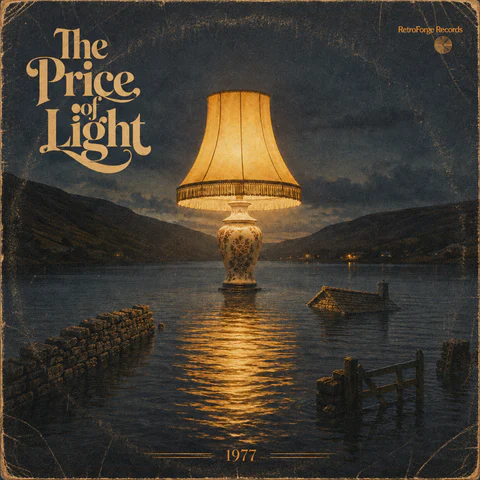
La copertina concentra questo rapporto in un’enorme lampada domestica accesa nell’acqua del bacino. Muri sommersi, un cancello e un tetto occupano il primo piano, con luci lontane oltre i crinali. L’aspetto opaco e consumato appartiene alla presentazione immaginaria anni Settanta; la lampada gigante è un simbolo visivo, non un evento soprannaturale nella storia.
Testi
Testi originali inglesi, riprodotti senza aggiungere indicazioni di strofe o di esecuzione.
01 · Pegs in the Lower Field
There are four red pegs in the lower field,
two by the ditch and two beyond the gate.
I nearly pulled the first one with my boot
before I saw the tape stretched through the grass
and the tripod standing where the cattle turn.

They have chalk on their sleeves and mud on their knees.
One of them asks which fence is ours.
I point to the wall, then farther down
where the hedge has grown through the wire,
and he writes something without looking up.

Leave them where they stand.
Leave them there until we know.

By dinner the men have crossed to the far side.
A white card is tied beneath the gate latch.
My name is typed correctly.
The field is described in numbers,
though nothing in it has moved.

I walk the line again before dark,
past the patch where the ground stays wet,
past the broken post we keep meaning to mend,
past the place the river shows between the alders.

Leave them where they stand.
Now we know enough.
02 · Compensation Day
Property to be acquired.
Access to be retained.
Fixtures by separate schedule.
Outbuildings subject to inspection.

A hand turns the page.
From the second row: does the orchard count?
At the back, twenty years of rent
is placed on the table as if it ought to count for something.

Reasonable costs of removal.
Alternative accommodation where applicable.
Livestock transport to be assessed.
Existing rights to be extinguished.

A chair scrapes back.
A man beside the window says,
“If you mean the house, say house.”
Nobody writes that sentence down.

Sign here.
Initial there.
Take a copy home.

Market value at the appointed date.
No allowance for attachment.
No allowance for expectation.
No allowance for inconvenience beyond the terms stated.

One family whispers over debts.
Another folds the paper twice.
Across the aisle comes the remark
that accepting early makes it easier for them.

Property to be acquired.
Access to be retained.
The same words return,
but the room has changed around them.

A woman asks who moves the piano.
Laughter breaks too loudly near the door.
Another form slides across the table.

Sign here.
Keep your copy.

Next.
03 · Against the Motion
Put it to the room, then.
Put the paper down where everyone can see it.
You say refusal keeps the road open.
He says refusal only changes the date.
From the back comes: the churchyard first,
and three people answer before the chair can call order.

We came here together.
That lasted ten minutes.

You call it surrender.
I call it knowing what comes next.
You have land above the line.
We do not.
You can wait another winter.
We have already packed the upstairs rooms.

No, that is not what I said.
No, don't tidy it for me.
If the offer stands, I take it.
If you want to hate me for that,
use my name when you do it.

The chairman asks for order.
The chairman asks again.

A hand rises slowly near the wall:
What happens to the graves?

For once,
nobody answers at once.

Against the motion.
For the motion.
Abstain if you must.

A vote is a useful thing
when the question fits inside it.

This one does not.

From the left: we should stand as one.
From the doorway: we stopped doing that
the moment the first figure arrived.

Count the hands.
Count them twice.
Record the result.

Then meet your neighbor's eyes.
04 · Rooms Without Curtains
The curtains went yesterday, and without them the front room looks taller than it ever did when the table was under the window and the kettle could be heard from the hall.

There are pale squares above the mantel where the pictures hung,
and two clean strips on the floor where the cabinet stood,
and one bent hook by the door that I leave in place because removing it would be more deliberate than I can manage today.

We carry the last boxes down the stairs slowly, not because they are heavy but because there is no reason to hurry anymore, and the sound of our shoes travels farther through the house than it used to.

In the kitchen a cup has been left behind.
Not the good one.
Not anyone's favorite.
Just a chipped brown cup at the back of the shelf.

I put it in a box anyway.

You have the keys in your coat pocket, and I still reach for mine when I come through the passage, which makes us both laugh once, briefly, before neither of us knows what to say after it.

The bedroom door catches at the same place.
The third stair still complains.
There is dust under the bedstead and a nail in the wall we never used.

Everything is exactly where the house left it.

Except us.

At the gate I turn the key until the lock takes,
then try the handle twice from habit.

We walk to the road.

I do not look back again.
05 · Aggregate
Stone through the hopper.
Dust whitening the road.
A loaded lorry crawls
where the sheep track ran.

Check the grade.
Brace the shuttering.
Wave the mixer forward.
The chute swings over the timber.

Crush it.
Grade it.
Pour it.
Hold.

Boots on wet boards.
Cable drawn taut.
A banksman lifts one arm
through the engine noise.

The drum turns.
The barrows queue.
A shovel works the corners
before the mix can stiffen.

By noon the forms are full.
Cement dries grey across the gloves.
A man knocks each board with his hammer,
listens,
then moves to the next.

Another lorry backs into place.

Crush it.
Grade it.
Pour it.

Hold.
06 · Below the Red Line
The cattle go first to the upper farm.
Tools are tagged and loaded by the shed.
Two pews leave through the vestry door.
The brass cross travels wrapped in blankets.
A crate is marked for books,
another for the kitchen things no one has claimed.

Take what can be carried.
Leave the rest below the red line.

The gate comes off its hinges.
Useful timber is stacked by the road.
A stone trough takes four men and a chain.
The old mower will not start,
so they drain it, curse it,
and winch it onto the lorry anyway.

Move what can be moved.
Mark the rest below the red line.

Names are copied from the grave markers.
Numbers are checked against a list.
Soil is lifted carefully.
Families stand farther back than they expected to.
The small stones travel with the large ones.
The cracked one is kept because the name can still be read.

At the church door
someone asks whether the bell is coming.

It is.

Raise what can be raised.
Close the road below the red line.

By evening there are fewer reasons to return.
One crate waits without a label.
One gate stands open.
One room still has a broom against the wall.

Nobody needs it.

Take what can be carried.
The line has already decided the rest.
07 · Sluice
The gate is checked.
The channel is clear.
Pressure holds where the concrete joins.
A hand signal passes down the platform.

Close.

The current turns.
The intake takes it.
Levels climb past marks
painted months before.

By noon the lower road
ends in brown water.

Road below.
Wall below.
Orchard below.

The gauge moves.

Water finds the contour.
Concrete holds.
At the spillway the needles settle.
Beyond the wall,
the river runs narrow.

One level.
Then another.

The last red mark
goes under.
08 · Lights Beyond the Ridge
Lights beyond the ridge,
warm in rooms we never see.
A hand finds the switch,
and evening changes quietly.

A kettle starts in a kitchen.
A workshop keeps one bench alive.
Street lamps take the corner one by one.
Pages turn beneath a shaded bulb.
At closing time a sign stays burning
above a door on the high street.

Nothing in those rooms is extraordinary.

Lights beyond the ridge,
steady along the road.
Current through the wire,
ordinary as being home.

You do not know the lower field.
You have no reason to.
You do not know which house had curtains
or who carried the bell uphill.

You turn the lamp toward the table.
You finish what you were doing.
Outside, the line runs over the ridge
and disappears from view.

Lights beyond the ridge,
small and warm and clear.
The wire drops behind the hill.
Work goes on till late.
Continua a esplorare
Per chi ama il prog britannico anni Settanta, i concept album narrativi, gli arrangiamenti pastorali e il rock analogico guidato dalle tastiere.
Altri album progressive di RetroForge come consigli d’ascolto, senza suggerire una storia condivisa.