
En esta página
Sobre este álbum
The Price of Light empieza antes del agua. En un valle montañoso británico, ficticio y sin nombre, todavía hay granjas activas, casas de piedra, una carretera estrecha, una iglesia y un cementerio. Cuatro estacas bastan para dividir ese terreno familiar entre lo que puede quedarse y lo que debe desaparecer.
El proyecto hidroeléctrico sale bien. Su electricidad cubre necesidades reales y quienes lo construyen no se reducen a villanos. El álbum sigue las exigencias de ese éxito: tasaciones, reuniones divididas, despedidas del hogar, hormigonado y el cuidadoso traslado de objetos cuyo entorno no se puede salvar.
La primera mitad permanece cerca de los habitantes. Después, los ritmos de trabajo y los sistemas hidráulicos cobran protagonismo, hasta que la voz humana escasea en «Sluice». La última canción abandona el valle por las habitaciones que ilumina su electricidad. Ni el beneficio ni la destrucción anulan al otro.
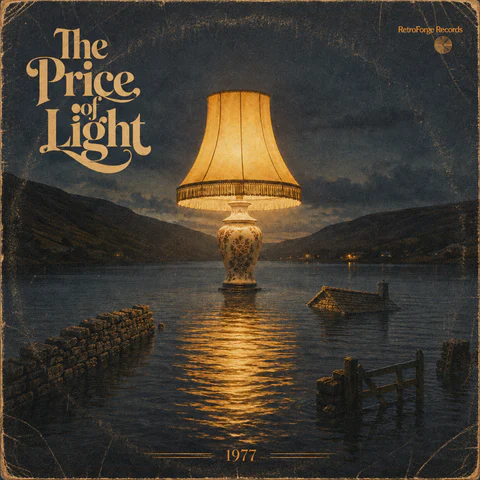
1977 indica el marco de archivo ficticio y la estética sonora, no una fecha histórica de grabación. Es un álbum de ficción independiente, no el relato de una catástrofe documentada en un embalse.
Lista de canciones
- 1Pegs in the Lower Field05:02
- 2Compensation Day04:42
- 3Against the Motion05:17
- 4Rooms Without Curtains03:52
- 5Aggregate04:09
- 6Below the Red Line05:19
- 7Sluice05:04
- 8Lights Beyond the Ridge04:48
Duración musical total: 38:13. Las ocho canciones tienen voces; «Sluice» es marcadamente instrumental.
Canción por canción
1. Pegs in the Lower Field
Cuatro estacas rojas anuncian un cambio que aún no ha alterado el paisaje. La notificación mecanografiada acierta con el nombre del vecino, pero describe el campo únicamente con números. La orden de no tocar las estacas pasa de esperar información a comprender lo que significa.
2. Compensation Day
El lenguaje administrativo tropieza con preguntas que no sabe resolver bien: si cuenta el huerto, qué representan veinte años de alquiler y quién trasladará un piano. Los formularios conservan la compostura mientras la sala se inquieta. El dinero es necesario, pero una tasación no describe todo lo que se entrega.
3. Against the Motion
La reunión pública descubre intereses distintos bajo la llamada a la unidad. Quienes viven sobre la futura línea del agua pueden permitirse una resistencia inaccesible para quienes ya hacen las maletas. La pregunta sobre las tumbas detiene brevemente la discusión; votar registra un resultado sin resolver el desacuerdo.
4. Rooms Without Curtains
La mirada se estrecha hasta una casa casi vacía. Paredes desnudas, ruidos conocidos y una taza desportillada cargan con el duelo que no cabía en los baremos de indemnización. Las frases largas y conversacionales retrasan la partida; el último giro de llave es tanto costumbre como decisión.
5. Aggregate
El punto de mayor peso físico del álbum da a la construcción su propio vocabulario. Tolvas, encofrados, hormigoneras y señales manuales sustituyen las palabras de la reunión. Los trabajadores son personas cualificadas que manejan materiales reales; la inquietud nace de lo que hace posible su trabajo eficaz.
6. Below the Red Line
La retirada pasa por ganado, herramientas, muebles de la iglesia y lápidas. El cuidado práctico persiste dentro de una decisión irreversible: se conserva la piedra agrietada porque el nombre aún se lee. La campana se puede levantar; la comunidad que le daba sentido no cabe en un camión.
7. Sluice
Las escasas voces documentales dejan espacio al gran clímax arquitectónico. Compuertas, presión e indicadores gobiernan la secuencia mientras el agua ocupa carretera, muro y huerto. La obra no falla: la última marca roja desaparece porque el sistema cumple su función.
8. Lights Beyond the Ridge
El cierre llega a cocinas, talleres y calles corrientes que reciben electricidad. No acusa a sus habitantes ni los convierte en testigos de un valle que nunca conocieron. Una lámpara permite terminar una tarea; tras la sierra, la pérdida permanece. La utilidad de la corriente no resuelve su precio.
Paleta sonora
El rock progresivo pastoral aporta intimidad rural, mientras el prog sinfónico da escala a la construcción y la inundación. Los compases irregulares y cambios de ritmo siguen la acción en vez de exhibir técnica constantemente.
El piano es el nexo recurrente. El órgano Hammond va de acentos contenidos a grandes pasajes arquitectónicos; el Mellotron aporta un color más frío en apariciones dosificadas. El sintetizador analógico es discreto. El violonchelo y algunos matices de clarinete o saxofón añaden otro registro humano a los teclados.
Las guitarras acústicas pulsadas y de doce cuerdas conviven con figuras eléctricas limpias, contrapunto anguloso, notas sostenidas y pasajes más pesados de saturación selectiva. El bajo permanece melódico y audible en el registro medio, pasando del lirismo a los ritmos de obra. La batería acústica natural conserva dinámica y ambiente de sala.
La voz masculina principal cambia con la situación: observación, procedimiento seco, conjuntos en discusión, casi conversación y canto de obra firme. La calidez analógica de inspiración setentera tardía, la saturación, el delay selectivo y las reverberaciones de placa o cámara conectan estas formas sin borrar la separación instrumental.
Notas de archivo
La línea aparece primero como cinta entre estacas. Se convierte en límite administrativo, orden de retirada y, por último, marca sumergida. El paisaje aún no se ha movido cuando se describe en números; al final, esos números ayudan a decidir lo que permanece visible.
La piedra también cambia de función. Muros y viviendas se vuelven bienes tasados, mientras áridos y hormigón adquieren fuerza para contener el río. Las lápidas se trasladan con especial cuidado. Sus nombres legibles conservan algo concreto aunque el lugar que las rodea no pueda sobrevivir.
«Rooms Without Curtains» es el repliegue íntimo anterior a «Aggregate». Una taza importa porque se queda atrás, no porque sea valiosa. «Aggregate» aporta peso físico; «Sluice» lo convierte en arquitectura. El agua espera hasta ese punto para dominar las imágenes, igual que la luz se reserva para el final.
La portada concentra esa relación en una lámpara doméstica gigantesca que brilla dentro del embalse. En primer plano quedan muros sumergidos, una verja y un tejado; tras las crestas, luces lejanas. El acabado mate y gastado pertenece a la presentación setentera imaginada: la lámpara es un símbolo de portada, no un suceso sobrenatural de la historia.
Letras
Letras originales en inglés, sin añadir indicaciones de estrofas o interpretación.
01 · Pegs in the Lower Field
There are four red pegs in the lower field,
two by the ditch and two beyond the gate.
I nearly pulled the first one with my boot
before I saw the tape stretched through the grass
and the tripod standing where the cattle turn.

They have chalk on their sleeves and mud on their knees.
One of them asks which fence is ours.
I point to the wall, then farther down
where the hedge has grown through the wire,
and he writes something without looking up.

Leave them where they stand.
Leave them there until we know.

By dinner the men have crossed to the far side.
A white card is tied beneath the gate latch.
My name is typed correctly.
The field is described in numbers,
though nothing in it has moved.

I walk the line again before dark,
past the patch where the ground stays wet,
past the broken post we keep meaning to mend,
past the place the river shows between the alders.

Leave them where they stand.
Now we know enough.
02 · Compensation Day
Property to be acquired.
Access to be retained.
Fixtures by separate schedule.
Outbuildings subject to inspection.

A hand turns the page.
From the second row: does the orchard count?
At the back, twenty years of rent
is placed on the table as if it ought to count for something.

Reasonable costs of removal.
Alternative accommodation where applicable.
Livestock transport to be assessed.
Existing rights to be extinguished.

A chair scrapes back.
A man beside the window says,
“If you mean the house, say house.”
Nobody writes that sentence down.

Sign here.
Initial there.
Take a copy home.

Market value at the appointed date.
No allowance for attachment.
No allowance for expectation.
No allowance for inconvenience beyond the terms stated.

One family whispers over debts.
Another folds the paper twice.
Across the aisle comes the remark
that accepting early makes it easier for them.

Property to be acquired.
Access to be retained.
The same words return,
but the room has changed around them.

A woman asks who moves the piano.
Laughter breaks too loudly near the door.
Another form slides across the table.

Sign here.
Keep your copy.

Next.
03 · Against the Motion
Put it to the room, then.
Put the paper down where everyone can see it.
You say refusal keeps the road open.
He says refusal only changes the date.
From the back comes: the churchyard first,
and three people answer before the chair can call order.

We came here together.
That lasted ten minutes.

You call it surrender.
I call it knowing what comes next.
You have land above the line.
We do not.
You can wait another winter.
We have already packed the upstairs rooms.

No, that is not what I said.
No, don't tidy it for me.
If the offer stands, I take it.
If you want to hate me for that,
use my name when you do it.

The chairman asks for order.
The chairman asks again.

A hand rises slowly near the wall:
What happens to the graves?

For once,
nobody answers at once.

Against the motion.
For the motion.
Abstain if you must.

A vote is a useful thing
when the question fits inside it.

This one does not.

From the left: we should stand as one.
From the doorway: we stopped doing that
the moment the first figure arrived.

Count the hands.
Count them twice.
Record the result.

Then meet your neighbor's eyes.
04 · Rooms Without Curtains
The curtains went yesterday, and without them the front room looks taller than it ever did when the table was under the window and the kettle could be heard from the hall.

There are pale squares above the mantel where the pictures hung,
and two clean strips on the floor where the cabinet stood,
and one bent hook by the door that I leave in place because removing it would be more deliberate than I can manage today.

We carry the last boxes down the stairs slowly, not because they are heavy but because there is no reason to hurry anymore, and the sound of our shoes travels farther through the house than it used to.

In the kitchen a cup has been left behind.
Not the good one.
Not anyone's favorite.
Just a chipped brown cup at the back of the shelf.

I put it in a box anyway.

You have the keys in your coat pocket, and I still reach for mine when I come through the passage, which makes us both laugh once, briefly, before neither of us knows what to say after it.

The bedroom door catches at the same place.
The third stair still complains.
There is dust under the bedstead and a nail in the wall we never used.

Everything is exactly where the house left it.

Except us.

At the gate I turn the key until the lock takes,
then try the handle twice from habit.

We walk to the road.

I do not look back again.
05 · Aggregate
Stone through the hopper.
Dust whitening the road.
A loaded lorry crawls
where the sheep track ran.

Check the grade.
Brace the shuttering.
Wave the mixer forward.
The chute swings over the timber.

Crush it.
Grade it.
Pour it.
Hold.

Boots on wet boards.
Cable drawn taut.
A banksman lifts one arm
through the engine noise.

The drum turns.
The barrows queue.
A shovel works the corners
before the mix can stiffen.

By noon the forms are full.
Cement dries grey across the gloves.
A man knocks each board with his hammer,
listens,
then moves to the next.

Another lorry backs into place.

Crush it.
Grade it.
Pour it.

Hold.
06 · Below the Red Line
The cattle go first to the upper farm.
Tools are tagged and loaded by the shed.
Two pews leave through the vestry door.
The brass cross travels wrapped in blankets.
A crate is marked for books,
another for the kitchen things no one has claimed.

Take what can be carried.
Leave the rest below the red line.

The gate comes off its hinges.
Useful timber is stacked by the road.
A stone trough takes four men and a chain.
The old mower will not start,
so they drain it, curse it,
and winch it onto the lorry anyway.

Move what can be moved.
Mark the rest below the red line.

Names are copied from the grave markers.
Numbers are checked against a list.
Soil is lifted carefully.
Families stand farther back than they expected to.
The small stones travel with the large ones.
The cracked one is kept because the name can still be read.

At the church door
someone asks whether the bell is coming.

It is.

Raise what can be raised.
Close the road below the red line.

By evening there are fewer reasons to return.
One crate waits without a label.
One gate stands open.
One room still has a broom against the wall.

Nobody needs it.

Take what can be carried.
The line has already decided the rest.
07 · Sluice
The gate is checked.
The channel is clear.
Pressure holds where the concrete joins.
A hand signal passes down the platform.

Close.

The current turns.
The intake takes it.
Levels climb past marks
painted months before.

By noon the lower road
ends in brown water.

Road below.
Wall below.
Orchard below.

The gauge moves.

Water finds the contour.
Concrete holds.
At the spillway the needles settle.
Beyond the wall,
the river runs narrow.

One level.
Then another.

The last red mark
goes under.
08 · Lights Beyond the Ridge
Lights beyond the ridge,
warm in rooms we never see.
A hand finds the switch,
and evening changes quietly.

A kettle starts in a kitchen.
A workshop keeps one bench alive.
Street lamps take the corner one by one.
Pages turn beneath a shaded bulb.
At closing time a sign stays burning
above a door on the high street.

Nothing in those rooms is extraordinary.

Lights beyond the ridge,
steady along the road.
Current through the wire,
ordinary as being home.

You do not know the lower field.
You have no reason to.
You do not know which house had curtains
or who carried the bell uphill.

You turn the lamp toward the table.
You finish what you were doing.
Outside, the line runs over the ridge
and disappears from view.

Lights beyond the ridge,
small and warm and clear.
The wire drops behind the hill.
Work goes on till late.
Sigue explorando
Para quienes disfrutan del prog británico de los setenta, los álbumes conceptuales narrativos, los arreglos pastorales y el rock analógico de teclados.
Otros álbumes de rock progresivo de RetroForge como sugerencias de escucha, sin atribuirles una historia compartida.