
Sur cette page
À propos de cet album
The Price of Light commence avant l’eau. Une vallée britannique de moyenne montagne, fictive et sans nom, abrite encore des fermes en activité, des maisons de pierre, une route étroite, une église et un cimetière. Quatre piquets d’arpentage suffisent à séparer ce qui pourra rester de ce qui devra disparaître.
Le projet hydroélectrique réussit. Son électricité répond à de vrais besoins, et ses constructeurs ne sont pas réduits à des méchants. L’album suit ce que cette réussite exige : estimations, réunions divisées, départs, bétonnage et déplacement précautionneux d’objets dont le cadre ne peut être sauvé.
La première moitié reste auprès des habitants. Puis les rythmes du travail et les systèmes hydrauliques passent au premier plan, jusqu’à raréfier la parole humaine dans « Sluice ». La dernière chanson quitte la vallée pour les pièces éclairées par son électricité. Ni l’utilité ni la destruction n’annule l’autre.
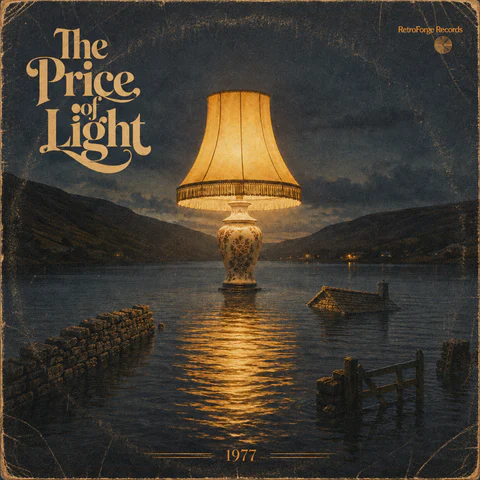
1977 désigne le cadre d’archives fictif et l’esthétique sonore, pas une date historique d’enregistrement. Cet album de fiction est autonome : il ne raconte pas une catastrophe documentée liée à un réservoir.
Liste des titres
- 1Pegs in the Lower Field05:02
- 2Compensation Day04:42
- 3Against the Motion05:17
- 4Rooms Without Curtains03:52
- 5Aggregate04:09
- 6Below the Red Line05:19
- 7Sluice05:04
- 8Lights Beyond the Ridge04:48
Durée musicale totale : 38:13. Les huit titres comportent du chant ; « Sluice » laisse une très grande place à l’instrumental.
Titre par titre
1. Pegs in the Lower Field
Quatre piquets rouges annoncent un changement qui n’a pas encore transformé le paysage. L’avis dactylographié donne correctement le nom de l’habitant, mais ne décrit le champ qu’en chiffres. L’instruction de ne pas toucher aux piquets passe de l’attente d’informations à la compréhension de leur portée.
2. Compensation Day
Le langage administratif rencontre des questions auxquelles il répond mal : le verger compte-t-il, que représentent vingt ans de loyer, qui déplacera le piano ? Les formulaires gardent leur calme tandis que la salle s’agite. L’argent est nécessaire, mais une estimation ne peut décrire tout ce qu’on abandonne.
3. Against the Motion
La réunion publique révèle des intérêts différents derrière l’appel à l’unité. Ceux qui vivent au-dessus de la future ligne d’eau peuvent se permettre une résistance inaccessible à ceux qui font déjà leurs cartons. La question des tombes suspend brièvement la dispute ; le vote produit un résultat sans résoudre le désaccord.
4. Rooms Without Curtains
Le regard se resserre sur une maison presque vide. Murs nus, bruits familiers et tasse ébréchée portent le chagrin que les barèmes d’indemnisation ne pouvaient accueillir. Les longues phrases de conversation retardent le départ ; le dernier tour de clé relève autant de l’habitude que de la décision.
5. Aggregate
Le moment le plus physiquement lourd de l’album donne au chantier son vocabulaire. Trémies, coffrages, bétonnières et gestes remplacent les mots de la réunion. Les ouvriers sont des gens compétents aux prises avec de vrais matériaux ; le malaise vient de ce que leur travail efficace rend possible.
6. Below the Red Line
L’évacuation passe par le bétail, les outils, le mobilier de l’église et les pierres tombales. Le soin pratique subsiste dans une décision irréversible : on garde la pierre fendue parce que le nom reste lisible. On peut soulever la cloche ; la communauté qui lui donnait un cadre ne tient pas dans un camion.
7. Sluice
Un chant documentaire rare laisse place au grand point culminant architectural. Vannes, pression et cadrans règlent la séquence tandis que l’eau prend la route, le mur et le verger. L’ouvrage ne cède pas : la dernière marque rouge disparaît parce que le système fait exactement ce pour quoi il a été construit.
8. Lights Beyond the Ridge
La dernière chanson rejoint les cuisines, ateliers et rues ordinaires qui reçoivent l’électricité. Leurs occupants ne sont ni accusés ni forcés de témoigner d’une vallée inconnue. Une lampe aide quelqu’un à finir une tâche ; derrière la crête, la perte demeure. L’utilité du courant ne règle pas la question de son prix.
Palette sonore
Le rock progressif pastoral apporte l’intimité rurale, tandis que le prog symphonique donne leur ampleur au chantier et à l’inondation. Mesures impaires et changements d’allure suivent l’action plutôt que de multiplier les démonstrations techniques.
Le piano assure le lien récurrent. L’orgue Hammond va des accents retenus aux grandes séquences architecturales ; le Mellotron apporte une couleur plus froide par touches mesurées. Le synthétiseur analogique reste discret. Le violoncelle, avec quelques couleurs de clarinette ou de saxophone, ajoute un registre humain aux claviers.
Guitares acoustiques en fingerpicking et douze-cordes côtoient figures électriques claires, contrepoint anguleux, notes tenues et passages plus lourds à la saturation ciblée. La basse demeure mélodique et audible dans les médiums, passant du lyrisme aux rythmes du chantier. La batterie acoustique naturelle conserve la dynamique et le caractère de la pièce.
Le chant masculin principal change selon les circonstances : observation, procédure sèche, ensembles qui se disputent, quasi-conversation et chant de chantier affirmé. Chaleur analogique inspirée de la fin des années 1970, saturation, delay choisi et réverbérations de type plaque ou chambre relient ces approches sans effacer la séparation des instruments.
Notes d’archives
La ligne apparaît d’abord comme un ruban entre des piquets. Elle devient frontière administrative, consigne d’évacuation, puis marque engloutie. Le paysage n’a pas bougé lorsqu’on le décrit pour la première fois en chiffres ; à la fin, ces chiffres ont contribué à décider de ce qui reste visible.
La pierre change elle aussi de fonction. Murs et maisons deviennent des biens évalués, tandis que granulats et béton acquièrent la force de contenir la rivière. Les pierres tombales sont déplacées avec un soin particulier. Leurs noms lisibles préservent quelque chose de précis, même si le lieu qui les entoure ne peut survivre.
« Rooms Without Curtains » est le repli intime avant « Aggregate ». La tasse compte parce qu’elle reste, non parce qu’elle est précieuse. « Aggregate » apporte le poids physique ; « Sluice » le transforme en architecture. L’eau attend ce stade tardif pour dominer les images, comme la lumière attend la fin.
La pochette condense ce rapport dans une lampe domestique démesurée, allumée au milieu du réservoir. Murs immergés, portail et ligne de toit occupent le premier plan, avec des lumières au-delà des crêtes. L’aspect mat et usé appartient à la présentation fictive des années 1970 ; la lampe géante est un symbole visuel, pas un événement surnaturel du récit.
Paroles
Paroles originales en anglais, reproduites sans indications de couplets ou d’interprétation ajoutées.
01 · Pegs in the Lower Field
There are four red pegs in the lower field,
two by the ditch and two beyond the gate.
I nearly pulled the first one with my boot
before I saw the tape stretched through the grass
and the tripod standing where the cattle turn.

They have chalk on their sleeves and mud on their knees.
One of them asks which fence is ours.
I point to the wall, then farther down
where the hedge has grown through the wire,
and he writes something without looking up.

Leave them where they stand.
Leave them there until we know.

By dinner the men have crossed to the far side.
A white card is tied beneath the gate latch.
My name is typed correctly.
The field is described in numbers,
though nothing in it has moved.

I walk the line again before dark,
past the patch where the ground stays wet,
past the broken post we keep meaning to mend,
past the place the river shows between the alders.

Leave them where they stand.
Now we know enough.
02 · Compensation Day
Property to be acquired.
Access to be retained.
Fixtures by separate schedule.
Outbuildings subject to inspection.

A hand turns the page.
From the second row: does the orchard count?
At the back, twenty years of rent
is placed on the table as if it ought to count for something.

Reasonable costs of removal.
Alternative accommodation where applicable.
Livestock transport to be assessed.
Existing rights to be extinguished.

A chair scrapes back.
A man beside the window says,
“If you mean the house, say house.”
Nobody writes that sentence down.

Sign here.
Initial there.
Take a copy home.

Market value at the appointed date.
No allowance for attachment.
No allowance for expectation.
No allowance for inconvenience beyond the terms stated.

One family whispers over debts.
Another folds the paper twice.
Across the aisle comes the remark
that accepting early makes it easier for them.

Property to be acquired.
Access to be retained.
The same words return,
but the room has changed around them.

A woman asks who moves the piano.
Laughter breaks too loudly near the door.
Another form slides across the table.

Sign here.
Keep your copy.

Next.
03 · Against the Motion
Put it to the room, then.
Put the paper down where everyone can see it.
You say refusal keeps the road open.
He says refusal only changes the date.
From the back comes: the churchyard first,
and three people answer before the chair can call order.

We came here together.
That lasted ten minutes.

You call it surrender.
I call it knowing what comes next.
You have land above the line.
We do not.
You can wait another winter.
We have already packed the upstairs rooms.

No, that is not what I said.
No, don't tidy it for me.
If the offer stands, I take it.
If you want to hate me for that,
use my name when you do it.

The chairman asks for order.
The chairman asks again.

A hand rises slowly near the wall:
What happens to the graves?

For once,
nobody answers at once.

Against the motion.
For the motion.
Abstain if you must.

A vote is a useful thing
when the question fits inside it.

This one does not.

From the left: we should stand as one.
From the doorway: we stopped doing that
the moment the first figure arrived.

Count the hands.
Count them twice.
Record the result.

Then meet your neighbor's eyes.
04 · Rooms Without Curtains
The curtains went yesterday, and without them the front room looks taller than it ever did when the table was under the window and the kettle could be heard from the hall.

There are pale squares above the mantel where the pictures hung,
and two clean strips on the floor where the cabinet stood,
and one bent hook by the door that I leave in place because removing it would be more deliberate than I can manage today.

We carry the last boxes down the stairs slowly, not because they are heavy but because there is no reason to hurry anymore, and the sound of our shoes travels farther through the house than it used to.

In the kitchen a cup has been left behind.
Not the good one.
Not anyone's favorite.
Just a chipped brown cup at the back of the shelf.

I put it in a box anyway.

You have the keys in your coat pocket, and I still reach for mine when I come through the passage, which makes us both laugh once, briefly, before neither of us knows what to say after it.

The bedroom door catches at the same place.
The third stair still complains.
There is dust under the bedstead and a nail in the wall we never used.

Everything is exactly where the house left it.

Except us.

At the gate I turn the key until the lock takes,
then try the handle twice from habit.

We walk to the road.

I do not look back again.
05 · Aggregate
Stone through the hopper.
Dust whitening the road.
A loaded lorry crawls
where the sheep track ran.

Check the grade.
Brace the shuttering.
Wave the mixer forward.
The chute swings over the timber.

Crush it.
Grade it.
Pour it.
Hold.

Boots on wet boards.
Cable drawn taut.
A banksman lifts one arm
through the engine noise.

The drum turns.
The barrows queue.
A shovel works the corners
before the mix can stiffen.

By noon the forms are full.
Cement dries grey across the gloves.
A man knocks each board with his hammer,
listens,
then moves to the next.

Another lorry backs into place.

Crush it.
Grade it.
Pour it.

Hold.
06 · Below the Red Line
The cattle go first to the upper farm.
Tools are tagged and loaded by the shed.
Two pews leave through the vestry door.
The brass cross travels wrapped in blankets.
A crate is marked for books,
another for the kitchen things no one has claimed.

Take what can be carried.
Leave the rest below the red line.

The gate comes off its hinges.
Useful timber is stacked by the road.
A stone trough takes four men and a chain.
The old mower will not start,
so they drain it, curse it,
and winch it onto the lorry anyway.

Move what can be moved.
Mark the rest below the red line.

Names are copied from the grave markers.
Numbers are checked against a list.
Soil is lifted carefully.
Families stand farther back than they expected to.
The small stones travel with the large ones.
The cracked one is kept because the name can still be read.

At the church door
someone asks whether the bell is coming.

It is.

Raise what can be raised.
Close the road below the red line.

By evening there are fewer reasons to return.
One crate waits without a label.
One gate stands open.
One room still has a broom against the wall.

Nobody needs it.

Take what can be carried.
The line has already decided the rest.
07 · Sluice
The gate is checked.
The channel is clear.
Pressure holds where the concrete joins.
A hand signal passes down the platform.

Close.

The current turns.
The intake takes it.
Levels climb past marks
painted months before.

By noon the lower road
ends in brown water.

Road below.
Wall below.
Orchard below.

The gauge moves.

Water finds the contour.
Concrete holds.
At the spillway the needles settle.
Beyond the wall,
the river runs narrow.

One level.
Then another.

The last red mark
goes under.
08 · Lights Beyond the Ridge
Lights beyond the ridge,
warm in rooms we never see.
A hand finds the switch,
and evening changes quietly.

A kettle starts in a kitchen.
A workshop keeps one bench alive.
Street lamps take the corner one by one.
Pages turn beneath a shaded bulb.
At closing time a sign stays burning
above a door on the high street.

Nothing in those rooms is extraordinary.

Lights beyond the ridge,
steady along the road.
Current through the wire,
ordinary as being home.

You do not know the lower field.
You have no reason to.
You do not know which house had curtains
or who carried the bell uphill.

You turn the lamp toward the table.
You finish what you were doing.
Outside, the line runs over the ridge
and disappears from view.

Lights beyond the ridge,
small and warm and clear.
The wire drops behind the hill.
Work goes on till late.
Poursuivre l’exploration
Pour les amateurs de prog britannique des années 1970, d’albums-concepts narratifs, d’arrangements pastoraux et de rock analogique dominé par les claviers.
D’autres albums de rock progressif de RetroForge à écouter, sans leur attribuer une histoire commune.