
About This Album
The Price of Light begins before the water. An unnamed fictional upland valley in Britain still contains working farms, stone houses, a narrow road, a church and a graveyard. Four survey pegs are enough to divide that familiar ground into what can remain and what will have to go.
The hydroelectric scheme succeeds. Its electricity serves real needs, and the people building it are not reduced to villains. The album follows what success requires: valuations, divided meetings, domestic departures, concrete work and the careful movement of objects whose surroundings cannot be saved.
The first half stays close to residents. Later, working rhythms and hydraulic systems take more of the foreground, until human speech becomes sparse in “Sluice.” The final song leaves the valley for rooms lit by its electricity. Neither the benefit nor the destruction is cancelled out by the other.
1977 describes the fictional archive setting and sonic aesthetic, not a historical recording date. This is a standalone fictional album, not an account of a documented reservoir disaster.
Tracklist
- 1Pegs in the Lower Field05:02
- 2Compensation Day04:42
- 3Against the Motion05:17
- 4Rooms Without Curtains03:52
- 5Aggregate04:09
- 6Below the Red Line05:19
- 7Sluice05:04
- 8Lights Beyond the Ridge04:48
Total music duration: 38:13. All eight tracks have vocals; “Sluice” is strongly instrumental.
Track by Track
1. Pegs in the Lower Field
Four red survey pegs introduce a change that has not yet altered the landscape. The typed notice gets the resident’s name right while describing the field entirely in numbers. The instruction to leave the pegs alone shifts from waiting for information to recognising what that information means.
2. Compensation Day
Procedural language meets questions it cannot comfortably answer: whether an orchard counts, what twenty years of rent means, and who will move a piano. The forms keep their composure while the room grows less settled. Money is necessary here, but a valuation cannot describe everything being surrendered.
3. Against the Motion
The public meeting exposes different stakes beneath the call for unity. Residents above the proposed waterline can afford a kind of resistance unavailable to those already packing. The question about graves briefly arrests the argument; the vote can record a result without resolving the disagreement.
4. Rooms Without Curtains
The perspective contracts to a nearly empty house. Bare walls, familiar noises and a chipped cup carry the grief that the compensation schedules could not accommodate. Its extended, conversational sentences delay departure, and the final turn of the key belongs as much to habit as to decision.
5. Aggregate
The album’s physical heavy point gives construction its own working vocabulary. Hoppers, shuttering, mixers and hand signals replace the language of the meeting. The workers are skilled people attending to real materials; the unease comes from what this effective labour is making possible.
6. Below the Red Line
Removal proceeds through livestock, tools, church furnishings and grave markers. Practical care persists inside an irreversible decision: the cracked marker is kept because its name remains legible. The bell can be raised; the community that gave it a setting cannot be packed onto a lorry.
7. Sluice
Sparse documentary vocals leave space for the larger architectural climax. Gates, pressure and gauges govern the sequence as water takes the road, wall and orchard. There is no failure of the works: the last red mark disappears because the system does what it was built to do.
8. Lights Beyond the Ridge
The closing song moves to kitchens, workshops and ordinary streets receiving electricity. Their occupants are neither accused nor made witnesses to a valley they never knew. A lamp helps someone finish a task; behind the ridge, the loss remains. The usefulness of the current does not settle its price.
Sound Palette
Pastoral progressive rock supplies the rural intimacy, while symphonic prog gives the construction and inundation their scale. Odd metres and changes of pace follow the action rather than functioning as a continuous display of technique.
Piano is the recurring connective instrument. Hammond organ moves from restrained accents to broad architectural passages; Mellotron brings a colder colour in carefully rationed appearances. Analogue synthesizer remains sparing. Cello, with limited clarinet or saxophone coloration, adds another human register to the keyboard palette.
Fingerpicked acoustic and 12-string guitar sit beside clean electric figures, angular counterpoint, sustained notes and selectively saturated heavier playing. The bass remains melodic and audible in the middle register, shifting from lyrical movement into the work rhythms of construction. Natural acoustic drums preserve dynamic room character.
The principal male vocal changes with the circumstances: observation, clipped procedure, argumentative ensemble passages, near-conversation and firm construction-song delivery. Late-1970s analogue-inspired warmth, saturation, selective delay and plate- or chamber-style reverb connect these approaches without erasing instrumental separation.
Archive Notes
A line first appears as tape between survey pegs. It becomes an administrative boundary, a removal instruction and finally a mark submerged by water. The landscape has not moved when it is first described in numbers; by the end, those numbers have helped determine what remains visible.
Stone also changes function. Walls and homes become valued property, while aggregate and concrete acquire the strength to contain the river. Grave markers are moved with particular care. Their legible names preserve something specific, even when the place around them cannot survive.
“Rooms Without Curtains” is the intimate contraction before “Aggregate.” A cup matters because it is left behind, not because it is precious. “Aggregate” supplies physical weight; “Sluice” makes that weight architectural. Water is held back as the dominant image until this late stage, just as light is reserved for the ending.
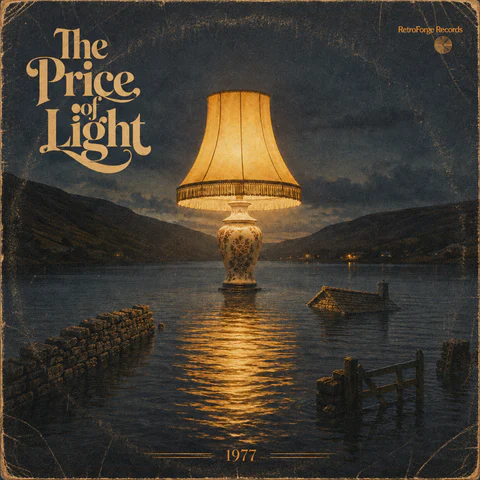
The cover compresses that relationship into an oversized glowing household lamp standing in reservoir water. Submerged walls, a gate and a roofline occupy the foreground, with distant lights beyond the ridges. Its worn, matte sleeve treatment belongs to the imagined 1970s presentation; the giant lamp is cover symbolism, not a supernatural event in the narrative.
Lyrics
Original English lyrics, reproduced without added verse or performance labels.
01 · Pegs in the Lower Field
There are four red pegs in the lower field,
two by the ditch and two beyond the gate.
I nearly pulled the first one with my boot
before I saw the tape stretched through the grass
and the tripod standing where the cattle turn.

They have chalk on their sleeves and mud on their knees.
One of them asks which fence is ours.
I point to the wall, then farther down
where the hedge has grown through the wire,
and he writes something without looking up.

Leave them where they stand.
Leave them there until we know.

By dinner the men have crossed to the far side.
A white card is tied beneath the gate latch.
My name is typed correctly.
The field is described in numbers,
though nothing in it has moved.

I walk the line again before dark,
past the patch where the ground stays wet,
past the broken post we keep meaning to mend,
past the place the river shows between the alders.

Leave them where they stand.
Now we know enough.
02 · Compensation Day
Property to be acquired.
Access to be retained.
Fixtures by separate schedule.
Outbuildings subject to inspection.

A hand turns the page.
From the second row: does the orchard count?
At the back, twenty years of rent
is placed on the table as if it ought to count for something.

Reasonable costs of removal.
Alternative accommodation where applicable.
Livestock transport to be assessed.
Existing rights to be extinguished.

A chair scrapes back.
A man beside the window says,
“If you mean the house, say house.”
Nobody writes that sentence down.

Sign here.
Initial there.
Take a copy home.

Market value at the appointed date.
No allowance for attachment.
No allowance for expectation.
No allowance for inconvenience beyond the terms stated.

One family whispers over debts.
Another folds the paper twice.
Across the aisle comes the remark
that accepting early makes it easier for them.

Property to be acquired.
Access to be retained.
The same words return,
but the room has changed around them.

A woman asks who moves the piano.
Laughter breaks too loudly near the door.
Another form slides across the table.

Sign here.
Keep your copy.

Next.
03 · Against the Motion
Put it to the room, then.
Put the paper down where everyone can see it.
You say refusal keeps the road open.
He says refusal only changes the date.
From the back comes: the churchyard first,
and three people answer before the chair can call order.

We came here together.
That lasted ten minutes.

You call it surrender.
I call it knowing what comes next.
You have land above the line.
We do not.
You can wait another winter.
We have already packed the upstairs rooms.

No, that is not what I said.
No, don't tidy it for me.
If the offer stands, I take it.
If you want to hate me for that,
use my name when you do it.

The chairman asks for order.
The chairman asks again.

A hand rises slowly near the wall:
What happens to the graves?

For once,
nobody answers at once.

Against the motion.
For the motion.
Abstain if you must.

A vote is a useful thing
when the question fits inside it.

This one does not.

From the left: we should stand as one.
From the doorway: we stopped doing that
the moment the first figure arrived.

Count the hands.
Count them twice.
Record the result.

Then meet your neighbor's eyes.
04 · Rooms Without Curtains
The curtains went yesterday, and without them the front room looks taller than it ever did when the table was under the window and the kettle could be heard from the hall.

There are pale squares above the mantel where the pictures hung,
and two clean strips on the floor where the cabinet stood,
and one bent hook by the door that I leave in place because removing it would be more deliberate than I can manage today.

We carry the last boxes down the stairs slowly, not because they are heavy but because there is no reason to hurry anymore, and the sound of our shoes travels farther through the house than it used to.

In the kitchen a cup has been left behind.
Not the good one.
Not anyone's favorite.
Just a chipped brown cup at the back of the shelf.

I put it in a box anyway.

You have the keys in your coat pocket, and I still reach for mine when I come through the passage, which makes us both laugh once, briefly, before neither of us knows what to say after it.

The bedroom door catches at the same place.
The third stair still complains.
There is dust under the bedstead and a nail in the wall we never used.

Everything is exactly where the house left it.

Except us.

At the gate I turn the key until the lock takes,
then try the handle twice from habit.

We walk to the road.

I do not look back again.
05 · Aggregate
Stone through the hopper.
Dust whitening the road.
A loaded lorry crawls
where the sheep track ran.

Check the grade.
Brace the shuttering.
Wave the mixer forward.
The chute swings over the timber.

Crush it.
Grade it.
Pour it.
Hold.

Boots on wet boards.
Cable drawn taut.
A banksman lifts one arm
through the engine noise.

The drum turns.
The barrows queue.
A shovel works the corners
before the mix can stiffen.

By noon the forms are full.
Cement dries grey across the gloves.
A man knocks each board with his hammer,
listens,
then moves to the next.

Another lorry backs into place.

Crush it.
Grade it.
Pour it.

Hold.
06 · Below the Red Line
The cattle go first to the upper farm.
Tools are tagged and loaded by the shed.
Two pews leave through the vestry door.
The brass cross travels wrapped in blankets.
A crate is marked for books,
another for the kitchen things no one has claimed.

Take what can be carried.
Leave the rest below the red line.

The gate comes off its hinges.
Useful timber is stacked by the road.
A stone trough takes four men and a chain.
The old mower will not start,
so they drain it, curse it,
and winch it onto the lorry anyway.

Move what can be moved.
Mark the rest below the red line.

Names are copied from the grave markers.
Numbers are checked against a list.
Soil is lifted carefully.
Families stand farther back than they expected to.
The small stones travel with the large ones.
The cracked one is kept because the name can still be read.

At the church door
someone asks whether the bell is coming.

It is.

Raise what can be raised.
Close the road below the red line.

By evening there are fewer reasons to return.
One crate waits without a label.
One gate stands open.
One room still has a broom against the wall.

Nobody needs it.

Take what can be carried.
The line has already decided the rest.
07 · Sluice
The gate is checked.
The channel is clear.
Pressure holds where the concrete joins.
A hand signal passes down the platform.

Close.

The current turns.
The intake takes it.
Levels climb past marks
painted months before.

By noon the lower road
ends in brown water.

Road below.
Wall below.
Orchard below.

The gauge moves.

Water finds the contour.
Concrete holds.
At the spillway the needles settle.
Beyond the wall,
the river runs narrow.

One level.
Then another.

The last red mark
goes under.
08 · Lights Beyond the Ridge
Lights beyond the ridge,
warm in rooms we never see.
A hand finds the switch,
and evening changes quietly.

A kettle starts in a kitchen.
A workshop keeps one bench alive.
Street lamps take the corner one by one.
Pages turn beneath a shaded bulb.
At closing time a sign stays burning
above a door on the high street.

Nothing in those rooms is extraordinary.

Lights beyond the ridge,
steady along the road.
Current through the wire,
ordinary as being home.

You do not know the lower field.
You have no reason to.
You do not know which house had curtains
or who carried the bell uphill.

You turn the lamp toward the table.
You finish what you were doing.
Outside, the line runs over the ridge
and disappears from view.

Lights beyond the ridge,
small and warm and clear.
The wire drops behind the hill.
Work goes on till late.
Keep Exploring
For listeners drawn to 1970s British-style prog, narrative concept albums, pastoral arrangements and analogue keyboard-led rock.
More RetroForge progressive-rock albums to explore as listening suggestions, without implying a shared story.