
Overview
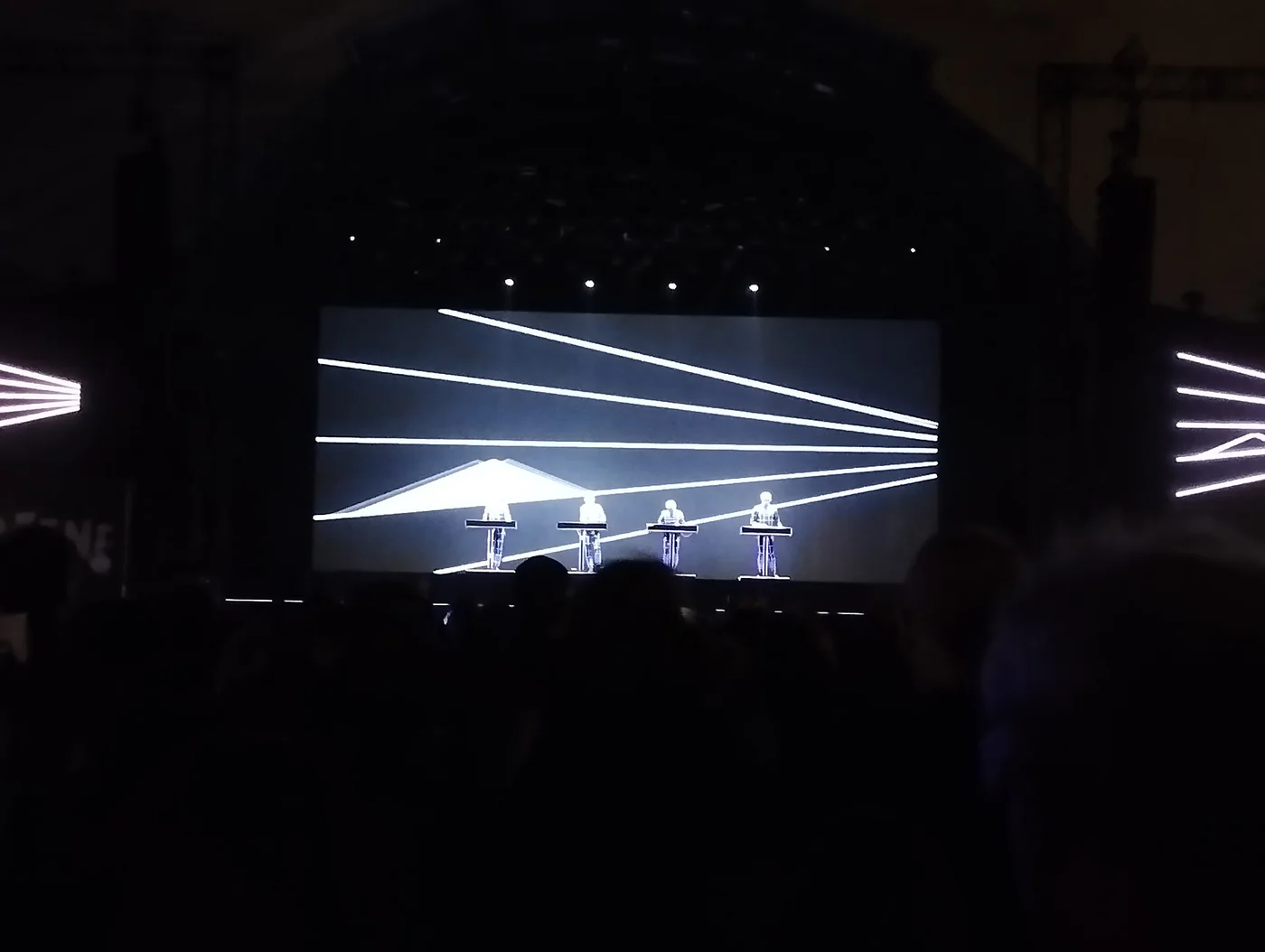
Kraftwerk turned a Düsseldorf experimental project into a precisely coordinated electronic and audiovisual practice. Between Autobahn in 1974 and Computer World in 1981, the group made transport, radio, robotics and data the subjects of records whose rhythms and synthetic textures travelled far beyond German experimental rock. Their importance is measurable without declaring them the sole inventors of later genres: the Recording Academy gave them a Lifetime Achievement Award in 2014, and the Rock & Roll Hall of Fame inducted them for Musical Influence in 2021.
Formation & History
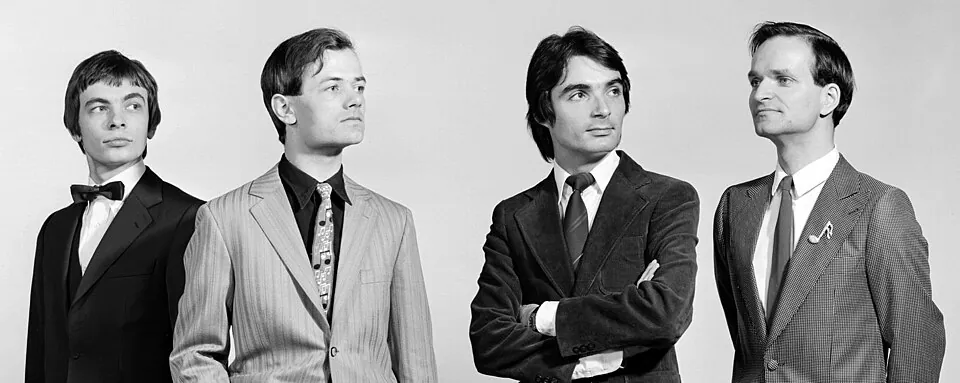
Ralf Hütter and Florian Schneider met while studying music in Düsseldorf and worked together in Organisation before founding Kraftwerk in 1970. The first three Kraftwerk albums still used flute, guitar, keyboards, percussion and changing collaborators alongside electronic processing. Ralf und Florian in 1973 moved further toward melody, synthesised timbre and a carefully controlled studio identity.
Autobahn changed the scale of the project in 1974. Its long title piece treats the motorway journey as form: a sung hook, engine-like pulse, passing sound effects and extended instrumental travel. Wolfgang Flür and later Karl Bartos helped establish the best-known quartet with Hütter and Schneider. Radio-Activity, Trans-Europe Express, The Man-Machine and Computer World then tightened the connection between concept, electronic rhythm, typography, photography and stage image.
After Electric Café in 1986, Bartos and Flür left during different stages of the group's later history. The Mix rebuilt earlier material with digital production in 1991, while Tour de France Soundtracks expanded the cycling theme into a full album in 2003. Schneider left in 2008 and died in 2020. Under Hütter, Kraftwerk developed museum residencies and 3-D concerts that presented the eight-album catalogue as a sequence of sound-and-image works; the official concert archive documents continued touring in 2026.
Sound & Style
The catalogue does not switch from acoustic instruments to machines in a single step. The early records place Schneider's flute and treated winds beside Hütter's keyboards and organ; Autobahn still combines electronic pulse with guitar, flute and acoustic textures. By Radio-Activity and Trans-Europe Express, synthesisers, sequencers and custom electronic percussion shape both the bar-by-bar motion and the larger concept.
Voices operate in several modes: plain sung slogans, vocoder harmonies, spoken place names, counting, synthetic speech and deliberately reduced bilingual texts. On The Man-Machine, short melodic songs and machine rhythms meet the posed image of the quartet; on Computer World, clipped numbers and calculator phrases turn information exchange into rhythm. The later 3-D performances make projection, typography, spatial sound and limited bodily movement part of the composition rather than decoration around it.
Essential Albums
Trans-Europe Express
1977Europe Endless opens with a gliding panorama before The Hall of Mirrors and Showroom Dummies turn observation and display into restrained electronic songs. The second half links Trans-Europe Express to Metal on Metal, then lets the railway pulse dissolve through Franz Schubert and the brief reprise Endless Endless. The result is a travel album whose transitions matter as much as its individual tracks.
Key tracks: Europe Endless · The Hall of Mirrors · Trans-Europe Express / Metal on Metal
Open album guide → View on Amazon →The Man-Machine
1978Six compact pieces connect the group's red-and-black constructivist image to increasingly concise electronic pop. The Robots introduces the mechanical persona; Spacelab and Metropolis widen the visual field; The Model reduces celebrity and display to a cool miniature; and the long melodic drift of Neon Lights leads into the title track's repeated human-machine equation.
Key tracks: The Robots · The Model · Neon Lights · The Man-Machine
Open album guide → View on Amazon →Computer World
1981The title track links governments, business and crime through shared data, while Pocket Calculator turns a portable device into an audience-ready instrument. Numbers strips language down to multilingual counting over one of the catalogue's hardest rhythms; Computer Love restores a vulnerable melody before Home Computer and It's More Fun to Compute close the circuit.
Key tracks: Computer World · Pocket Calculator · Numbers · Computer Love
Open album guide → View on Amazon →Affiliate note: Amazon links on this page may earn RetroForge Records a small commission, at no extra cost to you.
Deeper Cuts
Radio-Activity
1975A sequence built on the double meaning of broadcasting and radiation. Geiger Counter leads directly into the title song; brief pieces such as News, Intermission, Uranium and Transistor behave like signals between the fuller songs Radioland, Airwaves, Antenna and Radio Stars.
Open album guide → View on Amazon →Kraftwerk's most recent studio album as of 2026 expands the 1983 single into a complete cycling programme. The opening suite follows movement and landscape; Vitamin inventories the body's inputs; Aéro Dynamik and Titanium make cadence and resistance audible; Elektro Kardiogramm converts breath and heartbeat into structure.
Open album guide → View on Amazon →Autobahn
1974The long title track joins a simple vocal refrain to engine pulse, passing cars, Doppler-like motion and sections of open-road drift. The second side is not an appendix: the two-part Kometenmelodie moves from suspended tones to a bright sequenced theme, while Mitternacht and Morgenspaziergang carry the journey from night into morning.
Open album guide → View on Amazon →Why They Still Matter
Kraftwerk's influence is clearest in specific transfers of method. Afrika Bambaataa & the Soulsonic Force drew on Trans-Europe Express and Numbers for Planet Rock; electronic pop adopted the group's short melodic cells, sequenced pulse and controlled vocal delivery; hip-hop and dance records repeatedly sampled or reconstructed their rhythms. The catalogue also offered later musicians a model in which record design, stage image, language and technology could belong to the same work.
The institutional record supports that influence without turning it into mythology. Kraftwerk received the Recording Academy's Lifetime Achievement Award in 2014, won the 2018 Grammy for Best Dance/Electronic Album with 3-D The Catalogue, and entered the Rock & Roll Hall of Fame in 2021 under Musical Influence. Hütter's touring project continues to revise the audiovisual presentation rather than treating the catalogue as a conventional nostalgia show; Kraftwerk's official schedule lists concerts throughout 2026.
Sources & Further Reading
This guide was checked against Kraftwerk's official concert archive; the Staatliche Museen zu Berlin's Neue Nationalgalerie press dossier and eight-album concert factsheet; the Recording Academy's Lifetime Achievement profile; and the Rock & Roll Hall of Fame's 2021 induction record. Album-specific track, personnel and production details were cross-checked against the sourced RetroForge album guides linked above.
The Recording Academy's official Kraftwerk award record confirms the 2018 Best Dance/Electronic Album win for 3-D The Catalogue.
Connected archive routes
Explore This Band
Continue through the RetroForge knowledge graph
Curated paths into the people, records, events and ideas that give this subject its wider musical context.