

Overview
Faust began not with a conventional club circuit but with a working environment. In 1971 producer and journalist Uwe Nettelbeck brought six musicians together at a former schoolhouse in Wümme, where engineer Kurt Graupner helped turn the residential studio into part of the ensemble. Playing, recording, splicing and playback belonged to the same process.
The first four releases document how quickly that process changed shape. Faust builds three long pieces from songs, edits and abrupt collisions; So Far compresses the method into nine separate tracks; The Faust Tapes remakes two years of Wümme recordings as a continuous montage; and Faust IV carries the group into Virgin's British studio system without making its music conventional.
Formation & History
Nettelbeck assembled Werner “Zappi” Diermaier, Hans Joachim Irmler, Jean-Hervé Péron, Rudolf Sosna, Gunther Wüsthoff and Arnulf Meifert from musicians connected with two Hamburg-area groups. Polydor financed the Wümme base, but that support came with commercial expectations. The 1971 debut—three tracks on clear vinyl, packaged with a transparent X-ray image of a fist—did not meet them; Meifert left after the album.
So Far followed in 1972 with nine shorter pieces and a black package containing a set of square prints. That October, Faust recorded with violinist and composer Tony Conrad at Wümme; the collaboration appeared as Outside the Dream Syndicate in 1973. Virgin then introduced the band to a much larger British audience by issuing The Faust Tapes for 49 pence. The bargain-price record was the montage—not the transparent debut.
Faust IV, also released by Virgin in 1973, was followed by work toward another album, but Virgin declined the proposed successor. The original group's continuous phase ended in the mid-1970s. Péron and Diermaier returned to the stage in Hamburg in 1990 after roughly fifteen years; Irmler later rejoined some activity, and the 1990s produced live documents, the Jim O'Rourke-produced Rien and the film-related Faust Wakes Nosferatu.
Later Faust history is not one uninterrupted lineup. Péron and Diermaier continued one branch, often styled faUSt, while Irmler led another configuration. Treating both as a single continuous “1971–present” band hides the original break and the distinct work made under those later lineups.
Sound & Style
Faust's early sound depends on the boundary between a performance and its recording becoming unstable. Graupner's engineering and Nettelbeck's production let tape edits, room sound, speech, radio-like interruption and electronic processing sit beside drums, bass, organ, guitar, saxophone and piano. A hard rhythm can be cut off rather than resolved; an acoustic phrase can function as material inside a collage rather than as a complete song.
So Far makes repetition especially clear. “It's a Rainy Day, Sunshine Girl” reduces harmony and drumming to a stubborn pulse, while “Mamie Is Blue” places voice and riff inside a dense electronic surface. The Faust Tapes pushes in the opposite direction: brief fragments continually replace one another, so montage itself supplies continuity.
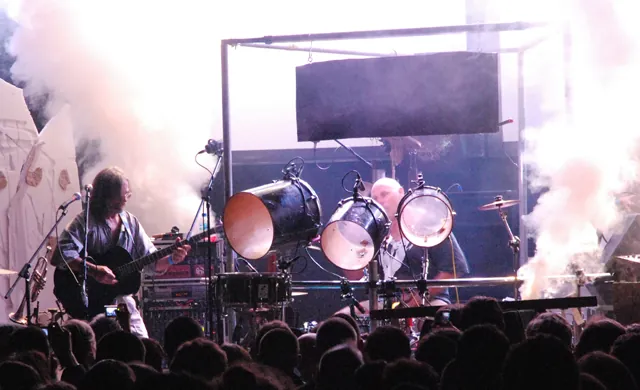
The reunion recordings did not simply reproduce Wümme. The Faust Concerts Vol. I documents acoustic passages, overloaded electronics and power tools in the same 1990 performance. Faust Wakes Nosferatu belongs to the Irmler–Diermaier-era ensemble and was developed in relation to F. W. Murnau's silent film; its CD and vinyl editions contain different programmes.
Essential Albums
Faust
1971Three long pieces made at Wümme by the original six with Nettelbeck and Graupner. “Why Don't You Eat Carrots?” and “Meadow Meal” turn abrupt edits, quotations, speech and ensemble playing into studio composition; the extended “Miss Fortune” preserves a looser performance. Clear vinyl and the transparent X-ray package make the recording process visible as well as audible.
Key tracks: Why Don’t You Eat Carrots? · Meadow Meal · Miss Fortune
Open album guide → View on Amazon →So Far
1972The second Polydor album divides its programme into nine tracks without abandoning the studio method. “It's a Rainy Day, Sunshine Girl” works through radical repetition, the title track concentrates organ and rhythm, and “Mamie Is Blue” buries a heavy riff in electronic texture. Its black sleeve originally accompanied ten square visual prints.
Key tracks: It's a Rainy Day, Sunshine Girl · So Far · Mamie Is Blue
Open album guide → View on Amazon →The Faust Tapes
1973Nettelbeck assembled this originally untitled, two-sided montage from material recorded at Wümme between June 1971 and June 1973. Songs, rehearsals, noise, conversation and tape edits appear as one discontinuous flow. Virgin's 49-pence British price turned an archive collage into many listeners' first Faust record.
Key tracks: [untitled]
Open album guide → View on Amazon →Affiliate note: Amazon links on this page may earn RetroForge Records a small commission, at no extra cost to you.
Deeper Cuts
Faust IV
1973Recorded for Virgin, the album places the blunt parody “Krautrock” beside the pulse of “Jennifer,” the abrasive “Picnic on a Frozen River, Deuxième Tableau” and two versions of “Psalter.” Its clearer separation into tracks does not erase the jumps between drone, melody, rhythm and interruption.
Open album guide → View on Amazon →Klangbad's 1997 CD presents six long pieces developed by an Irmler–Diermaier-era ensemble in relation to Murnau's 1922 Nosferatu. The seven-track vinyl edition contains different music and artwork, so the title identifies two related but non-identical programmes.
Open album guide → View on Amazon →The Faust Concerts Vol. I
1994 (recorded 1990)Issued by Table of the Elements in 1994, this nine-piece document captures Péron and Diermaier's 1990 Prinzenbar return—the first Faust concert in about fifteen years. Acoustic passages, overloaded electronics, group improvisation and power tools make the performance a new construction, not a replay of the 1970s albums.
Open album guide → View on Amazon →Why They Still Matter
Faust's early catalogue demonstrates that editing, packaging and distribution can be part of musical form. The clear-vinyl debut makes the record an object; So Far couples nine tracks to a visual portfolio; and Virgin's 49-pence Faust Tapes put uncompromising studio montage into the hands of a broad British audience.
The later archive also prevents the group from becoming a closed historical episode. The 1990 Prinzenbar concert, the 1994 American tour and Rien show Péron and Diermaier rebuilding the method through live intensity and contemporary production. Irmler's later work under the Faust name follows a different path. What connects these records is not a fixed lineup or one sound, but a practical idea: recordings can be assembled from collisions without smoothing away their seams.
Connected archive routes
Explore This Band
Continue through the RetroForge knowledge graph
Curated paths into the people, records, events and ideas that give this subject its wider musical context.
Genres and scenes
- Krautrock