

Overview
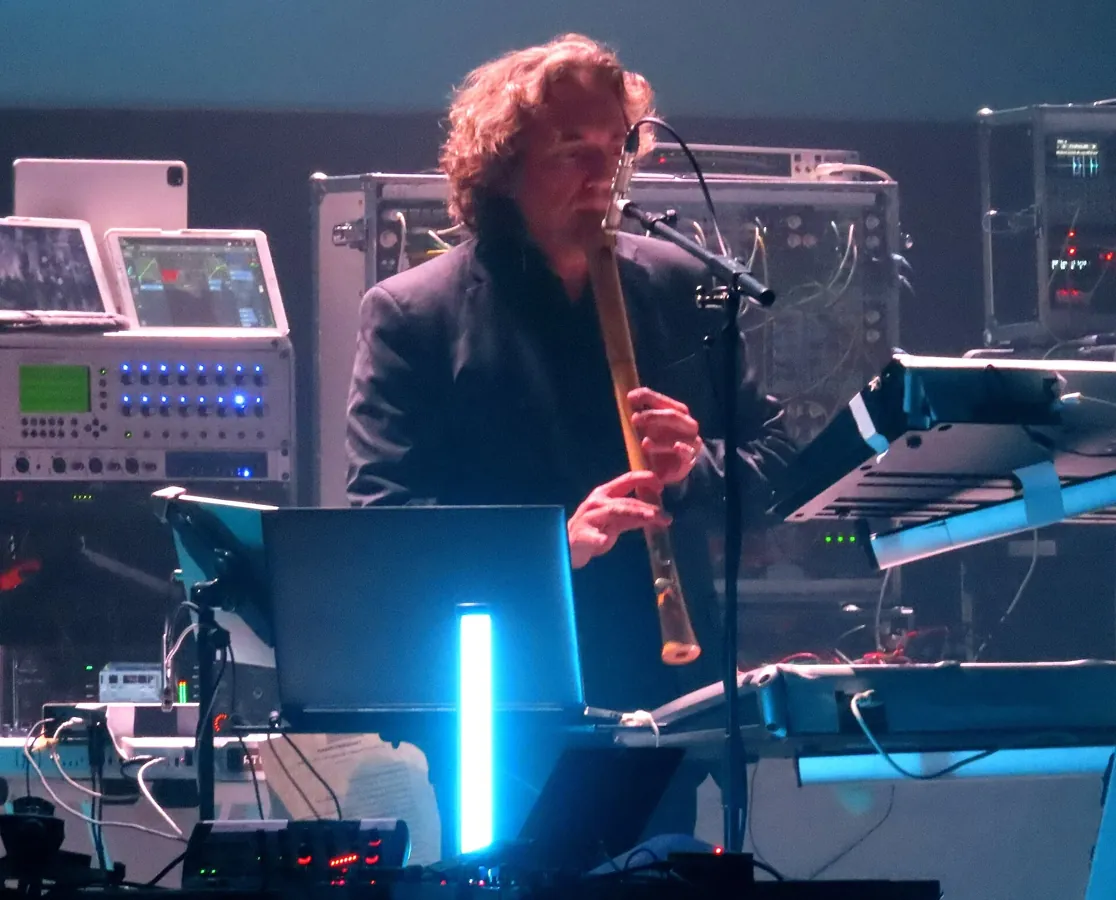
Tangerine Dream helped turn the synthesiser and sequencer into tools for long-form composition. Founded by Edgar Froese in West Berlin in 1967, the group moved from free-form psychedelic rock toward the electronic language later called Berlin School: repeating patterns, slowly shifting timbres and improvisations measured in album sides rather than pop-song units. The 1974–77 Virgin Records period brought that method to an international audience, but the catalogue extends from abrasive early experiments to film scores, digital studio work and the present-day band's real-time compositions.
Formation & History
Froese formed Tangerine Dream in 1967 and the band gave its first concert at the Technical University of Berlin in January 1968. The early personnel changed rapidly. Electronic Meditation captured the 1969–70 trio of Froese, Klaus Schulze and Conrad Schnitzler; Christopher Franke joined in 1970, and Alpha Centauri paired Froese and Franke with Steve Schroyder. Peter Baumann completed the best-known 1970s trio.
John Peel's support for Atem helped the Froese–Franke–Baumann lineup secure a deal with Virgin Records in 1973. Recorded at the Manor that November, Phaedra made the Moog sequencer central without eliminating flute, Mellotron or Froese's guitar. It reached number 15 in the UK; Rubycon climbed to number 10 the following year. Baumann left in 1977 and Franke in 1987, while Froese remained the group's constant member until his death in 2015.
Sound & Style
The classic 1970s sound is built around analogue sequencers: repeating voltage patterns that drive pitch and pulse while the musicians alter timbre, register and density in real time. Franke often supplied the rhythmic architecture; Froese added Mellotron, synthesiser, organ and guitar; Baumann brought keyboards, electronics and flute. On Phaedra unstable tuning and white noise become part of the composition, while Rubycon stretches the method across two continuous side-long pieces.
The palette was never purely synthetic. Piano opens the second half of Ricochet; acoustic guitar, harmonica and harpsichord enter Stratosfear; later lineups used drums, saxophone and digital sampling. That ability to retain a recognisable sense of motion while changing equipment and personnel is more useful than treating “Berlin School” as one fixed recipe.
Essential Albums
Phaedra
1974Recorded at the Manor in November 1973, the first Virgin album makes a malfunction-prone Moog sequencer the unstable pulse of its 17-minute title piece. “Mysterious Semblance at the Strand of Nightmares” is shaped by Froese's Mellotron and electronics, “Movements of a Visionary” turns repetition into a shifting rhythmic field, and Baumann's flute closes the record alone on “Sequent C”. It reached number 15 in the UK and established the band's international career.
Key tracks: Phaedra · Movements of a Visionary · Sequent 'C'
Open album guide → View on Amazon →Rubycon
1975Two side-long compositions refine Phaedra's discoveries into a more continuous architecture. Mellotron choirs, flute-like colours and turbulent abstract passages surround sequencer patterns that appear, recede and return in altered form. The absence of named subsections encourages uninterrupted listening. Rubycon reached number 10 in the UK, the band's highest position on the main album chart.
Key tracks: Rubycon (Part I) · Rubycon (Part II)
Open album guide → View on Amazon →Ricochet
1975The first Tangerine Dream live album was assembled from 1975 concerts in Britain and France, then shaped in the studio into two side-long pieces. “Part One” layers multiple rhythmic patterns with a force rarely heard on the studio albums; “Part Two”, drawn largely from Croydon's Fairfield Halls, begins with Froese's descending piano figure before Mellotron and echoing sequencer lines take over. It documents improvisation as composition rather than reproducing a studio programme.
Key tracks: Ricochet, Part One · Ricochet, Part Two
Open album guide → View on Amazon →Affiliate note: Amazon links on this page may earn RetroForge Records a small commission, at no extra cost to you.
Deeper Cuts
Stratosfear
1976The final studio album by the Froese–Franke–Baumann trio balances sequencers with acoustic guitar, grand piano, harpsichord and harmonica. Four separately titled pieces make the structure easier to follow than Rubycon, while “Invisible Limits” moves from electronic propulsion into a flute-led closing passage.
Open album guide → View on Amazon →Sorcerer
1977William Friedkin commissioned the music from a script before the band had seen the finished film. Twelve compact cues translate Tangerine Dream's long-form vocabulary into suspense, percussion and recurring motifs; “Betrayal” provides the score's most recognisable theme. The soundtrack reached number 25 in the UK.
Open album guide → View on Amazon →Alpha Centauri
1971Froese, Franke and Steve Schroyder combine organ, flute, percussion and the band's first prominent VCS 3 synthesiser passages. The 22-minute title track develops from near-silence and cymbal swells into electronic sirens and massed organ, capturing the point where free-rock improvisation began to turn into Kosmische Musik.
Open album guide → View on Amazon →Why They Still Matter
The film scores for Sorcerer, Thief, Risky Business and Firestarter carried Tangerine Dream's electronic vocabulary into cinemas, while the 1980 concert at East Berlin's Palast der Republik made them the first major Western group to perform in the GDR. Their catalogue also records changing technology: analogue modular systems in the 1970s, digital instruments and sampling in the 1980s, and computer-assisted real-time composition in the current “Sessions” work.
Continuation after Froese's death is not simply a tribute operation. Quaeschning had joined in 2005 and was appointed musical director by Froese in 2013. With Yamane and Frick, the present lineup combines Froese's surviving sketches on Quantum Gate with new collective work such as Raum and the live sessions. That continuity makes Tangerine Dream both a historical influence and an active electronic group.
Sources & Further Reading
Tangerine Dream — official biography
Tangerine Dream — official current lineup
Tangerine Dream — Phaedra archive entry
Tangerine Dream — Rubycon archive entry
Tangerine Dream — Ricochet archive entry
Connected archive routes
Explore This Band
Continue through the RetroForge knowledge graph
Curated paths into the people, records, events and ideas that give this subject its wider musical context.
Genres and scenes
Sounds and instruments
- Mellotron
- Long-Form Composition