

Overview
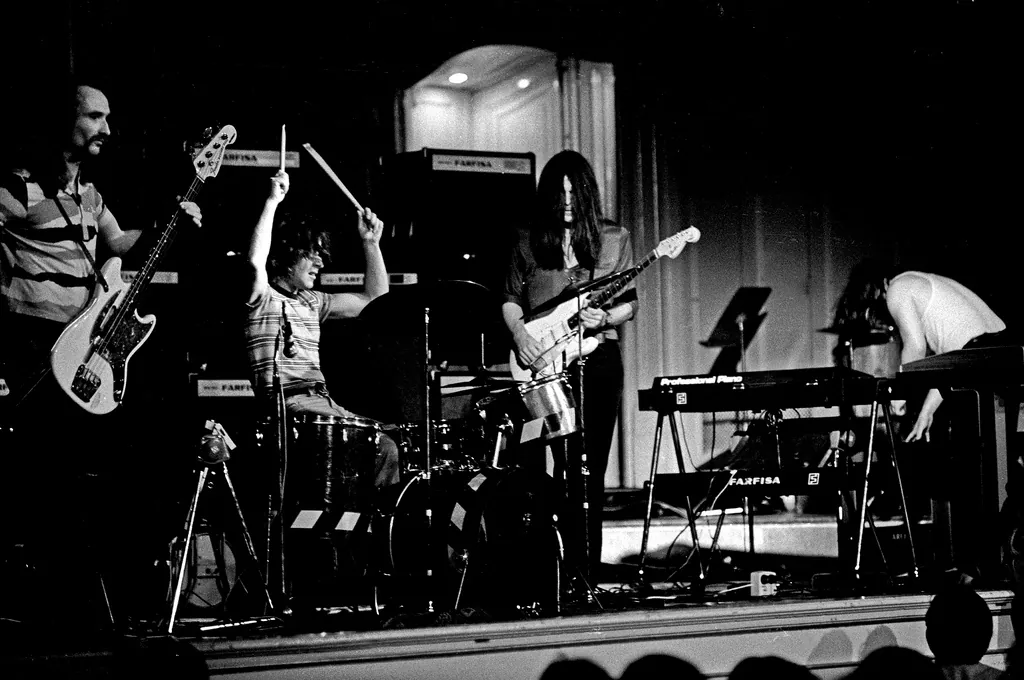
Can treated the rock group as a real-time composition system. Irmin Schmidt's keyboards, Holger Czukay's bass and tape work, Michael Karoli's guitar and Jaki Liebezeit's drums could repeat a figure for minutes while continually changing its weight, colour and internal spacing. The result connects experimental composition, free jazz, psychedelia, funk and rock without reducing any of them to decoration.
Liebezeit's precision is central, but Can's method depends on the whole ensemble. Czukay could remove, reorder and combine passages from long performances; Schmidt introduced prepared, electronic and keyboard textures; Karoli moved between clipped rhythm and open-ended lead playing. Malcolm Mooney and Damo Suzuki did not merely sing over that machinery—their different approaches altered how the band improvised around a voice.
Formation & History
In 1968 Schmidt, Czukay, Liebezeit, Karoli and flautist David Johnson began working together in Cologne. Their first concert, a collage of rock performance and tape material, took place at Schloss Nörvenich, where the group also established its first Inner Space studio. American sculptor Malcolm Mooney joined as vocalist; Johnson became the sound engineer and left by the end of the year.
Monster Movie was recorded directly to two-track tape and extensively edited before its 1969 release. Mooney returned to the United States after Soundtracks. In May 1970 Czukay and Liebezeit encountered Kenji “Damo” Suzuki busking in Munich; he performed with Can at the Blow Up club that same evening. With Suzuki, the group recorded Tago Mago, Ege Bamyasi and Future Days, as well as his contributions to Soundtracks.
Can moved to a former cinema in Weilerswist in December 1971 and built the studio used for every subsequent Can album except Rite Time. After Suzuki left in 1973, Karoli and Schmidt supplied more of the vocals; percussionist Rebop Kwaku Baah and bassist Rosko Gee joined during the later 1970s. Czukay left the touring band in 1977, and the group dissolved in 1978. The Monster Movie lineup reunited in 1986 to record Rite Time; later studio collaborations followed in 1991 and 1999, but no conventional reunion tour.
Sound & Style
Can often began with collective performance and discovered the finished composition through listening and editing. That did not mean an absence of themes or decisions: riffs, harmonic fields and rhythmic cells could provide a frame, while Czukay's tape work determined which stretches became the record. Tago Mago exposes the widest range of this method, from the song-shaped “Paperhouse” to the side-long pulse of “Halleluwah” and the tape-saturated “Aumgn.”
Mooney's repeated phrases make tension accumulate through insistence; Suzuki moves between murmured melody, phonetic attack and sudden clarity. Under both singers, Liebezeit avoids conventional rock emphasis in favour of interlocking cycles, while bass, guitar and keyboards continually redefine the space around the beat. The Weilerswist studio made recording and editing part of the band's everyday working environment rather than a separate final stage.
Essential Albums
Tago Mago
1971The first full album with Suzuki expands Can's editing and performance method across four vinyl sides. “Paperhouse” moves from song form into acceleration, “Halleluwah” sustains a single rhythmic engine across an entire side, and “Aumgn” and “Peking O” push voice, tape and electronics beyond the shape of a conventional band performance.
Key tracks: Paperhouse · Halleluwah · Bring Me Coffee or Tea
Open album guide → View on Amazon →Ege Bamyasi
1972Seven tracks compress the collective method without making it conventional. “Pinch” leaves wide gaps around a dry, elastic groove, “Vitamin C” turns Liebezeit's opening pattern into a compact song, and the drum-machine pulse of “Spoon” sits beside radically different live rhythms rather than defining the whole record.
Key tracks: Pinch · Vitamin C · Spoon
Open album guide → View on Amazon →Future Days
1973Suzuki's final Can album reduces vocal dominance and lets sound, pulse and open space carry the form. The title track drifts without losing rhythmic definition, “Moonshake” provides one concise song, and the twenty-minute “Bel Air” develops like a continuous environment rather than a chain of solos.
Key tracks: Future Days · Moonshake · Bel Air
Open album guide → View on Amazon →Affiliate note: Amazon links on this page may earn RetroForge Records a small commission, at no extra cost to you.
Deeper Cuts
Soon Over Babaluma
1974The first post-Suzuki studio album keeps the core quartet, with Karoli and Schmidt sharing the available vocals. “Dizzy Dizzy” sets violin against a circular groove, “Come Sta, La Luna” uses a sharper vocal frame, and the closing “Quantum Physics” turns percussion and electronics into a suspended field.
Open album guide → View on Amazon →Landed
1975Recorded at Inner Space and mixed at London's Studios at Britannia Row, Landed presents shorter, more separated songs before the full-side “Unfinished.” “Full Moon on the Highway” and “Hunters and Collectors” emphasise ensemble attack; the finale lets studio processing dismantle that directness.
Open album guide → View on Amazon →Delay 1968
1981Released in 1981, this collection preserves material from the Mooney-era sessions originally prepared as Prepared to Meet Thy Pnoom. “Butterfly,” “Uphill” and “Little Star of Bethlehem” reveal a rawer group still testing how repetition, blues forms, noise and editing could coexist.
Open album guide → View on Amazon →Why They Still Matter
Can's continuing importance lies in a reproducible idea rather than a vague claim of universal influence: repetition can generate change when every player adjusts timbre, density and placement inside the cycle. Their records also show that editing can be composition without erasing the evidence of collective performance. Those principles became useful to post-punk, electronic music and later experimental rock in different ways.
The catalogue resists a single “classic sound.” Monster Movie is built around Mooney's insistence, Tago Mago makes the studio unstable, Ege Bamyasi concentrates the method, and Future Days opens it into atmosphere. Hearing the differences is more useful than treating “motorik” as a catch-all label for everything the band recorded.
Sources & Further Reading
Formation, the Schloss Nörvenich and Weilerswist studios, the Mooney and Suzuki transitions, later sessions and the end of the group were checked against the official Can / Spoon Records history.
Album chronology was checked against the official Spoon Records discography. The lineup and 1968–1977 recording locations are also documented by Spoon Records and Mute in The Lost Tapes archive notes.
Connected archive routes
Explore This Band
Continue through the RetroForge knowledge graph
Curated paths into the people, records, events and ideas that give this subject its wider musical context.