
Timeline Archive · 1974
Autobahn
Autobahn turned the ordinary motion of a motorway journey into a twenty-two-minute electronic composition that felt distinctly German, modern and unexpectedly inviting.
The Record in Context
The title track of Autobahn begins with a car door, an engine and a horn before settling into a simple melodic phrase. The subject is not speed or danger. Kraftwerk builds the piece around the changing perception of a long drive: lane markings passing in rhythm, radios appearing and fading, the Doppler shift of vehicles, open stretches, tunnels and the mild hypnosis of sustained movement.
At more than twenty-two minutes, Autobahn occupied the first side of the original LP. Its scale connected Kraftwerk to the long-form music around German experimental rock, yet its clean motif and gently processed vocal made it unusually accessible. The track did not abandon acoustic instruments or the human performer. Flute, guitar and live percussion coexist with Minimoog, electronic keyboards, vocoder-like processing and studio-built rhythmic devices.
Historical Context
Ralf Hütter and Florian Schneider had formed Kraftwerk in Düsseldorf in 1970 after working together in Organisation. The group’s first three albums moved through improvisation, electronic texture and changing personnel. By Ralf und Florian in 1973, the pair had begun shaping a more concise identity around synthesisers, custom electronics, melody and a specifically German visual language.
Autobahn was developed in and around Kraftwerk’s Kling Klang studio, with Conny Plank credited as recording engineer. The album is associated primarily with Hütter and Schneider, while Klaus Röder contributed guitar and violin and Wolfgang Flür played electronic percussion. The later four-person public image of Kraftwerk was not yet fully established; Karl Bartos joined after the album for touring and subsequent work.
Released in Germany in November 1974, the album became an international breakthrough during 1975 after an edited version of the title track received radio play. Its success was striking because the record did not disguise its language or location. The German lyric and motorway subject were central to its identity rather than obstacles to export.
Sound and Production
The long title piece is organised through gradual environmental changes rather than verse-chorus repetition. A bright main theme returns as rhythm and timbre shift around it. Electronic percussion suggests the regularity of road travel, but small delays and human accents keep the motion buoyant. The vocal phrase is brief and functional, closer to signage than narrative: an invitation to drive rather than a story about a driver.
Kometenmelodie 1 and Kometenmelodie 2 turn from transport toward astronomy. The first is slow and suspended; the second gives related electronic material a more distinct pulse and melodic outline. Mitternacht returns to darker atmosphere, while Morgenspaziergang introduces morning sounds and flute. The side-two sequence shows that Kraftwerk had not become exclusively machine-like. Natural imagery and acoustic breath remain inside the electronic frame.
The production is important for what it avoids. Synthesisers are not used to imitate an orchestra, and electronics are not presented as a special-effect interruption to a rock arrangement. They define the record’s basic vocabulary. Repetition, tone colour and stereo movement carry form. That restraint gives Autobahn a clarity that distinguishes it from both free-form electronic music and the denser progressive rock of the same period.
Key Tracks
- AutobahnA side-long motorway composition where engine noise, electronic pulse, flute and recurring melody turn travel into form.
- Kometenmelodie 1A slow, spacious electronic piece that treats melody as a distant object moving through a dark field.
- Kometenmelodie 2Related cosmic material gains a brighter pulse and a concise melodic profile that anticipates later Kraftwerk.
- MitternachtNocturnal electronic textures replace the title track’s daylight motion with tension and suspended space.
- MorgenspaziergangFlute and imitated birdsong close the album with an acoustic-electronic morning scene.
Artwork and Visual Identity
The original German cover, painted by Kraftwerk collaborator Emil Schult, shows a stylised road curving through a landscape beneath a blue sky. A Volkswagen and a Mercedes travel in opposite directions while bridges and mountains reduce the motorway to a clean diagram of mobility. The image is modern but not cold; it retains the colour and optimism of travel advertising.
Later packaging changed the visual identity significantly. The 2009 remaster replaced the painted scene with a minimal blue-and-white motorway sign, bringing Autobahn into the stricter graphic system Kraftwerk developed on later albums. Both versions express the same subject from different phases of the group: first as landscape, later as symbol.
Legacy and Influence
Autobahn’s international success gave a wide audience sustained exposure to electronic rhythm and synthetic tone outside novelty records or academic composition. The Recording Academy traces Kraftwerk’s influence through new wave, synth-pop, industrial music and electronic dance. Hip-hop and electro artists would later draw on the group’s precise rhythms and machine imagery, especially as the catalogue moved through Trans-Europe Express and The Man-Machine.
Its influence should not flatten the album into a prediction of later genres. Autobahn still contains flute, guitar, pastoral sound and traces of Kraftwerk’s improvisational past. The record matters partly because it captures transition: the point where the electronic system became clear without yet becoming sealed.
What Came Next
Radio-Activity followed in 1975, tightening the group’s themes around broadcast, radiation and communication. Trans-Europe Express in 1977 replaced the motorway with rail travel and presented an even more controlled rhythmic and visual identity. By The Man-Machine, the red-and-black uniforms and deliberately depersonalised group portrait had become inseparable from the music.
The sequence from Autobahn through Computer World established one of popular music’s most coherent bodies of work. Each album selected a modern system—roads, radio, trains, machines, computers—and examined how human voices and bodies behave inside it. Autobahn is the first complete statement of that method.
Kling Klang Becomes a Laboratory
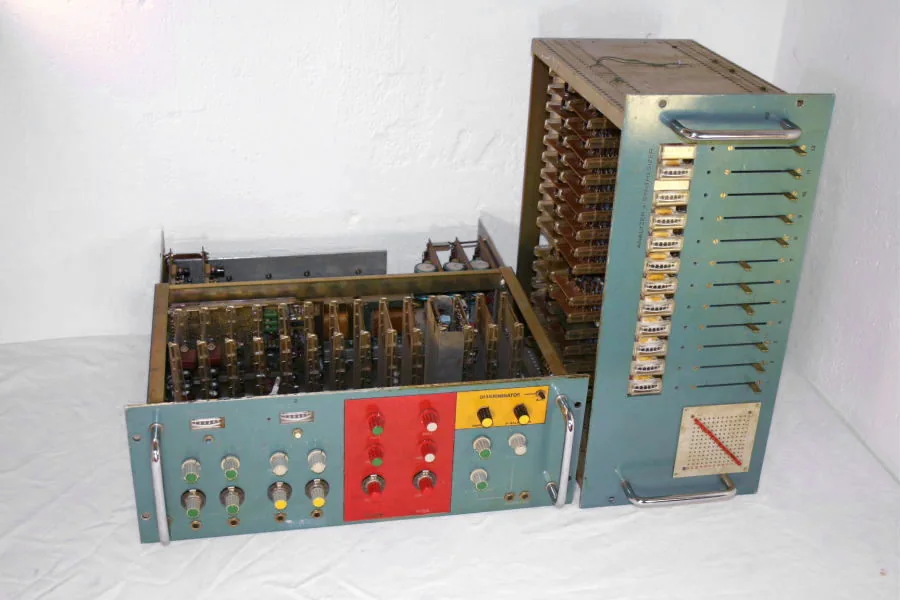
By Autobahn, Kraftwerk’s Düsseldorf workspace was becoming more than a room where a band recorded performances. Kling Klang functioned as an evolving instrument system: synthesizers, keyboards, electronic and acoustic percussion, voices, microphones and custom devices could be configured around a particular idea. The group was moving away from the open-ended experimental rock of its first albums toward a language based on precision, repetition and carefully selected sound.
Recording engineer Conny Plank remained crucial to the album’s sonic depth. The finished music is electronic without being clinically flat. Acoustic flute and guitar still appear, and Wolfgang Flür’s electronic percussion joins conventional playing rather than instantly replacing it. The transition matters. Autobahn captures a band discovering its future, not a fully automated machine arriving without a past.
Twenty-Two Minutes on the Road
The title piece does not tell a conventional travel story. It models movement through recurring pulses, passing motifs, Doppler-like shifts and changes in weather and attention. The famous vocal phrase is deliberately simple, closer to a road sign than a dramatic lyric. Car horns, engine suggestions and radio-like details make the motorway audible, but the music is neither straightforward celebration nor warning. Driving is presented as a modern state of perception.
Repetition creates the sensation of steady motion while arrangement prevents stasis. Sections open into flute, guitar and atmospheric electronics before the central pulse returns. This differs from rock’s usual idea of development through rising intensity. The journey advances because the soundscape changes around a stable system. Later motorik, ambient, electronic dance and synth-pop musicians would all recognise the usefulness of that design.
A German Modernism Heard Internationally
Kraftwerk rejected the assumption that modern popular music had to imitate American blues-rock or British progressive grandeur. The motorway, radio voice, clean typography and machine rhythm belonged to post-war West Germany’s own landscape. Their presentation could appear emotionally cool, but the title track contains humour, melody and a quietly romantic sense of distance. The machine is not the opposite of feeling; it changes the shape through which feeling arrives.
An edited version of “Autobahn” became an international hit, an unlikely outcome for material rooted in a side-long composition. The edit did not explain the entire album, but it gave radio listeners a clear entrance. Electronic sound was no longer confined to academic studios, novelty effects or the background of rock arrangements. It could carry a memorable piece of pop identity by itself.
The Blueprint Was an Attitude, Not a Preset
Later electronic groups borrowed Kraftwerk’s pulses, minimal melodies, vocoder-like voices and visual discipline. Hip-hop, electro, synth-pop, techno and post-punk found different futures inside the catalogue. Yet copying the surface misses the more radical lesson. Kraftwerk chose a contemporary system, studied its sounds and social meaning, then aligned composition, technology, artwork and performance around it.
The albums that followed would sharpen that method through radioactivity, trains, robots and computers. Autobahn is the turning point because it makes the method coherent for the first time. The road is both subject and structure: continuous, regulated, repetitive and full of changing perspective. In 1974, that was not merely a new keyboard sound. It was a new way for popular music to imagine modern life.
Related listening
Hear the RetroForge Echo
Transitnacht / Westlicht
The clearest RetroForge route into steady motorik motion, German electronic atmosphere and instrumental travel.
Open liner notes →
A System Without Voices
Its instrument-only design treats signals, systems and repeated electronic patterns as narrative material.
Open liner notes →
The Map Refuses the Territory
For another album interested in routes, abstract systems and structures that change while the listener moves through them.
Open liner notes →Research notes
Sources and Further Reading
- Autobahn — 50th Anniversary Editions — Rhino / Parlophone (21 January 2025)
- Lifetime Achievement Award: Kraftwerk — The Recording Academy (2014)
- GRAMMY Hall of Fame: Autobahn — The Recording Academy
- Kraftwerk Digital Titles Available from Parlophone — Rhino / Parlophone (2020)
- Autobahn (Remastered) — Apple Music / Parlophone Records