

Edition timeline
Sound Festival begins
Students inspired by Woodstock draw more than 12,000 people to a porous stage-and-camp site.
Non-profit organisation begins
A charitable association gives the festival governance and a purpose beyond one weekend.
The site learns to repeat
Volunteers, stages, camping and access become a deliberately organised temporary city.
The Orange One arrives
Roskilde buys the former Rolling Stones canopy for DKK 150,000 and makes it the main visual centre.
Why this decade matters
Roskilde is a story of institution-building rather than one perfect weekend. In less than a decade, a student experiment became a charitable association with volunteer labour, repeat governance, international booking power and a recognisable site. That continuity makes Roskilde a counterpoint to spectacular one-offs such as Fehmarn, Weeley and Bickershaw. Musical ambition mattered, but legal structure, social purpose and the capacity to return were the decisive innovations. Local high-school students drew inspiration from the community imagined around Woodstock. Roskilde’s official history records more than 12,000 visitors and a thirty-kroner ticket, alongside people jumping the fence. Camping and concert space barely had a boundary: visitors pitched tents near the single stage, slept there and woke surrounded by the event. That porosity was not merely incompetence. It preserved an improvised ideal that later organisers would need to formalise without erasing. From 1972 the festival was organised through the charitable association model now represented by Foreningen Roskilde Festival. Official organisational sources securely support that date; claims about a specific city-council handover should not be added without direct evidence. The change supplied legal, financial and administrative continuity beyond the student founders. It made the festival capable of surviving deficits, negotiating permissions and transferring knowledge from one year to the next. Roskilde states that festival proceeds have supported charitable purposes since 1972. That commitment was not a modern brand layer attached to an old concert. It helped justify the gathering locally and shaped an organisation in which surplus served public goals rather than private owners. The non-profit model also required governance, accountability and recurring volunteer participation, turning ethics into practical machinery for building and dismantling the site every year.

The site becomes a city
Across the 1970s, one porous stage-and-camp zone developed into a more legible temporary city. Access, food, camping, sanitation, volunteer teams and multiple production functions acquired boundaries and routines. Exact year-by-year capacity claims are unnecessary to see the structural change. Visitors could return, compare editions and build rituals, while organisers could redesign weak systems. Repeatability made space itself part of the institution’s collective memory. Early and mid-decade rock, folk, progressive and hard-rock currents gradually shared space with reggae and late-1970s punk or new-wave energy. Roskilde’s growing reputation attracted larger international tours without eliminating Danish and Nordic participation. Bob Marley and Elvis Costello on the 1978 canopy symbolise that widening vocabulary. Performers remain year-specific; the decade should not be flattened into one imaginary bill simply because all names belong to the same series. Annual return changed the psychology of Roskilde. Visitors learned routes, developed campsite customs and sometimes joined the volunteer workforce. The festival became less an isolated suspension of society than a temporary alternative city that knew how to rebuild itself. Early fence-jumping and blurred camping boundaries remained part of origin memory, while later systems made larger crowds possible. Familiarity did not eliminate surprise; it created a stable frame in which musical change could be experienced together. Production evolved from one stage surrounded by tents into a complex environment requiring specialised crews. Volunteers were not cheap decoration around a commercial core. They carried organisational memory, built structures, managed services and embodied the festival’s charitable identity. Modern volunteer numbers should not be projected backward, but the 1970s pivot is clear: repeat labour allowed stage, sound and site knowledge to accumulate beyond the careers of individual organisers.

1978: the Orange One arrives
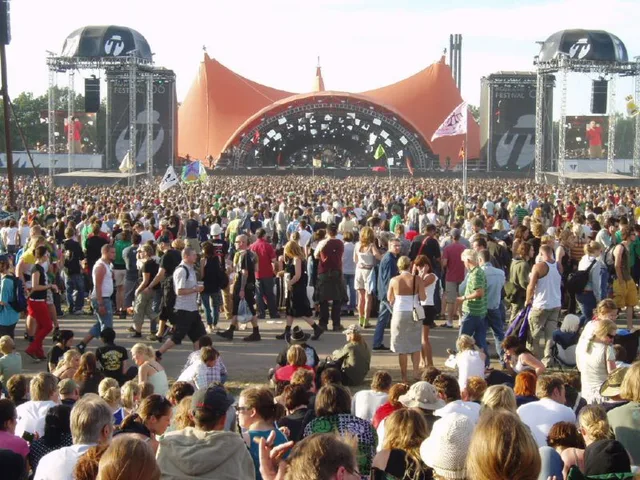
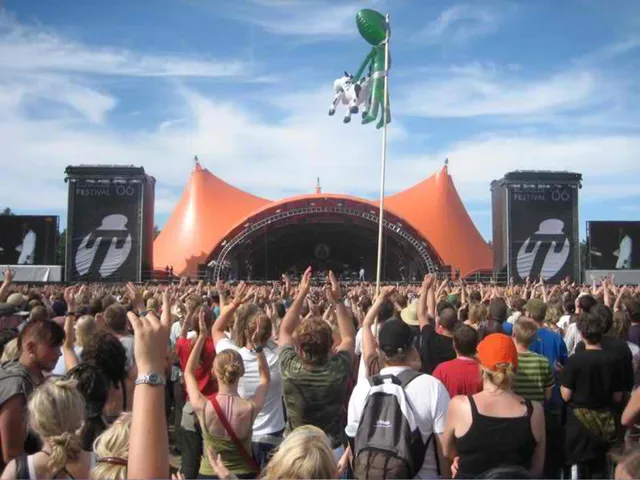
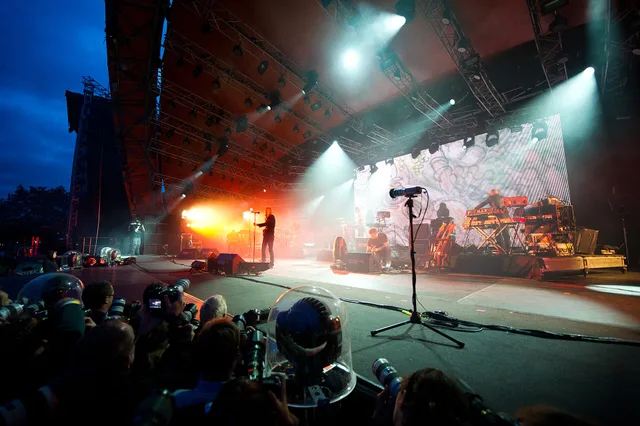
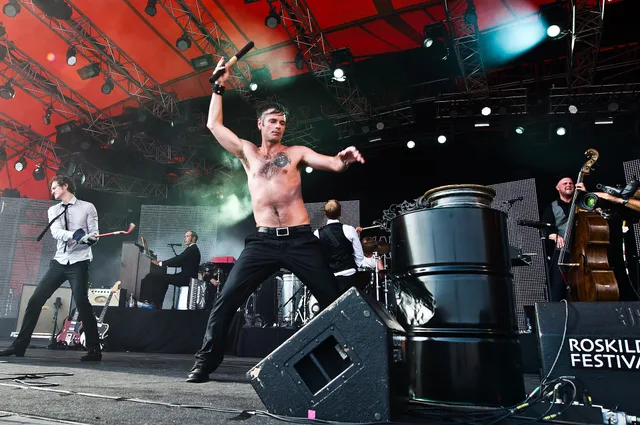
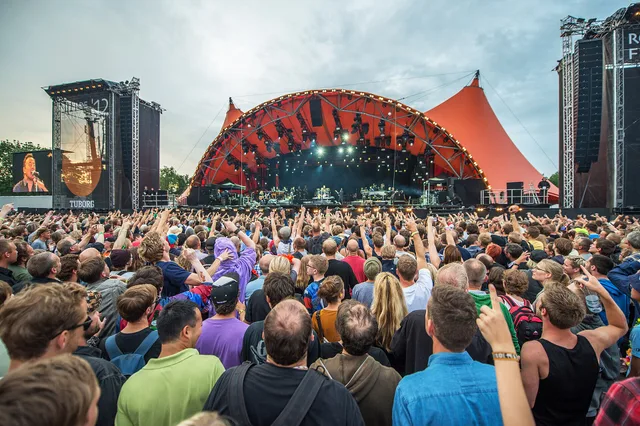
Director Leif Skov found an orange canopy in an English warehouse and bought it for DKK 150,000. Built for the Rolling Stones’ 1976 European tour, the structure had outlived its owner’s financial trouble. Official Roskilde accounts agree it arrived in 1978 and hosted Bob Marley and Elvis Costello; they differ on whether “Canopy Stage” was already its formal name or became official in 1980. “Orange Stage” is securely dated to 1986. Roskilde maintains rich official photography and stage histories, supplemented by Danish media archives, posters and organisational documents. “Official archive” does not automatically mean free commercial reuse. The images on this page are later licensed views of the Orange Stage and festival site, clearly captioned as institutional afterlife rather than 1970s documentation. Their purpose is to show what the 1978 purchase became while the source list carries the historical evidence. Permanence emerged from governance, charitable purpose, volunteer labour, site routines and a material symbol acquired second-hand. None of those elements alone guaranteed survival. Together they allowed Roskilde to absorb changing music and audience scale without rebuilding its legitimacy from zero each year. The orange canopy is a perfect metaphor: an abandoned touring structure became iconic not through novelty, but because a community repeatedly assembled, maintained and remembered it. By 1979 Roskilde was fundamentally different from the 1971 Sound Festival. It had a durable Northern European identity, a non-profit purpose, experienced volunteers and a stage that would become one of festival culture’s strongest symbols. The decade shows how countercultural openness could be institutionalised without simply becoming conventional. Roskilde’s later scale rests on those 1970s choices about who owned the event, what its surplus served and how knowledge returned each summer.


Follow the festival beyond the field
Timeline
Related genres
Related band guides
More routes will be connected as the archive grows.
Explore by sound
Essential listening
Sources and further reading
- Jump on a time travel through the stagesRoskilde Festival · accessed 23 July 2026
- New main stage: Orange Stage historyRoskilde Festival · accessed 23 July 2026
- Our historyRoskilde Festival Group · accessed 23 July 2026
- Festival with a purposeRoskilde Festival · accessed 23 July 2026
- Orange History timelineOrange History · accessed 23 July 2026
Image credits5 licensed images
The Orange Stage in 2006. This later image documents the durable tent form introduced to Roskilde in 1978, not a 1970s edition — Torstein Haldorsen from The beautifull city of Trondheim, Norway, The Royal Bananarepublic of Bømmelulu, Norway — Wikimedia Commons — CC BY 2.0 · source record · CC BY 2.0
Converted to WebP and resized; no generative or compositional alterations.
A later view of the Roskilde site, used to show the long-term institution that grew from the 1971 student experiment — Halfdanj at English Wikipedia — Wikimedia Commons — Public domain · source record · Public domain
Converted to WebP and resized; no generative or compositional alterations.
The Orange Stage during a later festival. Its structure is the historical subject; the performance shown is not from the 1970s — Bill Ebbesen — Wikimedia Commons — CC BY-SA 3.0 · source record · CC BY-SA 3.0
Converted to WebP and resized; no generative or compositional alterations.
A later Orange Stage view that helps explain how the 1978 “Orange One” became Roskilde’s visual emblem — Bill Ebbesen — Wikimedia Commons — CC BY-SA 3.0 · source record · CC BY-SA 3.0
Converted to WebP and resized; no generative or compositional alterations.
A later crowd at the Orange Stage, used as institutional afterlife rather than evidence for a specific 1970s audience — Bill Ebbesen — Wikimedia Commons — CC BY-SA 3.0 · source record · CC BY-SA 3.0
Converted to WebP and resized; no generative or compositional alterations.