
.jpg)
Why Reading matters
Reading's festival history is a story of migration and adaptation rather than sudden invention. The National Jazz Festival began at Richmond in 1961, added blues to its identity and moved through several sites before reaching Reading in 1971. By then, amplified rock had transformed the programme, audience and technical requirements. The old name carried institutional memory even as the sound beneath it changed.
The seventies established Reading as a recurring British rock gathering with a particularly strong relationship to progressive, blues and hard-rock audiences. It also exposed that audience to change. By the decade's end, punk and new wave acts could appear on bills once dominated by long-form musicianship and guitar virtuosity. The festival became a public negotiation over what rock now included.
.jpg)
The National Jazz Festival lineage
Harold Pendleton, associated with London's Marquee Club, founded the National Jazz Festival in 1961. Its changing title—first adding blues, later rock—records more than marketing. British popular music was reorganising itself around electrified rhythm-and-blues groups, album audiences and increasingly powerful amplification. A festival that remained limited to a narrow jazz definition would have ignored the scene forming around its own stages.
That transition did not mean jazz vanished in one clean break. Musicians, audiences and organising networks overlapped. Blues remained a shared root, while progressive and fusion groups carried jazz harmony, improvisation and instrumental discipline into louder formats. Reading inherited this mixed ancestry even when press coverage simplified it as a rock festival.
Arrival at Reading in 1971
Reading Museum's research shows that the festival's arrival was connected to the town's 1971 Festival of Arts and anniversary celebrations. Little John's Farm offered a site beside the Thames with transport advantages and room for a large outdoor audience. What began partly through local opportunity became the event's lasting home.
The first Reading edition had to establish practical relations with residents, council services, police, traders and the existing arts programme. A festival is never only imported onto empty land. It enters a local calendar and leaves traffic, noise, spending, rubbish, memory and argument behind. Reading's later identity as a festival town grew from repeated negotiation over those effects.
.jpg)
Progressive rock in a festival setting
During the early and middle seventies, artists associated with progressive rock and its borders found a receptive Reading audience. Genesis, Yes, Focus, Hawkwind, Gong and other groups brought different combinations of theatrical presentation, long-form composition, improvisation and electronic texture. Their appearances should be checked edition by edition rather than blended into one imaginary super-bill.
The festival setting changed how this music worked. A carefully sequenced album side could not depend on studio silence. Daylight reduced lighting effects; wind and crowd noise altered quiet sections; shared staging limited setup time. At the same time, repetition, strong themes and large dynamic arcs could communicate across distance. Reading tested which parts of progressive craft survived exposure to a field.
Blues and hard-rock authority
Rory Gallagher became closely associated with Reading through performances whose directness suited the event. Status Quo, Thin Lizzy and other hard-rock acts could build momentum through rhythmic clarity and visible physical effort. Heavy music was not a crude opposite to progressive sophistication. Many performers crossed the border, using extended arrangements, twin guitars, keyboards or improvisation inside a harder attack.
This overlap gave Reading a recognisable identity without making every year identical. The audience expected volume and instrumental command, but the form of that command changed. A blues guitarist, a space-rock collective and a tightly structured hard-rock group could all make sense on the same stage because each offered a different answer to scale.

The 1975 archive
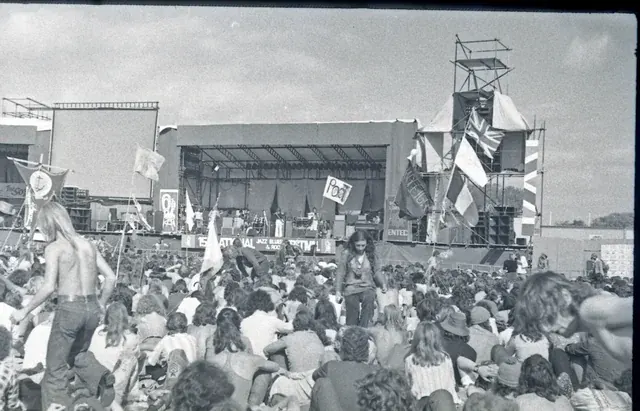
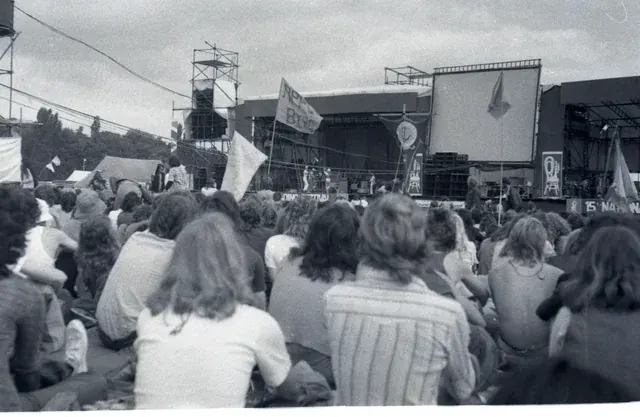
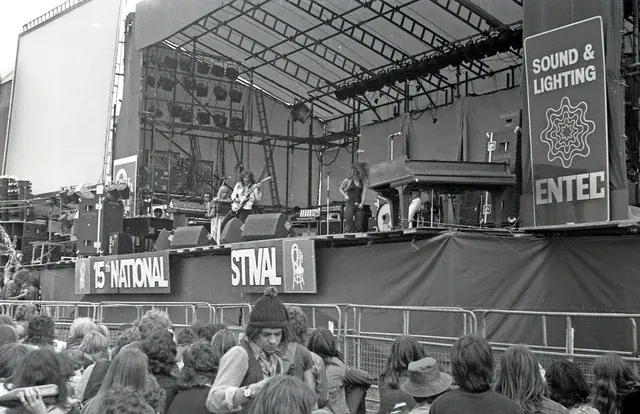
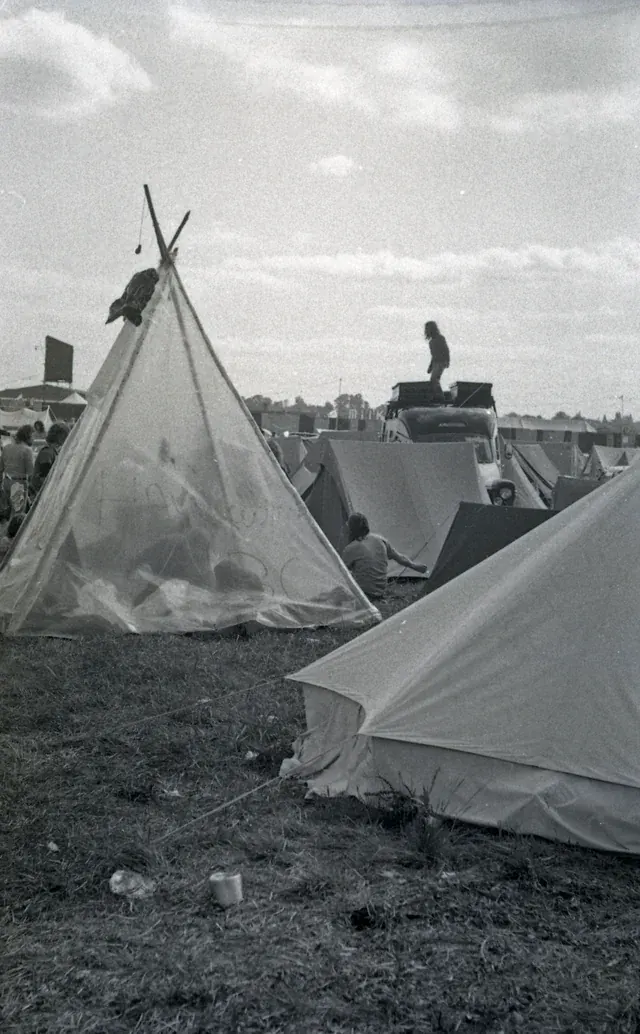
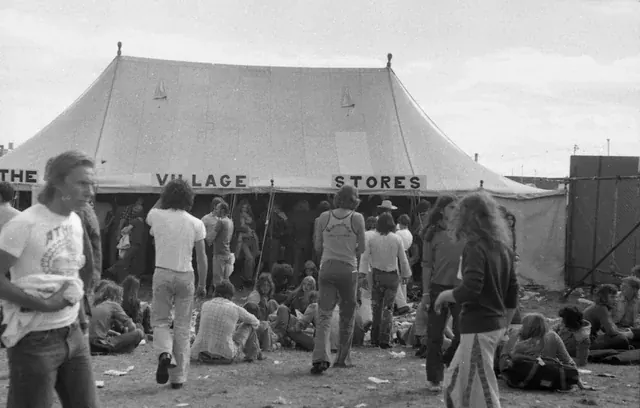
David Major's reusable photographs from 1975 are unusually valuable because they look beyond headline portraits. They show the stage at crowd level, temporary shops, tents and the visual clutter of flags and structures. Babe Ruth appears as one identifiable performance, but the larger set documents how an audience inhabited the site.
One Commons description incorrectly labels a file in the 1975 category as 1974, a reminder that archival metadata deserves independent confirmation rather than blind repetition. RetroForge uses only images whose subject and licence can be described responsibly. When a caption cannot establish an exact performer or date, a general description is more accurate than a guess.
Audience and temporary town
A recurring festival creates its own practical culture. People learn routes, meeting points and informal expectations. Traders return. Camping equipment and clothing respond to remembered weather. Local residents develop strategies for avoidance, participation or commerce. These patterns rarely appear in line-up histories, yet they are the difference between a one-off crowd and an institution.
The site also contained inequalities of access and experience. A photographer near the stage did not see what a late arrival at the back saw. Some visitors camped for days; others attended selectively. Safety, sanitation and food were experienced according to location and resources. “The Reading audience” is therefore useful shorthand, not one collective witness.

Punk and new wave enter the programme
Late-seventies bills brought the Jam, Patti Smith Group, the Police, Sham 69 and other newer acts into contact with a festival culture often identified with older rock forms. The reception was not uniformly welcoming. Genre change at a recurring event can become a conflict over ownership: audiences who helped establish the festival may treat programming evolution as betrayal, while younger listeners see the existing bill as closed.
Reading's willingness to absorb some of that disruption helped it survive beyond the progressive and hard-rock peak. The change was uneven rather than revolutionary. Established guitar music remained, and punk itself was already diversifying. What mattered was the breach in expectation. The festival could no longer define relevance entirely through the early-seventies album hierarchy.
Sound, stage and professionalisation
Across the decade, outdoor sound systems, stage roofing, power distribution and lighting became more standardised. Reading benefited from recurrence: suppliers and organisers could refine a known site instead of solving every problem from zero. Professionalisation did not produce perfect sound, but it made technical responsibility more visible and repeatable.
Shared stages still imposed limits. Equipment-heavy progressive groups required keyboards, amplification and careful line checks; hard-rock bands brought increasing stage volume; weather threatened electrical systems and schedules. The festival became a machine for resolving these competing needs quickly enough that an audience still perceived continuity.
Legacy
Reading continued through later shifts into metal, alternative rock, indie, dance and contemporary pop, eventually adding a linked Leeds event. Its longevity can make the seventies appear merely introductory. In fact, that decade established the site, annual expectation and capacity for stylistic argument on which later versions depended.
The most useful legacy is not a claim that Reading belonged to one genre. It is the opposite. A jazz festival became a jazz-and-blues festival, then a rock institution, then a place where the definition of rock was repeatedly contested. Its identity was durable because it could change without pretending it had never changed before.
The archive is therefore best read as a sequence of negotiations rather than a hall of fame. Each programme balances inherited audience expectations against the need to recognise a changing present. Some decisions now look visionary, others dated, and many made practical sense only within that year’s touring economy. The continuity lies in the argument itself.
Follow the festival beyond the field
Timeline
Related genres
Related band guides
Explore by sound
Essential listening
RetroForge Echo
Hear a Fictional Archive Response
These modern RetroForge releases echo part of the festival’s musical vocabulary; they are not historical festival recordings.
Sources and further reading
- The 1971 Reading Festival: For the First TimeReading Museum · accessed 23 July 2026
- Reading Festival’s 50th anniversary exhibitionReading Borough Council · accessed 23 July 2026
- Reading Festival collectionsReading Museum · accessed 23 July 2026
- Reading in 1971: the town of the first Reading FestivalReading Museum · accessed 23 July 2026
- 1970s British jazz contextNational Jazz Archive · accessed 23 July 2026
Image credits5 licensed images
Reading Festival in 1975, when the National Jazz, Blues and Rock Festival had developed a strong progressive, blues and hard-rock identity — David Major — Wikimedia Commons — CC BY 2.0 · source record · CC BY 2.0
Converted to WebP and resized; no generative or compositional alterations.
Festivalgoers at Reading in 1975 — David Major — Wikimedia Commons — CC BY 2.0 · source record · CC BY 2.0
Converted to WebP and resized; no generative or compositional alterations.
Babe Ruth at Reading in 1975, one performance within a programme spanning blues-derived rock, progressive music and harder forms — David Major — Wikimedia Commons — CC BY 2.0 · source record · CC BY 2.0
Converted to WebP and resized; no generative or compositional alterations.
Hawkwind's transparent tent at Reading in 1975: a glimpse of the visual culture and improvised architecture around the main performances — David Major — Wikimedia Commons — CC BY 2.0 · source record · CC BY 2.0
Converted to WebP and resized; no generative or compositional alterations.
The Village Stores at Reading in 1975 — David Major — Wikimedia Commons — CC BY 2.0 · source record · CC BY 2.0
Converted to WebP and resized; no generative or compositional alterations.