
Overview
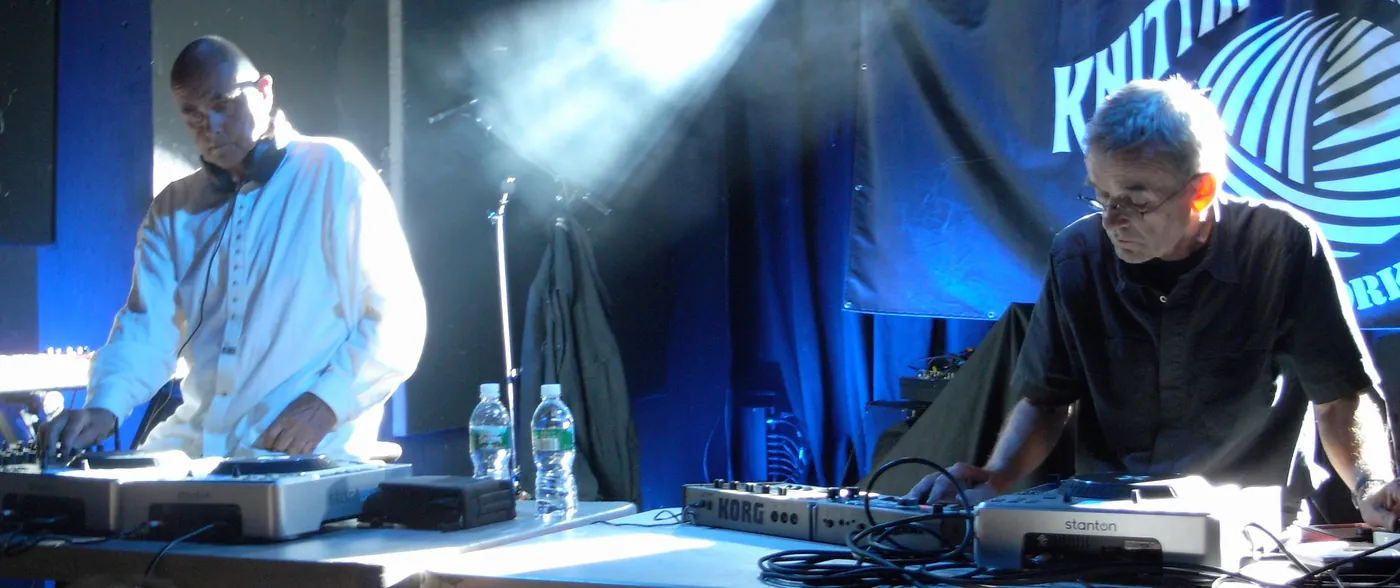
Cluster was the electronic duo of Hans-Joachim Roedelius and Dieter Moebius. Its roots lie in Kluster, the West Berlin trio they formed with Conrad Schnitzler in 1969. After Schnitzler's departure, the change from K to C marked both a new two-person identity and a new recorded partnership with producer and engineer Conny Plank.
The catalogue changes method without following a simple path from difficult to easy. Cluster transforms organs, strings, electrical generators and amplified objects into three untitled studio environments. Zuckerzeit separates ten short pieces by author and gives analogue rhythm machines a central role. Sowiesoso then makes repetition quieter and more spacious without abandoning irregular movement.
Formation & History
Roedelius and Schnitzler helped establish Berlin's Zodiak Free Arts Lab before Kluster took shape with Moebius in 1969. The trio recorded Klopfzeichen and Zwei-Osterei with Plank, using improvised instruments and live electronics. Schnitzler left after the Kluster period; Moebius and Roedelius continued as Cluster, recording the self-titled debut in January 1971 at Star-Studio in Hamburg. Plank's electronic treatment and production were part of the record's construction, not merely its documentation.
Cluster II followed on Brain in 1972. The pair then moved from Berlin to Forst on the river Weser. Michael Rother joined them there to form Harmonia in 1973, while Cluster acquired its own recording equipment. Rother co-produced Zuckerzeit; Sowiesoso was recorded by Moebius and Roedelius alone in their modest home studio and mixed by Plank.
Brian Eno's work with the Forst musicians came after Sowiesoso. Cluster & Eno appeared in 1977, followed in 1978 by After the Heat, credited to Eno, Moebius and Roedelius. After Curiosum in 1981 the duo concentrated on other projects, returning with Apropos Cluster in 1990 and later live and studio releases. Their final studio album under the Cluster name was Qua, first released in 2009; Moebius died in 2015.
Sound & Style
The 1971 debut obscures its sources through amplification, echo and studio processing. Organ, cello, Hawaiian guitar, alarms and electrical generators lose their familiar identities as attack, pitch and distance continually shift. Cluster II divides that open field into six named pieces: guitar, organ and low electronic tones become more recognisable, but no conventional drummer or bass line stabilises them.
The move to Forst changed both equipment and working practice. On Zuckerzeit, Roedelius and Moebius each composed five tracks; analogue rhythm machines, triggered synthesizers and hand-played patterns turn their contrasting personalities into interleaved electronic miniatures. Sowiesoso uses a four-track machine, two stereo tape decks and a simple mixer to build seven longer shared pieces from electronic and acoustic elements. The later Eno collaborations add another set of players and production decisions; they should not be treated as the template for everything Cluster recorded.
Essential Albums
Cluster II
1972Six named pieces replace the debut's three untitled spans. Moebius and Roedelius are the performing duo, while Plank produces and engineers the electronic field. Long-form "Im Süden" and the partly live "Live in der Fabrik" sit beside the compact "Für die Katz'" and "Nabitte", making scale itself part of the album's design.
Key tracks: Plas · Für die Katz' · Nabitte
Open album guide → View on Amazon →Zuckerzeit
1974Ten short tracks alternate five Roedelius compositions with five by Moebius. Their new Forst equipment makes separate construction possible, analogue rhythm machines provide a crooked pulse, and co-producer Michael Rother helps shape the transition from diffuse electronic fields to concise miniatures.
Key tracks: Hollywood · Fotschi Tong · Heiße Lippen
Open album guide → View on Amazon →Sowiesoso
1976Recorded by Roedelius and Moebius without guests in their Forst home studio, then mixed by Conny Plank. Seven shared compositions use limited equipment to balance cyclical melody, acoustic detail and understated rhythm. The full-length title track is important because some later CD editions shortened it.
Key tracks: Sowiesoso · Umleitung · In Ewigkeit
Open album guide → View on Amazon →Affiliate note: Amazon links on this page may earn RetroForge Records a small commission, at no extra cost to you.
Deeper Cuts
Cluster
1971The first record under the Cluster spelling: three untitled pieces assembled from organs, cello, Hawaiian guitar, alarms, amplifiers and electrical sound generators. Plank's processing makes the studio an active compositional tool.
Open album guide → View on Amazon →Cluster & Eno
1977The first album credited jointly to Cluster and Brian Eno. Recorded at Conny Plank's studio with Eno, Moebius and Roedelius joined by guests including Holger Czukay and Asmus Tietchens, it expands the Forst language through additional instruments and players.
Open album guide → View on Amazon →After the Heat
1978Credited to Brian Eno, Dieter Moebius and Hans-Joachim Roedelius—not to Eno and Roedelius alone. Its ten pieces include instrumentals and several vocal tracks, extending the collaboration beyond the quieter surfaces often associated with these musicians.
Open album guide → View on Amazon →Why They Still Matter
Cluster's catalogue documents several workable models for electronic composition. The early records turn performance and processing into one inseparable act; Zuckerzeit shows how short forms and rhythm machines can remain irregular and personal; Sowiesoso demonstrates that reduced equipment can support subtle variation rather than simple repetition.
The duo also sits at a junction between projects rather than at the head of one neat genre family. Kluster connects them to West Berlin's experimental culture, Harmonia brings Michael Rother into the Forst studio, and the Eno albums place their methods inside a broader collaborative setting. Those documented exchanges explain Cluster's historical importance more clearly than sweeping claims that every later ambient, industrial or synth-pop record descends directly from them.
Sources & Further Reading
Bureau B — Cluster — official-label essays on Zuckerzeit, Sowiesoso, the Forst studio and album chronology.
Bureau B — Kluster: Eruption reissue notes — the trio, Schnitzler's departure and the continuation as Cluster.
Grönland Records — Hans-Joachim Roedelius — Berlin background, Kluster formation and the transition to Cluster.
Grönland Records — Conny Plank — Plank's long-running creative role with Kluster, Cluster and related projects.
Connected archive routes
Explore This Band
Continue through the RetroForge knowledge graph
Curated paths into the people, records, events and ideas that give this subject its wider musical context.