

Overview
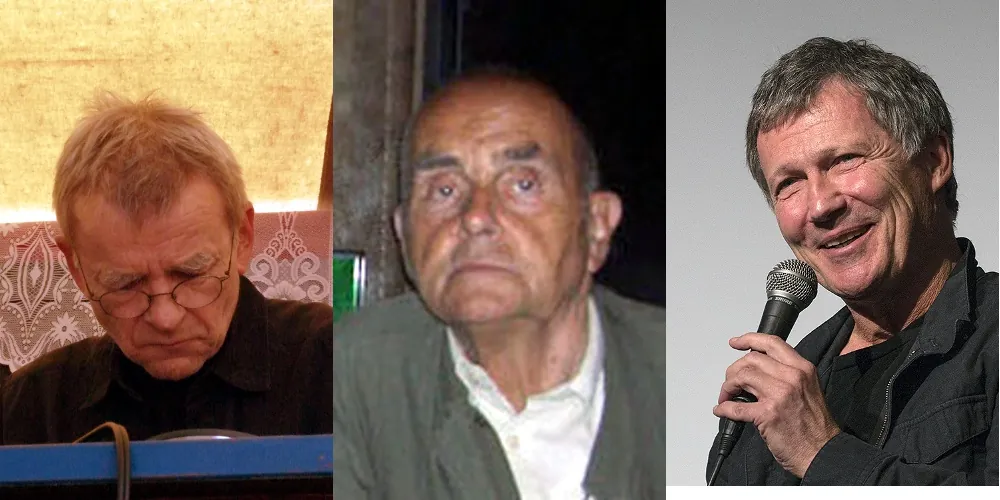
Harmonia joined Michael Rother of Neu! with Hans-Joachim Roedelius and Dieter Moebius of Cluster in the Lower Saxon village of Forst. The trio released only two studio albums during its original existence, but those records established a distinct meeting point between melodic guitar, early drum machines, keyboards and electronic sound.
Brian Eno later called Harmonia the world's most important rock group. The remark is often repeated because it captures the contrast between the group's small contemporary audience and its later reputation. The useful evidence lies in the recordings themselves: Musik von Harmonia and Deluxe solve the balance between pulse, melody and abstraction in different ways, while the 1974 live tape and 1976 Eno sessions reveal how open the method remained.
Formation & History
In 1973 Rother travelled to Forst, where Roedelius and Moebius had established Cluster's rural base and recording space. Instead of simply extending Neu! or Cluster, the three formed Harmonia. They recorded Musik von Harmonia at Harmonia Studio from June to November 1973; Brain released it in January 1974. A surviving concert tape from Penny Station in Griessem on 23 May 1974 later became Live 1974.
Deluxe was recorded in June 1975 at the Forst studio with Conny Plank's mobile equipment and mixed the following month at his studio. Harmonia and Plank shared the production credit, and Mani Neumeier of Guru Guru played acoustic drums. Joint plans ended in 1976 as all three musicians developed other work. Brian Eno then arrived in late summer, temporarily bringing the trio back together for sessions recorded in September. Selections appeared in 1997 as Tracks and Traces.
Roedelius, Moebius and Rother reunited at Berlin's Worldtronics festival on 27 November 2007, their first concert together in roughly thirty years. Further appearances followed in 2008 and 2009. Moebius died in 2015; the archival sequence later expanded through the Complete Works set and Documents 1975.
Sound & Style
Harmonia did not use one fixed version of the motorik beat. Electronic percussion can click, shuffle or hold a steady grid while Rother's guitar supplies repeated melodic figures rather than conventional rock riffs. Roedelius and Moebius divide organ, piano and synthesizer parts into contrasting layers: one instrument may provide a warm chord sequence while another introduces noise, abrupt tones or a deliberately unstable pattern.
On Musik von Harmonia, the trio worked without an outside producer, using limitation as part of the sound; pieces such as “Watussi” and “Dino” build momentum from economical patterns, while “Sehr kosmisch” and “Hausmusik” leave wider spaces. Deluxe has greater weight and definition from Plank's engineering and Neumeier's drumming. Its title track also introduces group vocals, making the contrast with the largely instrumental debut immediately audible.
Essential Albums
Musik von Harmonia
1974 (recorded 1973)Recorded in Forst from June to November 1973 and produced by the trio, the debut moves between compact rhythmic pieces and more spacious electronic studies. “Watussi” locks guitar, keyboards and electronic percussion into a bright opening pattern; “Ohrwurm” tests repetition at a smaller scale; “Hausmusik” closes with a gentler domestic drift. The eight tracks make the improvised studio method feel composed without sanding away its irregular edges.
Key tracks: Watussi · Ohrwurm · Hausmusik
Open album guide → View on Amazon →Deluxe
1975Recorded with Conny Plank's mobile equipment and jointly produced by Harmonia and Plank, Deluxe gives the trio a broader, more physical sound. Mani Neumeier's acoustic drums strengthen “Deluxe (Immer wieder)” and “Monza (Rauf und runter),” while vocals and Rother's sustained guitar make the title piece unusually direct. “Notre Dame” and “Kekse” retain the quieter, stranger side of the Forst studio.
Key tracks: Deluxe (Immer wieder) · Notre Dame · Kekse
Open album guide → View on Amazon →Live 1974
released 2007Recorded at Penny Station in Griessem on 23 May 1974, this archival release contains five pieces absent from the two contemporary studio albums. “Schaumburg” establishes a mechanical live pulse, the seventeen-minute “Veteranissimo” stretches repetition into collective improvisation, and “Arabesque” offers the set's most concise turn. “Holta-Polta” and “Über Ottenstein” show how much space the trio could create without studio overdubbing.
Key tracks: Schaumburg · Veteranissimo · Arabesque · Über Ottenstein
Open album guide → View on Amazon →Affiliate note: Amazon links on this page may earn RetroForge Records a small commission, at no extra cost to you.
Deeper Cuts
Tracks and Traces
1997 (recorded 1976)Recorded with Brian Eno at Harmonia Studio in September 1976, after the trio's regular plans had ended. The 1997 edition assembled part of the surviving four-track material; a revised 2009 edition added “Welcome,” “Atmosphere” and “Aubade” and changed the sequence. It is best heard as a document of a temporary studio reunion, not as a third album completed for release in the 1970s.
Open album guide → View on Amazon →Why They Still Matter
Harmonia's importance is clearest in the way the two studio albums refuse an easy division between rock band and electronic studio project. Guitar remains central without demanding a soloist's role; drum machines organise time without making the music rigid; synthesizers can supply melody, atmosphere or disruption. That working balance became easier to recognise as electronic pop, ambient music and post-rock developed their own vocabularies.
The later archive has also changed how the group can be understood. Live 1974 disproves the idea that Harmonia's precision depended entirely on studio assembly, while Documents 1975 preserves both concert material and stages in the development of Deluxe. The 1976 Eno recordings place an influential admirer inside the Forst process rather than treating his praise as a substitute for listening to the band.
Connected archive routes
Explore This Band
Sources & Further Reading
Continue through the RetroForge knowledge graph
Curated paths into the people, records, events and ideas that give this subject its wider musical context.