
Overview
Jethro Tull began as a blues-rooted quartet and became one of British rock's most changeable long-running groups. Ian Anderson's voice, flute, acoustic guitar and writing remained the centre, but the music was shaped just as decisively by changing ensembles: Mick Abrahams and Clive Bunker on the debut, Martin Barre's electric guitar from Stand Up onward, and the John Evan, Jeffrey Hammond and Barriemore Barlow lineup that recorded the early-1970s concept works.
The catalogue does not follow one progressive-rock formula. It moves through the concise hard rock and folk of Stand Up and Aqualung, the continuous compositions of Thick as a Brick and A Passion Play, the arranged acoustic-electric contrasts of Minstrel in the Gallery, the rural trilogy beginning with Songs from the Wood, and the synthesizer-heavy reset of A.
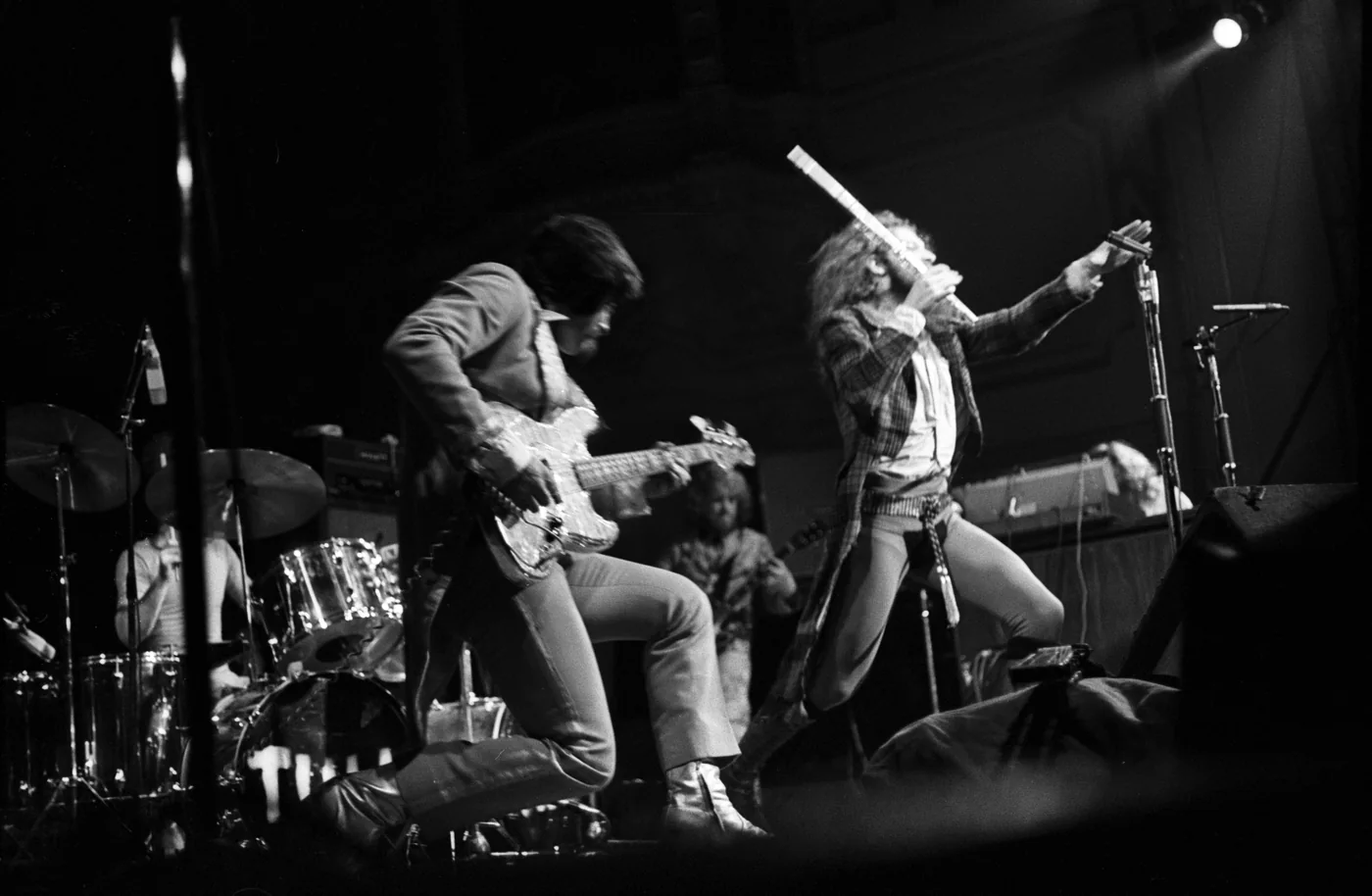
Formation & History
Jethro Tull formed from two regional bands in late 1967. Ian Anderson and bassist Glenn Cornick came from the Blackpool-rooted John Evan Band; guitarist Mick Abrahams and drummer Clive Bunker came from Luton group McGregor's Engine. The quartet secured a Marquee Club residency in London in March 1968 and recorded the blues-oriented This Was. Abrahams left in November 1968, and Martin Barre joined in time for Stand Up in 1969.
The personnel kept changing as the arrangements expanded. Cornick left after Benefit; Jeffrey Hammond replaced him for Aqualung, while Bunker departed after that album and Barriemore Barlow took over the drums. With keyboardist John Evan, that Anderson-Barre-Hammond-Barlow-Evan lineup made Thick as a Brick, A Passion Play, War Child and Minstrel in the Gallery. John Glascock and arranger-keyboardist Dee Palmer then joined the late-1970s ensemble heard across Songs from the Wood, Heavy Horses and Stormwatch.
A marked a hard personnel and sonic reset in 1980, retaining Anderson and Barre while bringing in Dave Pegg, Mark Craney and Eddie Jobson. Barre remained until the previous band era ended in 2011. Anderson later resumed recording and touring under the Jethro Tull name with another lineup; The Zealot Gene (2022), RökFlöte (2023) and Curious Ruminant (2025) extend the studio catalogue, while the group remains active onstage.
Sound & Style
Anderson uses the flute as a lead, rhythmic and percussive instrument, often punctuating lines with breath and vocalized attacks. Barre's sustained guitar tones and hard-edged riffs answer it rather than merely accompany it; acoustic guitar, organ, piano, bass and drums continually shift the balance between chamber-like detail and heavy rock. The strongest lineups could change metre, texture and volume without losing the shape of a song.
The records document that development clearly. This Was keeps close to British blues; Stand Up and Aqualung broaden the palette with acoustic writing and composed arrangements. Thick as a Brick turns recurring themes into one LP-length piece, while A Passion Play is denser and more theatrical. Minstrel in the Gallery places strings and acoustic passages against Barre's guitar, the late-1970s trilogy foregrounds folk forms and rural subjects, and A and Under Wraps make synthesizers and electronic rhythm part of the band's language.
Essential Albums
Aqualung
1971The album's two original LP sides were headed Aqualung and My God, linking portraits of marginal lives with Anderson's attack on organized religion. That structure encouraged the concept-album label, although Anderson has repeatedly rejected it. John Evan joined as a full member, Jeffrey Hammond made his first Tull album, and Clive Bunker made his last; the lineup gives "Cross-Eyed Mary," "My God" and "Locomotive Breath" distinctly different weights.
Key tracks: Aqualung · Cross-Eyed Mary · My God · Locomotive Breath
Open album guide → View on Amazon →Thick as a Brick
1972A single continuous composition split by the physical sides of the LP, performed by the 1972 Anderson-Barre-Evan-Hammond-Barlow lineup. Themes return in altered metres and arrangements instead of behaving like separate tracks. The elaborate St. Cleve Chronicle newspaper sleeve attributes the poem to fictional schoolboy Gerald Bostock, turning the package into part of the album's satire.
Key tracks: Thick as a Brick, Part 1 · Thick as a Brick, Part 2
Open album guide → View on Amazon →The final studio album with bassist Jeffrey Hammond sets close-miked acoustic writing against Barre's heaviest guitar passages and orchestral parts arranged by Dee Palmer. The title track moves from a staged acoustic opening into a full-band attack; "Requiem" and "Grace" are miniatures, while "Baker St. Muse" occupies most of the second side as a linked suite.
Key tracks: Minstrel in the Gallery · Requiem · Grace
Open album guide → View on Amazon →Affiliate note: Amazon links on this page may earn RetroForge Records a small commission, at no extra cost to you.
Deeper Cuts
A Passion Play
1973A second LP-length composition, assembled at Morgan Studios after the band abandoned earlier sessions at the Château d'Hérouville. Its dense recurring motifs, soprano saxophone, keyboards and theatrical narration are interrupted midway by "The Story of the Hare Who Lost His Spectacles."
Open album guide → View on Amazon →Songs from the Wood
1977The first studio album with Dee Palmer credited as a full member opens the band's late-1970s folk-rock trilogy. Layered vocal rounds, mandolin, acoustic guitar and whistles coexist with the electric rhythm section on "Songs from the Wood," "Jack-in-the-Green" and "Hunting Girl."
Open album guide → View on Amazon →Heavy Horses
1978The middle record of the folk-rock trilogy turns from woodland celebration toward working animals and threatened rural labour. "No Lullaby" gives the band room to stretch, Darryl Way adds violin to the title track, and "Moths" and "Weathercock" keep the acoustic detail intact.
Open album guide → View on Amazon →Why They Still Matter
Jethro Tull's importance lies in how completely the band integrated an unlikely lead instrument with rock composition. The flute was not a novelty placed over a conventional backing group: its articulation altered riffs, vocal phrasing and ensemble rhythm. The albums also demonstrate that progressive rock could be concise or continuous, acoustic or amplified, satirical or pastoral without surrendering a recognizable musical identity.
The history remains active rather than sealed in the 1970s. Anderson's current Jethro Tull lineup tours and has issued three studio albums since 2022, most recently Curious Ruminant in 2025. That continuity does not erase the different historical ensembles; it makes the catalogue easier to hear as a sequence of deliberate reinventions built around one enduring writer and performer.
Sources & Further Reading
Jethro Tull official biography — formation, early albums and career overview.
Jethro Tull official musicians archive — current and former personnel.
Jethro Tull official discography — album chronology and recent releases.
Official Mick Abrahams profile and official Martin Barre profile — original quartet and guitar succession.
Connected archive routes