
Overview
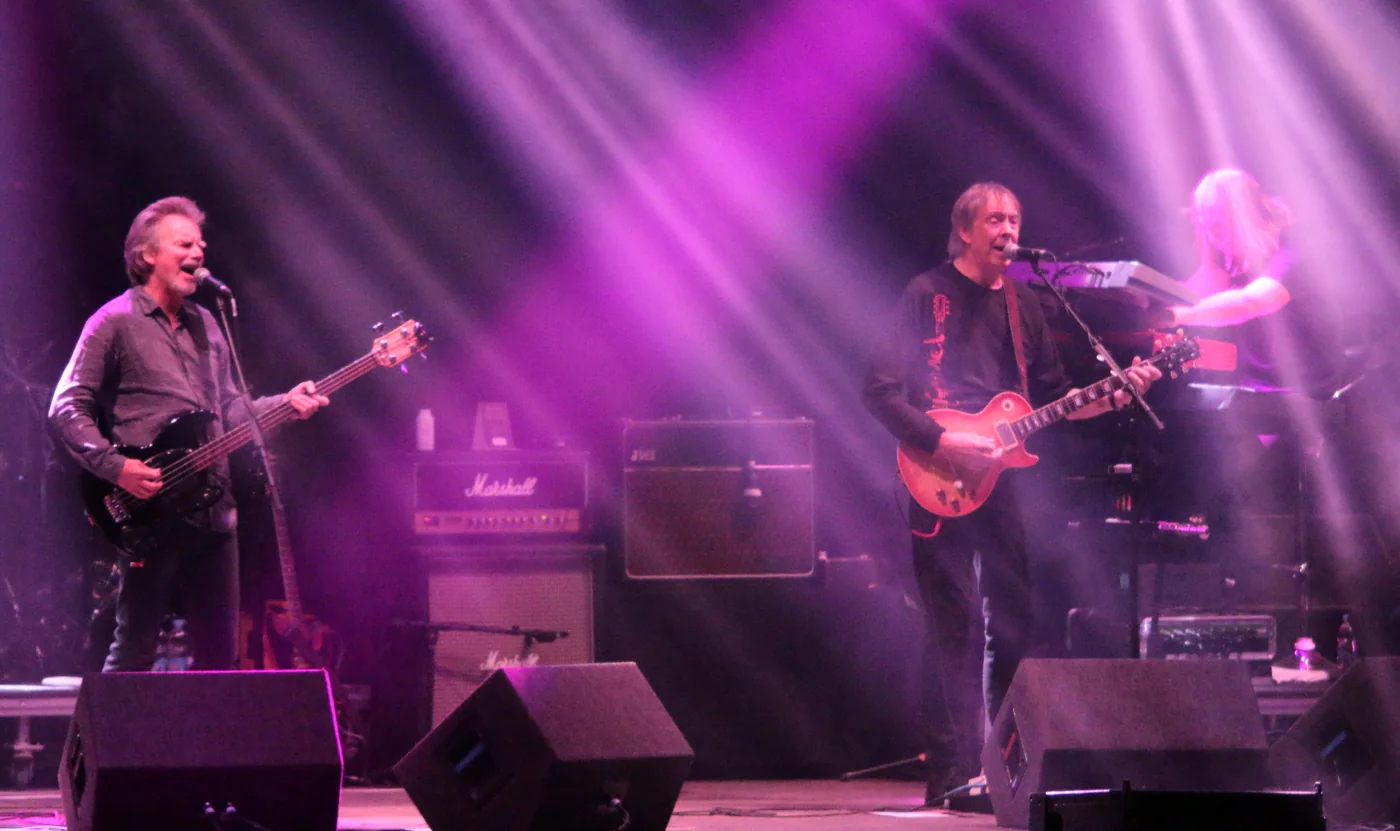
Camel built progressive rock around melody and instrumental conversation. Andrew Latimer's guitar and flute supply long, singing lines; Peter Bardens's organ, piano and synthesisers answer with harmony and texture; Doug Ferguson and Andy Ward give the classic quartet a firm rhythmic centre. The result can be gentle without being slight: the arrangements move through odd metres, recurring themes and extended forms while keeping a clear melodic thread.
The sequence from Mirage through Moonmadness captures the original quartet at its strongest. Later records changed personnel and emphasis—toward jazzier ensemble writing on Rain Dances, compact songs on Breathless, and narrative albums such as Nude—but Latimer's phrasing remained the identifying voice.
Formation & History
Latimer, Ferguson and Ward first worked together as the Brew and backed singer-songwriter Phillip Goodhand-Tait before keyboardist Peter Bardens joined them in 1971. Renamed Camel, the quartet played its first advertised concert under that name at Waltham Forest Technical College on 4 December 1971, supporting Wishbone Ash. The self-titled debut followed in 1973; Mirage in 1974 then established the longer pieces and guitar-keyboard dialogue most associated with the band.
For Music Inspired by The Snow Goose, Camel translated Paul Gallico's novella into a fully instrumental suite. The group performed it with the London Symphony Orchestra at a sold-out Royal Albert Hall on 17 October 1975. Moonmadness returned vocals to the foreground in 1976 and became the last studio album by the founding quartet.
Mel Collins expanded the concert and studio palette with reeds, while Richard Sinclair replaced Ferguson for Rain Dances and Breathless. Bardens left in 1978; Colin Bass and Kit Watkins joined the changing late-1970s lineup. After Andy Ward became unable to continue in 1981, Latimer increasingly carried the name through guest-heavy projects such as The Single Factor and Stationary Traveller. Camel returned on Latimer's independent Camel Productions label with Dust and Dreams in 1991, followed by Harbour of Tears, Rajaz and A Nod and a Wink.
Sound & Style
Latimer often treats the electric guitar as a sustained melodic voice rather than a source of dense riffing. His flute provides a lighter counterpart, heard especially clearly in pieces such as “Supertwister” and “Air Born.” Bardens moves between Hammond organ, acoustic piano, Mellotron and synthesisers; on the classic records, the contrast between his chordal colour and Latimer's single-note lines creates much of the drama.
Ward's drumming can pivot from a restrained pulse to quick metric accents without making the music feel mechanical, while Ferguson's bass leaves room for the upper instruments. The Snow Goose demonstrates how the quartet could develop short motifs across an album-length sequence; Moonmadness places those skills inside seven separate songs and instrumentals. With Sinclair and Collins, Rain Dances introduces a more explicit jazz and Canterbury flavour through fretless bass, saxophone and flute.
Essential Albums
The Snow Goose
1975An entirely instrumental concept album based on Paul Gallico's novella. Short recurring themes connect “The Great Marsh,” “Rhayader,” “Flight of the Snow Goose” and the closing reprise, allowing the quartet to tell the story through changes in instrumentation, tempo and dynamics rather than sung narration.
Key tracks: The Great Marsh · The Snow Goose · Migration
Open album guide → View on Amazon →Moonmadness
1976The founding quartet's final studio album combines concise vocal writing with extended instrumental development. “Song Within a Song” moves from flute-led calm to a synthesiser-driven second half, “Air Born” balances piano and flute against heavier guitar, and “Lunar Sea” closes with a spacious, rhythmically mobile instrumental.
Key tracks: Aristillus · Spirit of the Water · Lunar Sea
Open album guide → View on Amazon →Mirage
1974Five tracks define the early Camel language. “Freefall” supplies the compact vocal opening; “Supertwister” foregrounds Latimer's flute; the Tolkien-inspired “Nimrodel / The Procession / The White Rider” and the twelve-minute “Lady Fantasy” show how Bardens and Latimer exchange themes across long, carefully paced forms.
Key tracks: Freefall · Nimrodel / The Procession / The White Rider · Lady Fantasy: Encounter / Smiles for You / Lady Fantasy
Open album guide → View on Amazon →Affiliate note: Amazon links on this page may earn RetroForge Records a small commission, at no extra cost to you.
Deeper Cuts
Rain Dances
1977Richard Sinclair's bass and vocals and Mel Collins's saxophones and flute alter the balance of the band. “First Light” opens instrumentally, “Unevensong” compresses shifting metres into a song, and “One of These Days I'll Get an Early Night” gives the expanded lineup room for a jazzier ensemble performance.
Open album guide → View on Amazon →Nude
1981A narrative album inspired by the story of a Japanese soldier who remains on an island long after the Second World War. Mostly instrumental transitions connect songs such as “City Life,” “Drafted,” “Lies” and “The Homecoming,” making the record read as one continuous journey rather than a loose song collection.
Open album guide → View on Amazon →Rajaz
1999Released by Camel Productions, Rajaz builds its long pieces around spacious rhythms and Latimer's sustained guitar. “Three Wishes,” “Sahara” and the title track revisit Camel's melodic patience without attempting to reproduce the founding quartet's exact sound.
Open album guide → View on Amazon →Why They Still Matter
Camel's catalogue demonstrates that complexity does not require constant display. The strongest records make recurring themes, instrumental tone and pacing carry the structure; listeners can follow the melody first and discover the formal detail later. That approach gives Mirage, The Snow Goose and Moonmadness distinct identities instead of reducing them to interchangeable examples of 1970s progressive rock.
Latimer also created an independent route for the later catalogue through Camel Productions. The 1990s and early-2000s albums therefore belong to a separate, artist-led chapter rather than a continuous run of major-label releases. After recovering from a serious blood disorder and a bone-marrow transplant, he returned Camel to the stage in 2013 with a complete performance of The Snow Goose; the comeback connected the later touring band to the founding quartet without pretending the intervening decades had not changed the group.
Sources & Further Reading
The formation, first concert, album chronology, The Snow Goose title dispute and 1975 Royal Albert Hall performance were checked against Camel Productions' official 1964–1981 timeline.
Broader catalogue and personnel context was cross-checked with the Universal Music artist biography and Camel Productions. Album labels refer to the original UK issues; Janus handled contemporary US editions.
Connected archive routes
Explore This Band
Continue through the RetroForge knowledge graph
Curated paths into the people, records, events and ideas that give this subject its wider musical context.
Sounds and instruments
- Hammond Organ
- Mellotron