

Overview
Genesis did not follow one straight path. The group moved from the tentative pop of From Genesis to Revelation to long-form progressive rock, survived the departures of Peter Gabriel and Steve Hackett, and then reshaped its writing for the three-person studio unit of Tony Banks, Phil Collins and Mike Rutherford. Across those phases, arrangement remained central: songs grow through changes of texture, metre, viewpoint and scale rather than through instrumental display alone.
The early records join English character writing to organ, Mellotron, twelve-string guitars and sharply controlled rhythm. Later albums retain that concern with structure while making more room for drum machines, synthesizers and concise songs. Treating the catalogue as simply “Gabriel prog” followed by “Collins pop” misses how gradually those working methods changed.
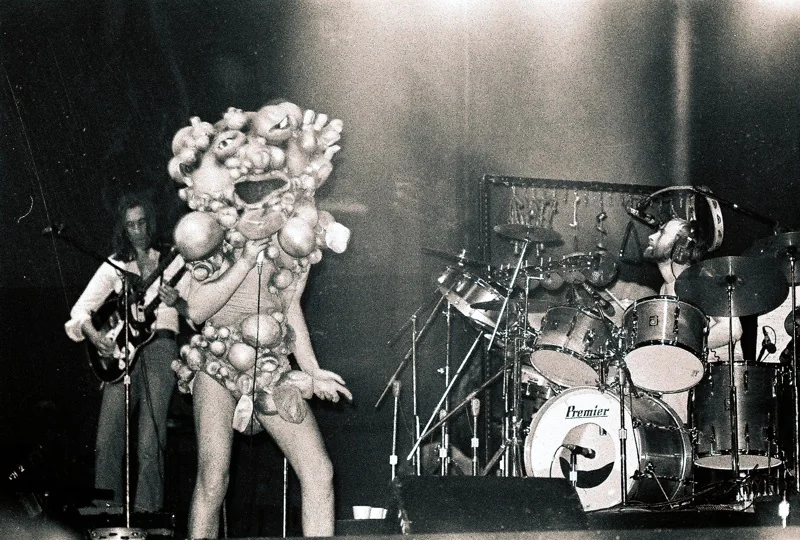
Formation & History
Genesis began at Charterhouse School in Surrey in 1967. Peter Gabriel, Tony Banks and drummer Chris Stewart had played in Garden Wall; Mike Rutherford and Anthony Phillips came from Anon. Their demos attracted producer Jonathan King, who proposed the name Genesis and produced the 1969 debut From Genesis to Revelation. Stewart was succeeded by John Silver and then John Mayhew during the group’s first years.
Trespass followed in 1970 with Gabriel, Banks, Rutherford, Phillips and Mayhew. Phillips left after the album, and the rhythm and guitar positions changed again: Phil Collins joined in August 1970, while Steve Hackett arrived in January 1971 after a brief period with guitarist Mick Barnard. That created the five-piece heard from Nursery Cryme through The Lamb Lies Down on Broadway.
Gabriel left after the 1975 Lamb tour. Collins took the lead-vocal role on A Trick of the Tail and Wind & Wuthering while remaining the studio drummer. Hackett’s departure was announced in 1977, leaving Banks, Collins and Rutherford as the permanent recording trio; Daryl Stuermer and Chester Thompson expanded that lineup on stage.
The trio’s run from ...And Then There Were Three... through We Can’t Dance joined longer instrumental thinking to increasingly direct singles. Collins left in 1996. Banks and Rutherford recruited Ray Wilson for Calling All Stations and its 1998 European tour, then confirmed in 2000 that there were no further recording or touring plans. Collins, Banks and Rutherford later reunited for the 2006–2007 Turn It On Again tour and the 2020–2022 Last Domino? tour.
Sound & Style
Tony Banks supplies many of the group’s harmonic centres through piano, organ, Mellotron and synthesizer. Mike Rutherford moves between bass, twelve-string acoustic guitar and electric guitar, often making the transition between quiet interludes and full-band passages possible. In the classic five-piece, Hackett adds sustained electric lines, volume swells and nylon-string detail; Gabriel’s voice, flute and character writing carry the theatrical layer without replacing the music underneath it.
Collins changes the ensemble twice: first as a drummer and harmony singer whose precise accents clarify irregular metres, then as a lead vocalist able to carry both extended pieces and shorter songs. On Duke, Abacab and later trio records, gated drums, drum machines and brighter synthesizer colours alter the surface, but recurring motifs and carefully staged transitions still connect the writing to the earlier catalogue.
Essential Albums
The eight-track album places the compact single I Know What I Like (In Your Wardrobe) beside the piano-led architecture of Firth of Fifth, the linked sections of The Cinema Show and the crowded character writing of The Battle of Epping Forest. Phil Collins sings lead on More Fool Me, while Aisle of Plenty returns to material from the opening track. It reached number three on the UK album chart.
Key tracks: Dancing With the Moonlit Knight · Firth of Fifth · The Cinema Show
Open album guide → View on Amazon →This 23-track double album follows Rael through a transformed New York of chambers, creatures and doubles. Gabriel developed the story and lyrics while the band built the music, producing a sequence of short transitions, recurring motifs and larger set pieces rather than one uninterrupted suite. It was the final Genesis studio album with Gabriel and reached number ten in the UK.
Key tracks: The Lamb Lies Down on Broadway · Lilywhite Lilith · it.
Open album guide → View on Amazon →Nursery Cryme
1971Recorded at Trident Studios with producer John Anthony, this is the first Genesis studio album with both Collins and Hackett. The Musical Box and The Return of the Giant Hogweed establish the new lineup’s range between exposed twelve-string passages, organ, bass pedals and abrupt full-band climaxes; Collins takes a brief lead vocal on For Absent Friends.
Key tracks: The Musical Box · Seven Stones · The Return of the Giant Hogweed
Open album guide → View on Amazon →Affiliate note: Amazon links on this page may earn RetroForge Records a small commission, at no extra cost to you.
Deeper Cuts
Foxtrot
1972The six-track album opens with the Mellotron weight of Watcher of the Skies, clears space for Hackett’s acoustic miniature Horizons, then gives the second side to the roughly 23-minute, seven-part Supper’s Ready. Recorded at Island Studios with producer David Hitchcock, it became Genesis’ first clear UK album-chart breakthrough, peaking at number twelve.
Open album guide → View on Amazon →Wind and Wuthering
1976Genesis’ second studio album with Collins as lead singer is also Hackett’s last with the group. Banks’ long keyboard forms dominate One for the Vine, while Unquiet Slumbers for the Sleepers... and ...In That Quiet Earth lead directly into Afterglow. Produced by Genesis and David Hentschel, it reached number seven in the UK.
Open album guide → View on Amazon →Duke
1980The trio’s 1980 album surrounds direct songs such as Turn It On Again, Duchess and Misunderstanding with the recurring “Duke” material that opens with Behind the Lines and returns in Duke’s Travels and Duke’s End. The combination of drum-machine pulse, large keyboards and instrumental reprise helped make it Genesis’ first UK number-one album.
Open album guide → View on Amazon →Why They Still Matter
Genesis matter because the catalogue documents adaptation without a complete break in method. The five-piece made album-side structures legible through recurring themes and sharply contrasted instrumentation; the quartet proved that Collins could sing the material without surrendering its complexity; the trio learned to compress the same attention to rhythm and arrangement into singles as well as extended tracks.
The UK chart sequence makes that development measurable: Foxtrot reached number twelve, Selling England by the Pound number three, Wind & Wuthering number seven and Duke number one. Those are different records made by different configurations of the band, not interchangeable examples of one style. Listening across them reveals continuity in Banks’ harmony, Rutherford’s structural guitar and bass work, and Collins’ rhythmic control even as the format changes.
Sources & Further Reading
Genesis — official website
Rhino — Genesis biography and lineup history
Rhino — lineup chronology
Official Charts — Genesis chart history
Connected archive routes
Explore This Band
Continue through the RetroForge knowledge graph
Curated paths into the people, records, events and ideas that give this subject its wider musical context.
Sounds and instruments
- Mellotron