

Overview
Yes built progressive rock from interlocking rather than subordinate parts. Jon Anderson's high lead voice and layered harmonies could carry long melodies above Chris Squire's foregrounded bass, while guitar and keyboards exchanged accompaniment, counterpoint and solo roles. The best-known 1971–72 lineup—Anderson, Squire, Steve Howe, Rick Wakeman and Bill Bruford—lasted for only two studio albums, but its ensemble method survived decades of personnel changes.
Formation & History
Jon Anderson and Chris Squire met at London's La Chasse club in 1968 and formed Yes with guitarist Peter Banks, keyboardist Tony Kaye and drummer Bill Bruford. That lineup recorded Yes (1969) and Time and a Word (1970). Steve Howe replaced Banks before The Yes Album (1971); Rick Wakeman then replaced Kaye for Fragile. The Anderson–Squire–Howe–Wakeman–Bruford lineup recorded Fragile and Close to the Edge, after which Bruford joined King Crimson and Alan White took over the drum seat.
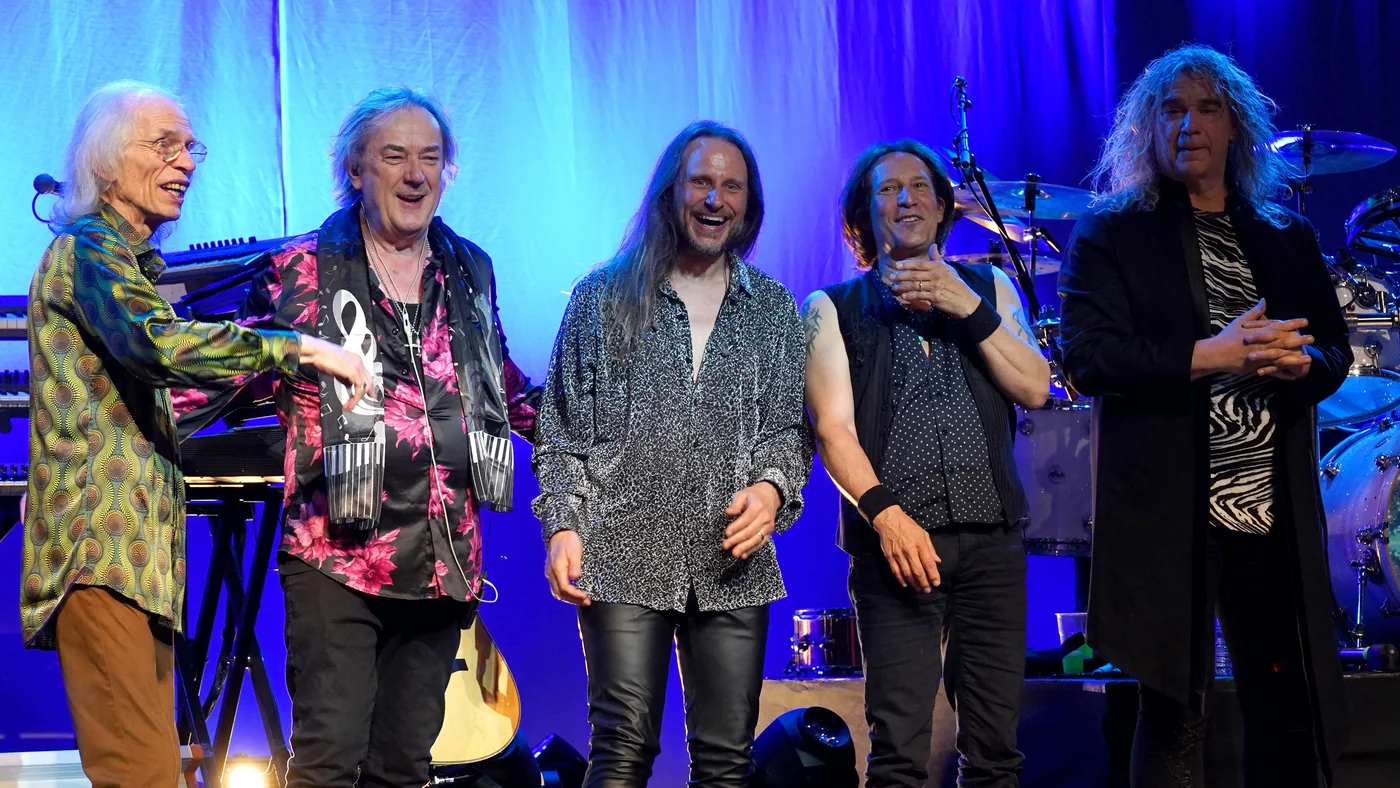
Wakeman left after Tales from Topographic Oceans; Patrick Moraz played keyboards on Relayer, and Wakeman returned for Going for the One. Anderson and Wakeman were absent from Drama (1980), replaced by Trevor Horn and Geoff Downes. Yes dissolved in 1981, returned in 1983 with Anderson, Squire, White, Kaye and guitarist Trevor Rabin, and found a new commercial audience with 90125. Later decades included parallel lineups, further reunions and many personnel changes. Squire died in 2015 and White in 2022. The current group comprises Howe, Downes, Jon Davison, Billy Sherwood and Jay Schellen.
Sound & Style
Yes arrange by continually redistributing musical function. Squire's picked Rickenbacker bass often states a countermelody instead of merely reinforcing the root; Bruford's sharply articulated accents or White's broader drive can reorganise the same ensemble from below. Howe moves among electric, acoustic and steel guitars, while the keyboard chair has changed the palette repeatedly: Kaye's Hammond focus, Wakeman's piano, organ, Mellotron and synthesisers, Moraz's denser electric-keyboard language, and Downes's modern keyboard layers do not produce interchangeable versions of the band.
The voices are equally structural. Anderson's lead sits inside stacked harmonies from Squire and Howe, and lyrics frequently work through sound, image and association rather than linear narrative. Longer pieces grow by returning to transformed themes: “Close to the Edge” moves through sharply differentiated sections before its opening environment returns, while “The Gates of Delirium” spends most of a vinyl side moving from preparation through conflict to the quiet “Soon” coda. Complexity in Yes is therefore not simply a high note count; it is the management of contrast over time.
Essential Albums
Close to the Edge
1972The final studio album by the Anderson–Squire–Howe–Wakeman–Bruford lineup contains only three compositions. The title piece fills side one and moves from environmental sound and a densely layered opening through vocal, organ-led and recurring ensemble sections. Side two pairs the multi-part acoustic-to-symphonic rise of “And You and I” with the compact, riff-driven “Siberian Khatru.” Bruford left after the recording, making the album both a culmination and the end of this particular rhythmic design.
Key tracks: Close to the Edge: I. The Solid Time of Change / II. Total Mass Retain / III. I Get Up I Get Down / IV. Seasons of Man · And You and I: I. Cord of Life / II. Eclipse / III. The Preacher the Teacher / IV. Apocalypse · Siberian Khatru
Open album guide → View on Amazon →Fragile
1971Rick Wakeman's first Yes album alternates four full-band pieces with five shorter individual showcases. “Roundabout” introduces the lineup through acoustic harmonics, Squire's bass pattern, Hammond organ and stacked vocals; “South Side of the Sky” places a hard ensemble section against a quieter piano centre; “Heart of the Sunrise” repeatedly changes scale and intensity. The solo pieces are not outtakes: they expose each musician's vocabulary and make the return of the whole group more legible.
Key tracks: Roundabout · South Side of the Sky · Heart of the Sunrise
Open album guide → View on Amazon →Relayer
1974Patrick Moraz replaces Wakeman on the only studio album by this five-piece lineup. “The Gates of Delirium” occupies side one, building from sung exposition into a long, percussive battle passage before resolving into the quiet “Soon” section. “Sound Chaser” compresses rapid ensemble exchanges, Moraz's keyboards and Howe's guitar into a more volatile form; “To Be Over” closes with a broader melodic arc. Alan White is now fully embedded in the writing rather than reproducing Bruford's role.
Key tracks: The Gates of Delirium · Sound Chaser · To Be Over
Open album guide → View on Amazon →Affiliate note: Amazon links on this page may earn RetroForge Records a small commission, at no extra cost to you.
Deeper Cuts
Going for the One
1977Wakeman returns to a five-song album recorded in Switzerland with Alan White on drums. The title track is concise and guitar-led, “Turn of the Century” unfolds as a carefully staged narrative, and “Awaken” expands across the closing side with church organ recorded at St Martin in Vevey. The sequence joins shorter forms to one of the band's major late-1970s long pieces.
Open album guide → View on Amazon →Four compositions occupy the four sides of this double album. Anderson and Howe developed its structure from a passage in Paramahansa Yogananda's Autobiography of a Yogi; the full band then shaped “The Revealing Science of God,” “The Remembering,” “The Ancient” and “Ritual.” Its scale and repetition make it demanding, while the quieter stretches reveal a different use of space from Close to the Edge. Wakeman departed after the ensuing tour.
Open album guide → View on Amazon →Drama
1980Trevor Horn and Geoff Downes joined Howe, Squire and White after Anderson and Wakeman left. The result is not simply “Yes with the Buggles”: “Machine Messiah” and “Does It Really Happen?” use the established rhythm section and Howe's guitar in a heavier, more angular setting, while “Into the Lens” and “Tempus Fugit” show Horn and Downes contributing new writing and production instincts. This lineup made one studio album before Yes dissolved in 1981.
Open album guide → View on Amazon →Why They Still Matter
Yes matter because the catalogue preserves several workable definitions of the same band. The early records turn psychedelic and folk-rock material into more elaborate arrangements; the 1971–74 sequence tests different keyboardists and drummers inside long-form writing; Drama changes the singers and keyboard language; 90125 rebuilds the name around concise studio rock without removing Squire's bass or the layered vocals.
The history did not end with the most celebrated lineup. Howe, Downes, Davison, Sherwood and Schellen remain an active recording and touring group, and the official band site announced its twenty-fourth studio album Aurora in 2026. That continuity does not make every incarnation identical. It makes lineup, arrangement and authorship central questions in how the Yes catalogue should be heard.
Connected archive routes
Explore This Band
Sources & Further Reading
Continue through the RetroForge knowledge graph
Curated paths into the people, records, events and ideas that give this subject its wider musical context.
Sounds and instruments
- Hammond Organ