

Overview
Gentle Giant released eleven studio albums between 1970 and 1980, plus the official live double album Playing the Fool. Their catalogue joins rock weight to counterpoint, multipart singing and an unusually broad instrumental palette. A single arrangement can pass material between voice, violin, vibraphone, recorder, keyboards, bass and guitar without treating those changes as decoration.
The group’s history divides into clear working phases: an original six-piece with Martin Smith, the one-album Malcolm Mortimore lineup, the heavier John Weathers sextet on Octopus, and the five-piece that continued after Phil Shulman left. Later records simplified some surfaces, but the change was gradual rather than a sudden abandonment of the band’s earlier method.
Formation & History
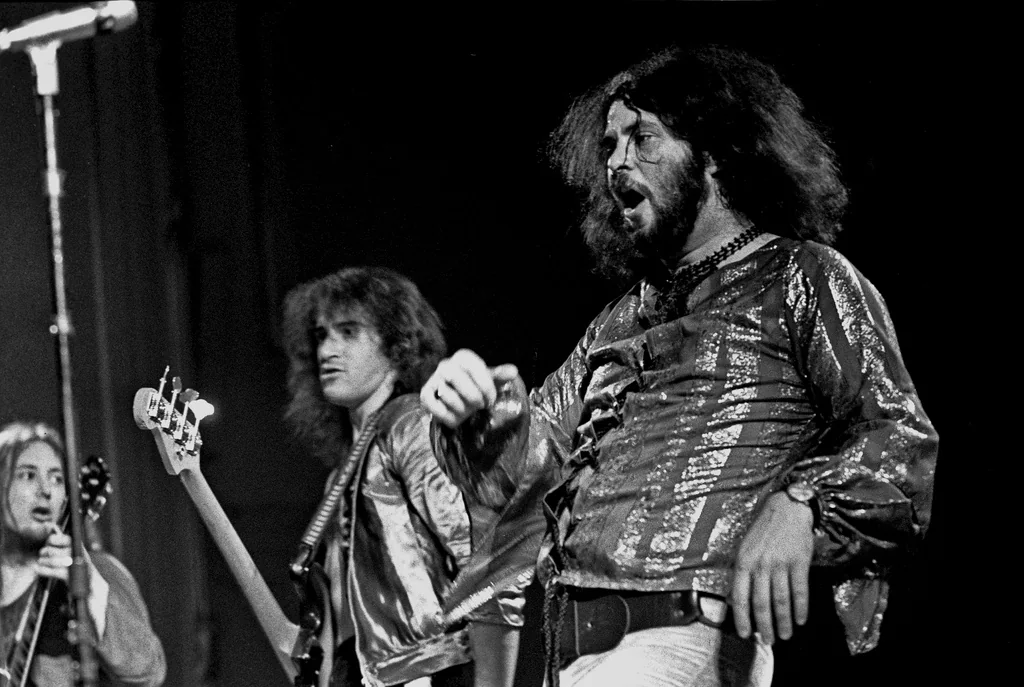
Phil, Derek and Ray Shulman had recorded and toured as Simon Dupree and the Big Sound, whose 1967 single Kites reached the UK Top 10. After that group ended in late 1969, the brothers formed Gentle Giant in February 1970. Former Simon Dupree drummer Martin Smith joined them, while Royal Academy of Music graduate Kerry Minnear and guitarist Gary Green completed the original six-piece.
Tony Visconti produced Gentle Giant and Acquiring the Taste. Smith left after the second album and Malcolm Mortimore played on Three Friends. A motorcycle accident prevented Mortimore from touring, so John Weathers joined in 1972 and became the permanent drummer. He first appeared on a Gentle Giant studio album with Octopus.
Phil Shulman left after Octopus, choosing family life over continued touring. Derek Shulman, Ray Shulman, Minnear, Green and Weathers made the next eight albums as a stable five-piece, beginning with In a Glass House. The band moved from WWA to Chrysalis for Free Hand in 1975 and documented its stage arrangements on Playing the Fool, recorded during the 1976 European tour.
The Missing Piece, Giant for a Day and Civilian placed increasing emphasis on shorter rock songs. During preparations for the 1980 Civilian tour, Minnear and Derek Shulman decided to leave; the group fulfilled its remaining dates and then ended. No full Gentle Giant reunion followed, although archival releases, remixes and limited collaborations have continued.
Sound & Style
Counterpoint is central, especially when independent vocal or instrumental lines remain individually clear while forming a larger pattern. Knots makes that audible through staggered voices; On Reflection opens as a vocal fugue before the same material is redistributed through the ensemble. Hocket-like exchanges appear within this broader contrapuntal language, but they are one device among many rather than the explanation for every arrangement.
Minnear moves among keyboards, vibraphone, cello and voice; Ray Shulman links bass to violin and guitar; Green adds electric force as well as acoustic, mandolin and recorder colour. Derek and Phil Shulman expand the vocal and reed writing, while each drummer gives the shifting metres a different physical character. The result can move from chamber-sized detail to a hard-rock attack without changing personnel or abandoning the composition’s internal logic.
Essential Albums
Octopus
1972The fourth album introduces John Weathers on a Gentle Giant studio recording and is the last with Phil Shulman. Its eight separate mechanisms include the Rabelaisian character exchange of The Advent of Panurge, the contrapuntal voices of Knots, the instrumental relay of The Boys in the Band and Minnear’s exposed piano-led Think of Me With Kindness. Gentle Giant produced it at Advision, with Martin Rushent engineering.
Key tracks: The Advent of Panurge · The Boys in the Band · River
Open album guide → View on Amazon →Free Hand
1975Recorded at Advision in April 1975, the seven-track album was Gentle Giant’s first for Chrysalis. Stamped rhythm and coordinated handclaps introduce Just the Same; the title track turns release from an exploitative contract into angular ensemble motion; On Reflection begins with a vocal fugue; and His Last Voyage proves that the five-piece’s formal control can sustain restraint as well as speed.
Key tracks: Just the Same · Free Hand · Time to Kill
Open album guide → View on Amazon →This eight-part concept album examines power, public language and corruption without retelling one specific political scandal. Material from Proclamation returns in the closing Valedictory, now heavier and more absolute; Cogs in Cogs compresses the system into interlocking rhythmic parts. Gentle Giant recorded and produced it at Advision in 1973–1974.
Key tracks: Proclamation · Cogs in Cogs · Valedictory
Open album guide → View on Amazon →Affiliate note: Amazon links on this page may earn RetroForge Records a small commission, at no extra cost to you.
Deeper Cuts
Three Friends
1972The first complete Gentle Giant concept album follows three school friends into different adult lives: a road worker in Working All Day, an artist in Peel the Paint and a white-collar figure in Mister Class and Quality?. The six-track sequence moves from shared childhood to social separation, then joins the last two pieces without inventing a sentimental reunion. It is the only studio album with drummer Malcolm Mortimore.
Open album guide → View on Amazon →Interview
1976Recorded at Advision in February and March 1976, the seven-song album frames its material as a fictitious press interview. Spoken questions interrupt rather than turn the songs into one continuous plot: Interview examines public explanation, Give It Back uses reggae inflection, and the two-part I Lost My Head moves from an older acoustic register into forceful rock.
Open album guide → View on Amazon →In a Glass House
1973The first album after Phil Shulman’s departure redistributes the earlier sextet’s roles across five players. Recorded at Advision in July 1973, its six compositions use breaking glass, acoustic strings, violin and harder ensemble passages to explore enclosure and observation. The original LP was not released in the United States, although imported copies circulated.
Open album guide → View on Amazon →Why They Still Matter
Gentle Giant matter because their records make ensemble organisation audible. Complexity is not confined to long solos: it appears in who carries a syllable, how a bass line contradicts the metre, when a chamber instrument changes the scale, and how a theme returns with a different political or emotional meaning. The six albums highlighted here document three distinct lineups rather than one fixed formula.
The archive has remained active without pretending that the original band reunited. Official and band-endorsed releases have restored live recordings, issued surviving multitracks in new mixes and kept territorial artwork and edition history visible. That work gives listeners a clearer view of a catalogue whose detail was always dependent on the relationship between parts.
Sources & Further Reading
Gentle Giant — official band site
Gentle Giant Home Page — band history
Gentle Giant Home Page — original album discography
Gentle Giant Home Page — Civilian and the band’s final tour
Connected archive routes
Explore This Band
Continue through the RetroForge knowledge graph
Curated paths into the people, records, events and ideas that give this subject its wider musical context.