Univers Zero created prog with the atmosphere and discipline of twentieth-century chamber composition.
The Belgian ensemble removed nearly every comforting assumption attached to progressive rock. Daniel Denis used drums as a compositional engine inside music shaped by bassoon, oboe, violin, harmonium and piano. The result is frequently dark, but not dark as surface decoration: tension emerges from dissonant counterpoint, repeated cells, unstable meters and the physical sound of acoustic instruments pushed with rock intensity.
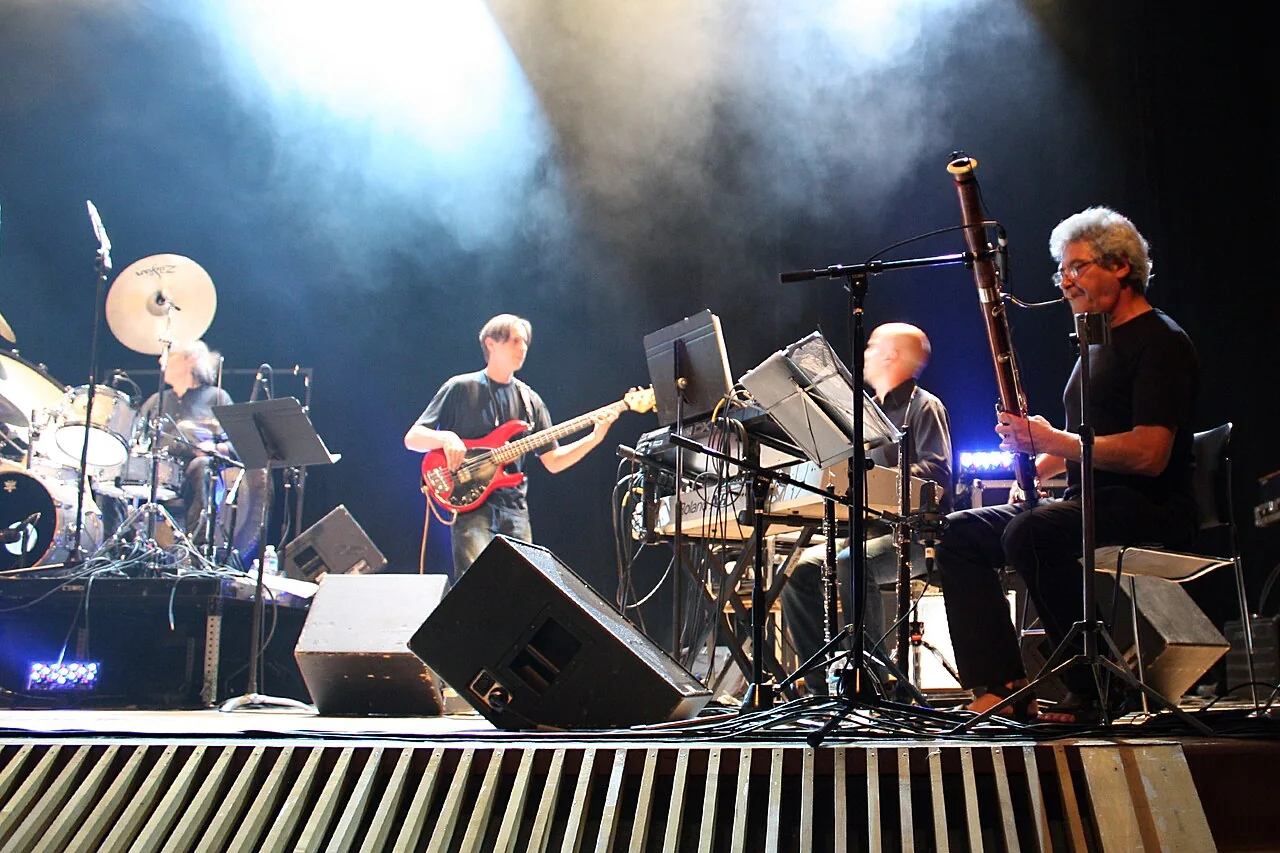
Univers Zero performing live.Photo: Hawkins from Washington DC / Wikimedia Commons · Licensed under CC BY 2.0. Converted to WebP for this page.
Formation & History
After Arkham ended, drummer Daniel Denis and trumpeter Claude Deron began a new Belgian ensemble under the name Necronomicon. Musicians including bassist Guy Segers and guitarist Roger Trigaux joined during the early development; as reeds, strings and harmonium displaced the brass-led plan, the group became Univers Zero.
The self-produced 1977 debut documented a seven-player acoustic lineup: Denis, Trigaux, Michel Berckmans, Marcel Dufrane, Christian Genet, Patrick Hanappier and Emmanuel Nicaise. In 1978 Univers Zero joined Henry Cow, Etron Fou Leloublan, Samla Mammas Manna and Stormy Six in the original Rock in Opposition network. Trigaux left after Hérésie and founded Present; keyboardist Andy Kirk then became important to the writing on Ceux du dehors and later records.
The group ceased activity in 1987. A one-off concert followed in 1997, and Denis and Berckmans resumed recording in 1998 for The Hard Quest, released the next year. A permanent live ensemble returned in 2004. Lineups and the acoustic-electric balance continued to change, while Lueur in 2024 confirmed that Univers Zero remained an active recording project.
Sound & Style
Bassoon, oboe, harmonium, violin, piano, bass and percussion build ritualistic tension through asymmetric repetition.
Denis writes percussion parts that lock into the composed argument instead of merely marking time. Berckmans's bassoon and oboe, Nicaise's harmonium and the strings give early records their dry, almost architectural sonority. Silence and low dynamics are crucial: a quiet repeated figure may create more pressure than a conventional climax. Later electric bass, guitar and synthesizer broaden the palette while preserving the music's severe internal discipline.
Essential Albums
1979
Hérésie
Atem · Original 1979 release
Hérésie is a three-part, forty-minute statement recorded at Sunrise Studio in Switzerland. Denis's side-long “La Faulx” sets drums and percussion against Berckmans's reeds, Hanappier's strings, Segers's bass and voices, while Trigaux moves among guitar, piano, organ and harmonium. “Jack the Ripper” and “Vous le saurez en temps voulu” divide the second side between Denis and Trigaux's writing. The sparse lineup makes every entrance consequential: weight comes from register, duration and repetition rather than a permanently dense arrangement.
Key tracks: La Faulx · Jack the Ripper · Vous le saurez en temps voulu
Ceux du dehors is the first studio album after Trigaux's departure and introduces Andy Kirk as a major keyboardist and composer. Its six pieces range from the twelve-minute “Dense” and “Combat” to the compact “Bonjour chez vous,” “La musique d'Erich Zann” and “La tête du corbeau.” Denis, Kirk, Guy Segers, Michel Berckmans and Patrick Hanappier are joined by Jean Lefebvre, Jean-Luc Aimé, Hona Chale and Thierry Zaboitzeff. The expanded personnel lets reeds, strings, keyboards and percussion change combinations from piece to piece instead of extending the deliberately restricted palette of Hérésie.
Key tracks: Dense · La corne du bois des pendus · Combat
The independently pressed debut originally carried only the band's name; its EF 1313 catalogue number supplied the title used by later editions. The original five-track programme runs from “Ronde” through “Complainte,” with Berckmans on bassoon, Dufrane and Hanappier on strings, Nicaise on harmonium and spinet, Trigaux on guitar, Genet on bass and Denis on percussion. Its passages of motion and open space contrast with the narrower severity of Hérésie. The live “La Faulx” heard on the 2008 reissue is a bonus track, not part of the 1977 running order.
Univers Zero made chamber rock a sustained compositional practice rather than a novelty defined by unusual instruments.
The importance is documented in the work itself: an original place in the 1978 RIO network, a sequence of early records that repeatedly altered personnel and instrumentation, and a revived catalogue that extends to Lueur in 2024. Denis's first-person account identifies Stravinsky and Bartók among his formative composers, but the records do not imitate concert music. They make percussion, acoustic timbre and amplified ensemble playing function inside one exacting language.
RetroForge Records publishes original music and independent editorial guides. This historical band guide is not affiliated with the artist, labels or rights holders. No unlicensed album artwork is reproduced.