

Overview
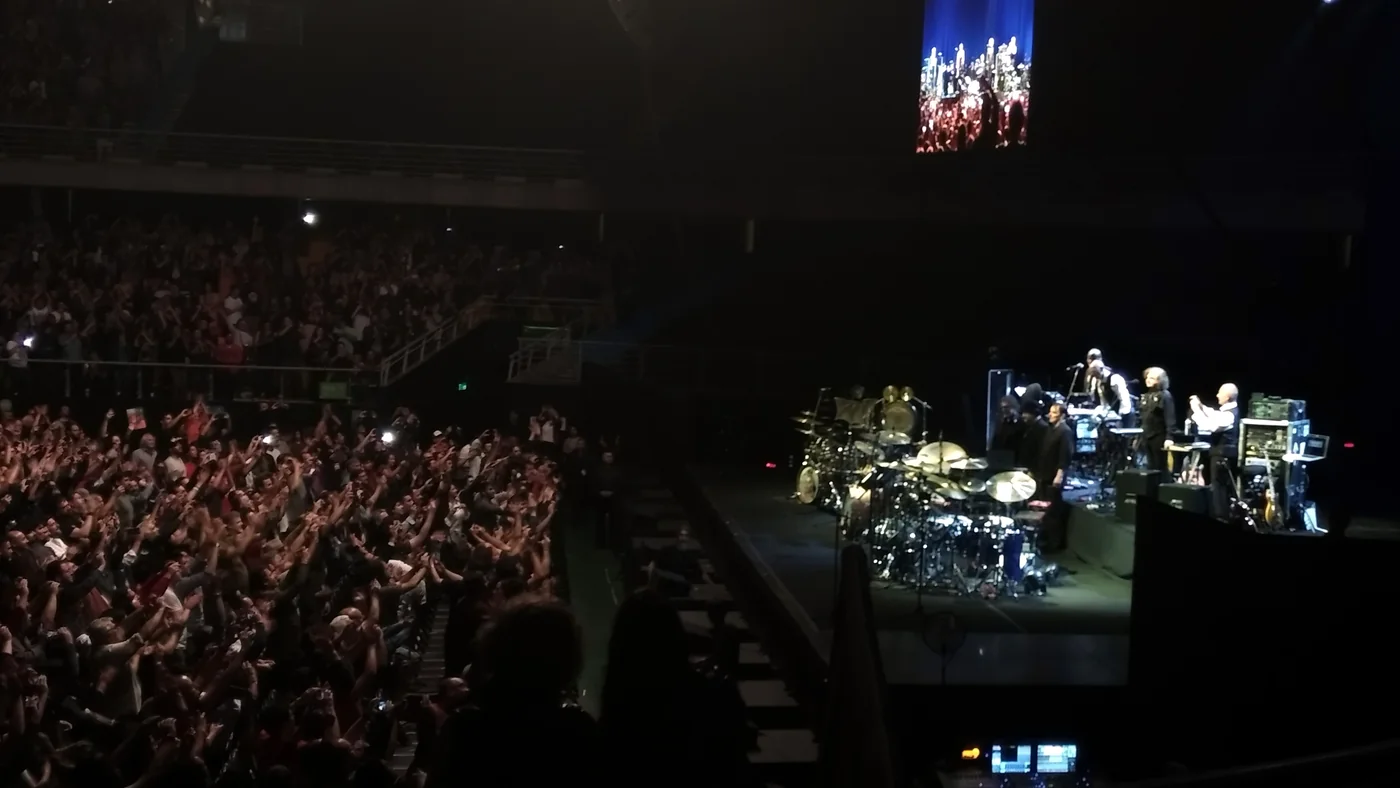
King Crimson is best understood as a sequence of ensembles rather than one stable band. Robert Fripp remained the only continuous member, but the instruments, writers and working methods changed: Ian McDonald's reeds and Mellotron shaped the 1969 group; concert improvisation became central to the 1972–74 lineup; Adrian Belew and Tony Levin helped define the interlocking-guitar quartet of the 1980s; and the final touring configuration placed three drummers across the front of the stage.
In the Court of the Crimson King was an unusually concentrated debut, but it did not single-handedly invent progressive rock. Its five tracks bring distorted ensemble attack, acoustic song, Mellotron writing, jazz-informed playing and open improvisation into one programme. Later Crimson periods did not merely reproduce that combination; they rebuilt the musical problem from different materials.
Formation & History
The first King Crimson lineup began rehearsing in London in January 1969. Fripp and drummer Michael Giles came from Giles, Giles and Fripp; Ian McDonald brought reeds, keyboards and Mellotron; Greg Lake became bassist and lead singer; Peter Sinfield wrote the lyrics, developed the visual presentation and proposed the band name. By the time they supported the Rolling Stones at Hyde Park on 5 July, they had also built a following through London club performances. The self-produced debut was recorded during July and August and released in October.
McDonald and Giles announced their departure during the first American tour, and Lake soon left as well. Fripp and Sinfield continued through In the Wake of Poseidon, Lizard and Islands with changing studio and touring personnel, including Mel Collins, Gordon Haskell, Boz Burrell and Ian Wallace. Sinfield was dismissed in late 1971; the Burrell-Collins-Wallace touring group ended after its April 1972 US tour.
A new band formed in July 1972 with Fripp, John Wetton, Bill Bruford, David Cross and percussionist Jamie Muir. After Muir left in early 1973, the quartet made extensive concert improvisation part of its nightly practice. Cross departed before the studio sessions for Red, leaving Fripp, Wetton and Bruford as the core trio; Fripp announced the group's end shortly before that album appeared in 1974.
Fripp, Bruford, Belew and Levin first performed as Discipline in April 1981, then adopted the King Crimson name and recorded Discipline, Beat and Three of a Perfect Pair before stopping in 1984. The six-member Double Trio reunited Fripp, Belew, Levin and Bruford with Trey Gunn and Pat Mastelotto for THRAK and 1994–96 touring. Further configurations followed in 2000–03 and 2008. From 2013, Fripp assembled a larger group built around multiple drummers, returning music from across the catalogue to the stage; DGM's tour archive lists its final concerts in Japan in December 2021.
Sound & Style
The 1969 band uses extreme contrasts: "21st Century Schizoid Man" locks guitar, reeds, bass and drums into distorted unison writing, while "I Talk to the Wind" and "Epitaph" give flute, acoustic textures and Mellotron different structural roles. The 1972–74 group is leaner and more volatile. Wetton's bass and Bruford's drums can drive written material such as "Larks' Tongues in Aspic, Part Two," but concert pieces including "Trio," "The Mincer" and "Starless and Bible Black" grew through collective improvisation.
The 1981 quartet changes the instrumental grammar again. Fripp and Belew play repeating, interlocking guitar cycles; Levin's Chapman Stick divides bass and upper-register functions; Bruford combines acoustic and electronic percussion; Belew's songs place concise vocal shapes inside the rhythmic system. The Double Trio duplicates guitar, low-string and percussion roles, while the 2013–21 ensemble reverses conventional stage layout by placing its three drummers at the front and melodic instruments behind them. Continuity lies less in one timbre than in the tension between exact structure and real-time decision.
Essential Albums
The original five members produced the debut themselves after an abandoned start with Tony Clarke. "21st Century Schizoid Man" combines a distorted vocal, heavy unison figures and the fast ensemble section "Mirrors"; "I Talk to the Wind" reduces the scale around Lake's voice and McDonald's flute; "Epitaph" and the title track use Mellotron as an arranging instrument rather than background decoration. "Moonchild" then moves from composed song into a long, quiet improvisation. The result is historically important because those methods coexist across five sharply differentiated tracks, not because one album can own the invention of a genre.
Key tracks: 21st Century Schizoid Man · Epitaph · The Court of the Crimson King
Open album guide → View on Amazon →Red
1974The final 1970s studio album is built around the trio of Fripp, Wetton and Bruford after Cross left the performing lineup. The title instrumental works from guitar overdubs, forceful bass and asymmetric drum accents; "One More Red Nightmare" gives Bruford's found cymbal sound a central role; and "Providence" preserves a live quartet improvisation recorded before Cross's departure. Collins, Ian McDonald and Marc Charig add winds to selected studio pieces. "Starless" closes by moving from Mellotron-backed song to a long rising bass-and-guitar tension and a final ensemble return.
Key tracks: Red · One More Red Nightmare · Starless
Open album guide → View on Amazon →The 1973 album introduces Fripp, Wetton, Bruford, Cross and Muir as a new five-person system. Muir's found objects, hand percussion and theatrical attack expand the percussion field around Bruford; Cross moves between violin, viola, flute and Mellotron; Wetton joins bass weight to a new lead voice. The two title-track parts frame vocal pieces and the studio improvisation "The Talking Drum." Because Muir left shortly after the recording, this is the only studio album to document the complete quintet.
Key tracks: Larks’ Tongues in Aspic, Part One · Easy Money · Larks’ Tongues in Aspic, Part Two
Open album guide → View on Amazon →Affiliate note: Amazon links on this page may earn RetroForge Records a small commission, at no extra cost to you.
Deeper Cuts
Much of the instrumental playing comes from 1973 concert tapes rather than live-in-the-studio sessions. Audience sound was removed, and studio vocals or other parts were added where needed: "Trio," "The Mincer," the title improvisation and "Fracture" all draw on performances outside the studio, while "The Great Deceiver" and "Lament" are studio recordings. The album therefore turns tour improvisation and composition into a deliberately ambiguous studio sequence.
Open album guide → View on Amazon →Discipline
1981Fripp, Belew, Levin and Bruford first worked under the name Discipline before recognising the quartet as King Crimson. "Elephant Talk" introduces Chapman Stick, guitar synthesiser and Belew's compressed vocal writing; "Frame by Frame" makes the two guitar patterns slip against each other; "The Sheltering Sky" develops from an improvisational rehearsal idea; and the title track closes with a precisely interlocked rhythmic design. It begins a three-album 1980s period rather than reviving the 1974 sound.
Open album guide → View on Amazon →The 2000 album documents the Double Duo of Fripp, Belew, Gunn and Mastelotto after the 1990s six-piece divided into smaller ProjeKcts. Gunn's Warr guitar covers low and upper registers, Mastelotto relies heavily on electronic percussion, and the two guitars return to interlocking systems in the title piece and "Larks' Tongues in Aspic, Part IV." The reduced lineup creates a hard, digital texture distinct from both Discipline and THRAK; later editions replaced the original drum parts on much of the material.
Open album guide → View on Amazon →Why They Still Matter
King Crimson's catalogue matters because each return tested a different relationship between composition and performance. The 1969 group made orchestral scale from rock instrumentation and studio overdubbing; the Wetton-Bruford band allowed concert improvisations to become album material; the Discipline quartet integrated minimalist cycles, new electronic instruments and songs; the Double Trio treated duplicated roles as both arrangement and improvisational problem. These are documented changes in method, not simply changes of personnel around a fixed style.
The 2013–21 group made the archive part of its present practice, performing material from several previous lineups while adding new drum-led pieces and arrangements. DGM's extensive concert archive also allows listeners to compare how written sections and improvisations changed from night to night. The final listed performance took place in Tokyo on 8 December 2021; treating that as the end of the latest active period is more accurate than describing King Crimson as continuously active since 1969.
Sources & Further Reading
This guide was checked against Discipline Global Mobile's official 1969 tour archive, features on Larks' Tongues in Aspic, Starless and Bible Black and Discipline, the official THRAK lineup notes, the Red anniversary notes, and DGM's complete tour-date archive. Album-specific personnel, track and recording details were cross-checked against the sourced RetroForge guides linked above.
Connected archive routes
Explore This Band
Continue through the RetroForge knowledge graph
Curated paths into the people, records, events and ideas that give this subject its wider musical context.
Genres and scenes
- Progressive Rock
Sounds and instruments
- Mellotron