Founded in Valenciennes by multi-instrumentalist Rocco Fernandez in 1969, Art Zoyd began as a progressive-rock group. Gérard Hourbette and Thierry Zaboïtzeff both arrived in 1971; after Fernandez left in 1975, they redirected the ensemble toward rigorously composed, amplified chamber music.
The 1976 debut Symphonie pour le jour où brûleront les cités established a language of strings, trumpet, bass, guitar and percussion in which repetition and dynamics supplied the physical force of rock. Across later decades, Art Zoyd expanded that method into electronics, dance, silent-film concerts and multimedia production.
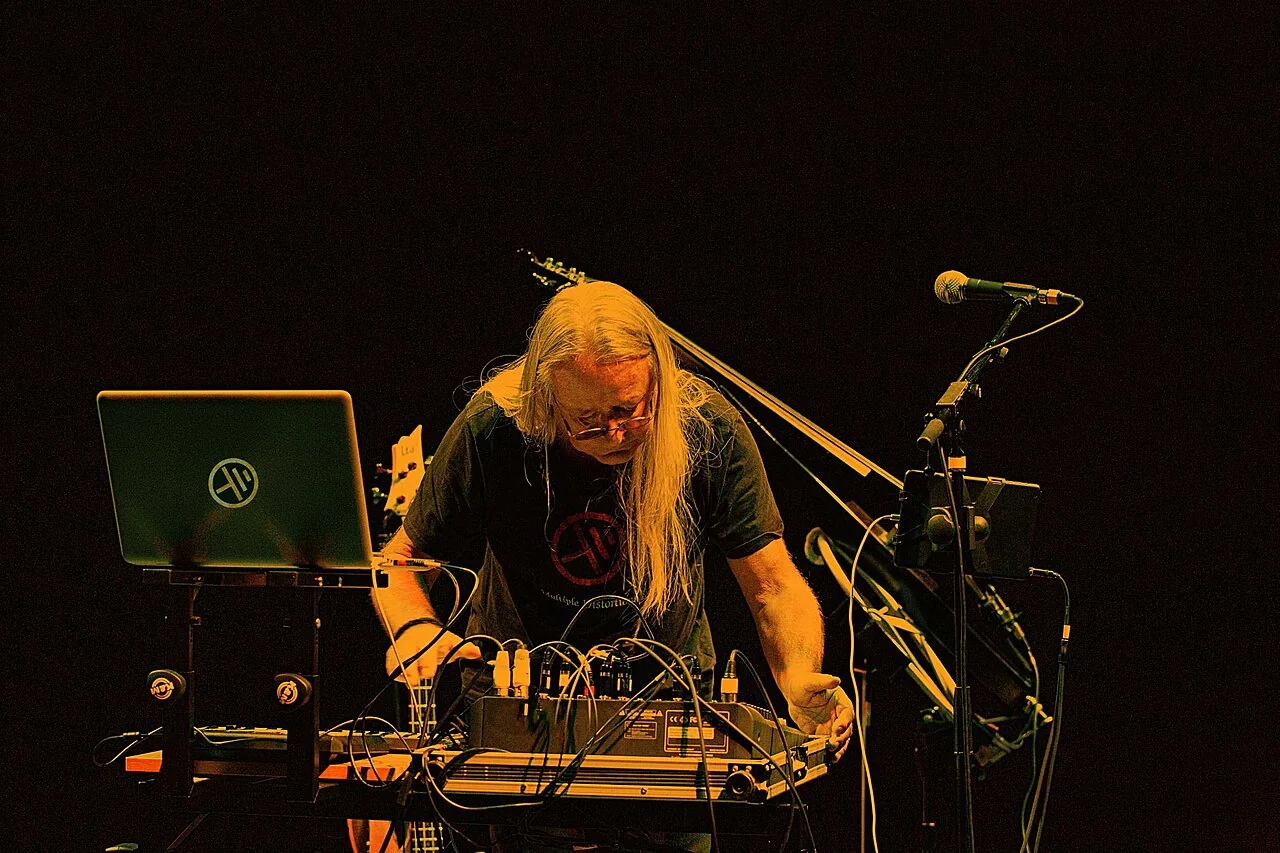
Art Zoyd member Thierry Zaboïtzeff in 2019.Photo: BettinaFrenzel / Wikimedia Commons · Licensed under CC BY-SA 4.0. Converted to WebP for this page.
Formation & History
Fernandez’s original group recorded the 1971 single “Sangria.” Hourbette and Zaboïtzeff joined that year and took artistic control in 1975. The first album appeared under the name Art Zoyd 3 in 1976, the same year the ensemble toured with Magma. In 1978 Art Zoyd joined the international Rock in Opposition collective.
The core of Hourbette, Zaboïtzeff and trumpeter Jean-Pierre Soarez developed through changing lineups; keyboardist Patricia Dallio became another important long-term contributor. Le Mariage du Ciel et de l’Enfer was created for Roland Petit’s ballet at La Scala’s festival in 1984 and released as an album in 1985. Art Zoyd later wrote concert scores for silent films including Nosferatu, Faust and Häxan.
Zaboïtzeff departed in 1997 after more than two decades of co-direction. Hourbette continued to lead the musical project and in 1999 founded the production and creation centre that developed into Art Zoyd Studios. After Hourbette’s death in 2018, the Studios continued its work in preservation, research, residencies and new creation.
Sound & Style
Early Art Zoyd replaces the guitar-led hierarchy of rock with violin, viola, trumpet, saxophone, electric bass, cello and percussion. Short cells repeat, collide and mutate; dynamics create suspense where a verse or chorus would normally provide orientation.
Amplification makes bowed strings and brass attacks feel monumental. Later samplers, synthesis and spatial systems widen the palette without replacing the group’s compositional logic: recurring timbres, unstable harmony and tightly controlled crescendos continue to give each piece architectural direction. Pulse often emerges from recurring cells instead of a drum kit.
Essential Albums
1976
Symphonie pour le jour où brûleront les cités
AZ Production Michel Besset · Original 1976 release
Symphonie pour le jour où brûleront les cités is Art Zoyd's foundational work. “Brigades spéciales,” “Masques” and “Simulacres” use strings, trumpet, bass, guitar and percussion to create tension without a verse-chorus framework. Written themes recur as marches, alarms and fractured chamber exchanges. The original 1976 recording carried rock intensity through ensemble dynamics rather than a conventional rhythm section; Art Zoyd re-recorded the work in 1981, making the distinction between editions important.
Musique pour l’Odyssée broadens the acoustic-electric ensemble with oboe, bassoon, saxophone and percussion. Low strings and brass establish weight, while violin, silence and Daniel Denis’s restrained percussion shape the pacing. Compared with the debut, each instrumental register has more room and the transitions feel less like abrupt confrontation than a sustained passage through shifting textures.
Le Mariage du Ciel et de l’Enfer grew from music created for Roland Petit’s ballet, first presented at La Scala’s festival in 1984. Electronics and keyboards are more prominent than on the 1970s records, while strings, low-register repetition and sharply defined attacks retain Art Zoyd's identity. The score marks a decisive move toward commissioned work for stage and image, a direction that later silent-film concerts would deepen.
Art Zoyd demonstrated that progressive music could leave the standard rock-band format without losing volume, repetition or physical tension. Their catalogue links the Rock in Opposition network to contemporary composition, electroacoustic production, ballet and live cinema.
The institutional legacy is equally distinctive. By building a permanent centre for production, research, residencies and preservation, Art Zoyd turned an ensemble’s working methods into infrastructure that could support other composers and new forms of sound-based art.
RetroForge Records publishes original music and independent editorial guides. This historical band guide is not affiliated with the artist, labels or rights holders. No unlicensed album artwork is reproduced.