

Overview
Christian Vander founded Magma in Paris in 1969 and gave the group an unusually complete artistic world: a repertoire partly sung in the invented Kobaïan language, recurring stories associated with the planet Kobaïa, and a musical method centred on drums, bass and massed voices. The band's first double album still carried prominent brass and jazz-rock movement; by Mëkanïk Dëstruktïẁ Kömmandöh, the choir and a heavy cyclical pulse had moved to the centre. That evolving approach became the reference point for the style known as Zeuhl.
Formation & History
The eight musicians on the 1970 debut came from jazz, classical, blues, rock and pop backgrounds. Vander played drums and sang; Claude Engel supplied guitar and flute, Francis Moze bass, François Cahen piano, Teddy Lasry and Richard Raux reeds and flute, Alain Charlery trumpet and percussion, and Klaus Blasquiz vocals. Recorded at Europa Sonor in Paris in April 1970, the double LP presents the flight from a damaged Earth toward Kobaïa while establishing the language used to tell it.
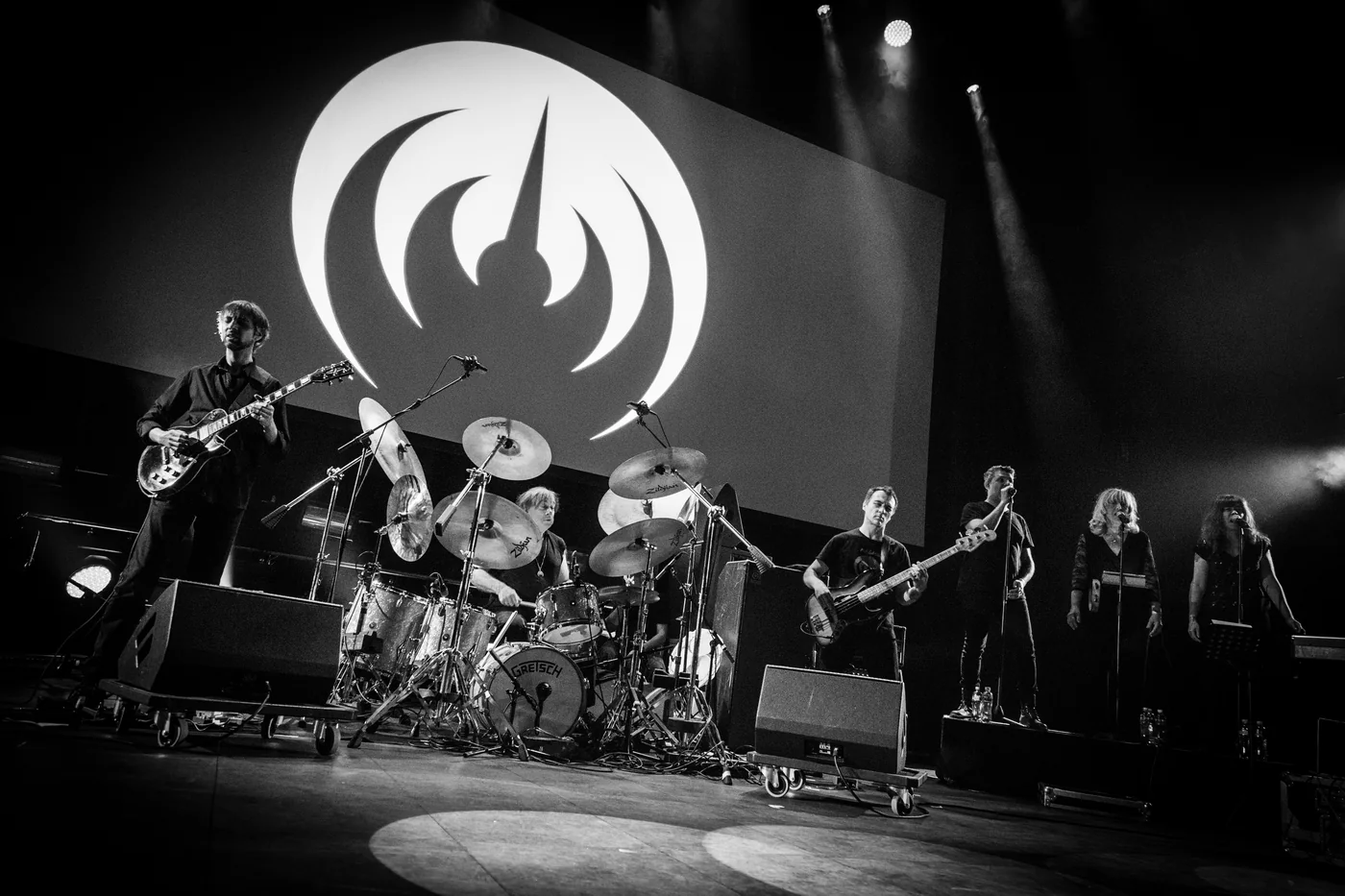
Personnel changed rapidly. Blasquiz remained a defining lead voice during the early 1970s, while Jannick Top's arrival brought a new weight and independence to the bass. Stella Vander first appeared on record with the choir of Mëkanïk Dëstruktïẁ Kömmandöh. After periods devoted to projects including Offering and the Christian Vander Trio, Magma returned to regular live work in 1996. Later studio albums such as K.A, Ëmëhntëhtt-Ré, Zëss and the collectively written Kartëhl show that the group did not remain a repertory act.
Sound & Style
The sound changes markedly across the catalogue. Kobaïa uses saxophones, trumpet, flute, electric guitar and piano around a forceful rhythm section. On Mëkanïk Dëstruktïẁ Kömmandöh, the brass recedes and an ensemble of female voices joins Christian Vander and Klaus Blasquiz, turning seven connected movements into a sustained choral drama. Köhntarkösz shifts the balance again: Jannick Top's bass, paired keyboards and Vander's more restrained but extremely weighted drumming create long spans of suspended tension.
Kobaïan is used for sound as well as story. Repeated syllables let voices work like percussion, while held vowels and stacked parts enlarge the harmony. Bass lines frequently carry an independent melodic contour rather than simply reinforcing guitar chords. The result can draw on jazz improvisation, classical repetition, rhythm and blues and rock volume without settling into the standard role divisions of any one of those traditions.
Essential Albums
Recorded at the Manor in Oxford and Aquarium in Paris, this seven-part suite narrows the earlier band's broad jazz-rock palette into choir, rhythm section, keyboards, guitar and clarinet. Jannick Top's bass locks to Vander's drums while Klaus Blasquiz, Christian Vander, Stella Vander and four additional singers carry the work's escalating vocal design. It is the third movement of the Theusz Hamtaahk trilogy, although it was the first of the three movements to receive a studio-album release.
Key tracks: Hortz Fur Dëhn Stekëhn Ẁest · Da Zeuhl Ẁortz Mëkanïk · Kreühn Köhrmahn Iss Dëh Hündïn
Open album guide → View on Amazon →Köhntarkösz
1974This single LP is organised around the two-part title composition, with Top's “Ork Alarm” and Vander's concise John Coltrane tribute “Coltrane Sündïa” completing the programme. The personnel includes Vander, Top, Blasquiz, Stella Vander, keyboardists Gérard Bikialo and Michel Graillier, and guitarist Brian Godding. Compared with M.D.K., the voices occupy less space while bass and paired keyboards make the slow-building title work feel denser and more suspended.
Key tracks: Köhntarkösz, Part One · Köhntarkösz, Part Two · Coltrane Sündia
Open album guide → View on Amazon →Magma
1970The debut introduces Kobaïa through ten pieces and a large eight-member arrangement. “Kobaïa” opens with the combination of bass, hammering drums, guitar and brass that frames the record; “Aïna” and “Sohia” move through contrasting vocal and instrumental sections; “Stoah” pushes repetition and chant toward the approach Magma would later intensify. Its reeds and trumpet make it more overtly jazz-rock than the choir-led albums that followed.
Key tracks: Kobaïa · Aïna · Stoah
Open album guide → View on Amazon →Affiliate note: Amazon links on this page may earn RetroForge Records a small commission, at no extra cost to you.
Deeper Cuts
Üdü Ẁüdü
1976Üdü Ẁüdü documents a transition between band configurations rather than one uniform session sound. Its centre of gravity is Jannick Top's “De Futura,” built from distorted bass, interlocking keyboards and a repeated low-register pulse; Vander's shorter pieces place choral writing and clipped rhythmic figures around it. The album makes Top's role as a composer, not only a bassist, impossible to miss.
Open album guide → View on Amazon →Attahk
1978Recorded at Château d'Hérouville from September to November 1977, Attahk replaces side-long architecture with seven shorter tracks. Vander takes a larger solo-vocal role and uses piano, Rhodes, Chamberlin and percussion alongside two bass parts, brass and a small chorus. “The Last Seven Minutes,” “Spiritual” and “Nono” bring gospel-inflected call-and-response and a more direct rhythmic surface into Magma's vocabulary. H.R. Giger designed the cover.
Open album guide → View on Amazon →Retrospektïẁ
1981These recordings come from three June 1980 concerts at the Olympia in Paris celebrating Magma's first decade and reuniting musicians from different periods. Retrospektïẁ 1/2 finally put the first movement of the Theusz Hamtaahk trilogy on record alongside M.D.K.; the separately issued Retrospektïẁ 3 contains “Retrovision,” “Hhaï” and “La Dawotsin.” The releases therefore function as a repertoire survey with changing vocalists and instrumental combinations, not simply a document of one touring lineup.
Open album guide → View on Amazon →Why They Still Matter
Magma established a repeatable musical vocabulary without freezing it. The close relationship between bass and drums, choral writing in Kobaïan and long-form repetition gave later musicians a concrete model for Zeuhl, while the differences between Kobaïa, Mëkanïk Dëstruktïẁ Kömmandöh, Köhntarkösz and Attahk show how much the model could change. The group's official history records a continuous return to new writing after the 1996 stage revival, culminating most recently in the collective method of Kartëhl. That combination of a recognisable language and changing personnel is the reason Magma remains more than a preserved 1970s catalogue.
Sources & Further Reading
Magma Official — Biography documents the changing lineups, the 1996 stage return and later studio work. Magma Official — Discography provides the band's album chronology.
Seventh Records — Kobaïa supplies the 1970 personnel, ten-track programme and recording details. Seventh Records — Mëkanïk Dëstruktïẁ Kömmandöh and Seventh Records — Köhntarkösz document their personnel and structures. Seventh Records — Retrospektïẁ identifies the June 1980 Olympia performances and original release configuration.
Connected archive routes