Area fused jazz-rock, electronics, Mediterranean and Balkan rhythm, radical politics and Demetrio Stratos’s extended vocal technique.
The full name Area – International POPular Group reflects the internationalism of both the lineup and its musical language. The records draw on free jazz, electric fusion, Balkan and Mediterranean metres, electronics and collective improvisation. Demetrio Stratos's voice could deliver political text, divide into multiphonic sound or operate like percussion, making him an active part of the ensemble's research rather than a conventional frontman.
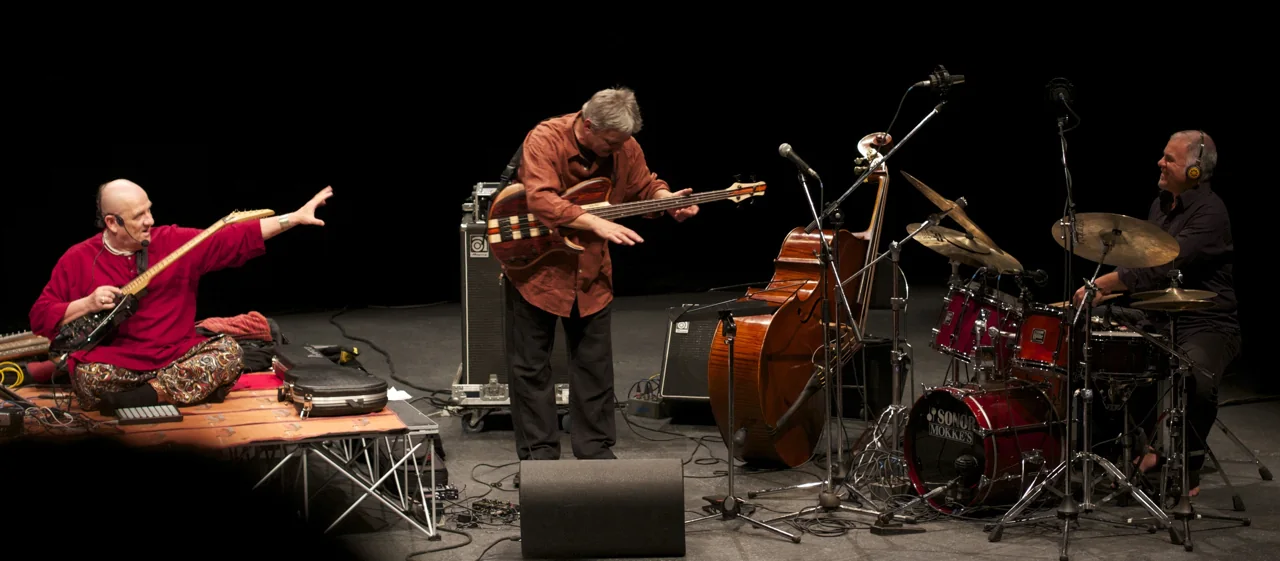
Area members Ares Tavolazzi, Paolo Tofani and Walter Paoli performing live.Photo: Biarnel at Italian Wikipedia / Wikimedia Commons · Licensed under Public domain. Converted to WebP for this page.
Formation & History
The classic lineup centred on Stratos, Patrizio Fariselli, Paolo Tofani, Ares Tavolazzi and Giulio Capiozzo.
Area formed in Milan in 1972 around Stratos and drummer Giulio Capiozzo. The first configuration also included saxophonist Eddie Busnello, pianist Leandro Gaetano, guitarist Johnny Lambizzi and bassist Patrick Djivas; Patrizio Fariselli replaced Gaetano, and Paolo Tofani replaced Lambizzi before the debut album. Arbeit macht frei therefore featured Stratos, Capiozzo, Busnello, Djivas, Fariselli and Tofani. Djivas subsequently joined PFM and Ares Tavolazzi took over bass; after Busnello's departure, the quintet of Stratos, Capiozzo, Fariselli, Tofani and Tavolazzi recorded Caution Radiation Area and Crac!. Cramps co-founder Gianni Sassi directed the group's visual presentation and collaborated on its political texts. Stratos died in 1979; Area continued until 1983, returned in the 1990s and reunited again in 2009.
Sound & Style
Electric piano, synthesizer, treated guitar and volatile rhythm move between composition, folk-derived metre and collective noise.
Capiozzo and Tavolazzi make asymmetric rhythms feel bodily rather than academic. Fariselli moves between prepared piano, electric keyboards and free improvisation; Tofani's guitar often becomes electronic texture instead of riff accompaniment. Stratos can sing a direct melody and then dissolve language into overtone, breath and attack. That range lets Area move from song to experiment without drawing a clean boundary between them.
Essential Albums
1973
Arbeit macht frei
Cramps · Original 1973 release
Arbeit macht frei opens Area's catalogue with its method already volatile. “Luglio, agosto, settembre (nero)” frames an Arabic-language opening and Mediterranean melody inside rapidly changing ensemble music. The title track and “Consapevolezza” move between written themes, electronic treatment and rhythm that refuses a square rock pulse. Stratos is commanding but never isolated from the instruments; his vowels and attacks alter the arrangement itself. The deliberately confrontational title announces a record concerned with memory, violence and political responsibility. It remains the strongest introduction to Area's original mixture of direct statement and musical instability.
Key tracks: Luglio, agosto, settembre (nero) · Arbeit macht frei · Consapevolezza
Crac! is Area at its most accessible without reducing its complexity. “L'elefante bianco” gives Stratos a soaring line over a rhythm section that keeps changing the ground beneath him. “La mela di Odessa” turns a political parable into compact jazz-rock theatre, and “Gioia e rivoluzione” offers a chorus audiences could actually carry away. Fariselli, Tofani, Tavolazzi and Capiozzo sound less like soloists taking turns than a mechanism capable of changing direction instantly. The record's brighter surfaces make its fractures and bursts of free playing more striking.
Key tracks: L’elefante bianco · La mela di Odessa · Gioia e rivoluzione
Maledetti (Maudits) uses a fictional collapse of historical memory to justify a deliberately unstable musical structure. Different guests and configurations appear across the record, including musicians from Italy's experimental and jazz worlds. “Evaporazione” begins with language itself becoming unreliable; “Diforisma urbano” and the second “Caos” section move between composed fusion, electronics and collective improvisation. This is not the easiest Area album, but it reveals the group as a cultural laboratory rather than a fixed lineup protecting a successful formula. The changing personnel from track to track becomes part of the concept.
Area joined political urgency to musical experiment without reducing either to decoration.
Area demonstrates how progressive rock could intersect with jazz, regional rhythm and contemporary politics. Virtuosity is not treated as decoration: technique becomes a way to question language, authority and the expected roles of instruments. The tension between tightly written material and collective improvisation remains central to the records.
RetroForge Records publishes original music and independent editorial guides. This historical band guide is not affiliated with the artist, labels or rights holders. No unlicensed album artwork is reproduced.