Henry Cow treated the rock group as a laboratory for composition, improvisation, politics and collective organisation. Formed at Cambridge University by Fred Frith and Tim Hodgkinson, the band developed music in which chamber writing, free improvisation, jazz rhythm, tape work and amplified noise could challenge one another rather than settle into a stable fusion. Their difficulty was purposeful: familiar rock habits were material to examine, not rules to obey.
The group’s history is also inseparable from how it worked. Constant touring connected Henry Cow to experimental scenes across Europe; collaboration with Slapp Happy brought Dagmar Krause’s voice into the centre; disputes with the commercial record system encouraged independent distribution and the Rock in Opposition initiative. The catalogue is small, but its influence reaches avant-prog, experimental composition, improvisation and artist-run networks.
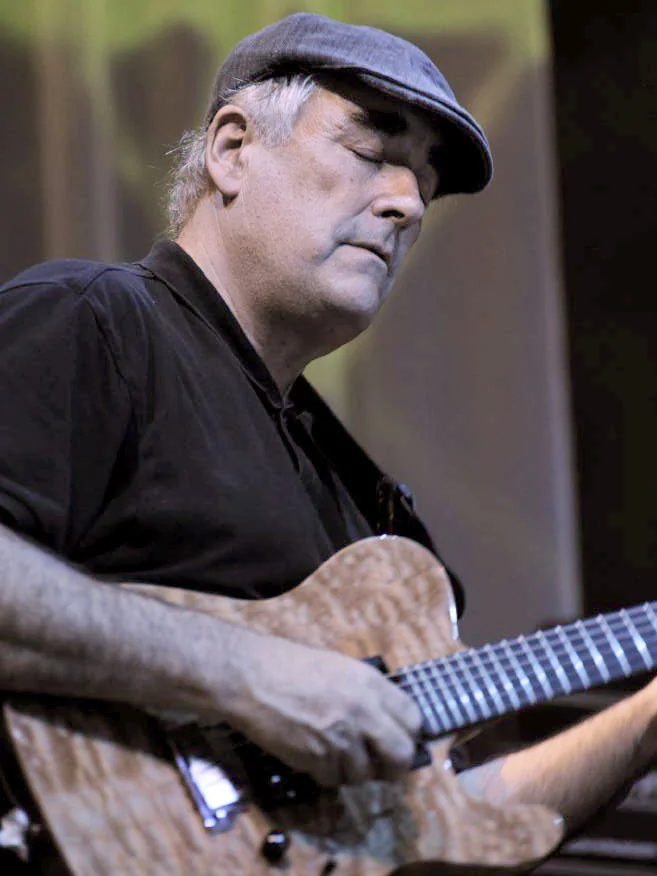
Henry Cow co-founder Fred Frith performing live.Photo: Nomo michael hoefner / http://www.zwo5.de / Wikimedia Commons · Licensed under CC BY-SA 3.0. Converted to WebP for this page.
Formation & History
Fred Frith and Tim Hodgkinson formed Henry Cow at Cambridge in 1968. The lineup changed frequently while the group developed through university performances, residencies and increasingly demanding compositions. Bassist John Greaves and drummer Chris Cutler became central members; saxophonist and flautist Geoff Leigh appears on the debut, Legend. Bassoonist and composer Lindsay Cooper joined during the next phase and gave the ensemble a new low-reed voice.
After signing to Virgin, Henry Cow recorded Legend in 1973 and created parts of Unrest through studio improvisation when composed material ran short. A close relationship with Slapp Happy produced Desperate Straights and then In Praise of Learning, with singer Dagmar Krause joining Henry Cow. The band’s music and public statements became more explicitly political while its working life remained financially precarious.
On 12 March 1978 Henry Cow organised the first Rock in Opposition festival in London, inviting Univers Zero, Etron Fou Leloublan, Samla Mammas Manna and Stormy Six. Internal disagreements had already separated song-oriented material, which became the Art Bears’ Hopes and Fears, from the instrumental compositions retained for Western Culture. Henry Cow played its final concert in Milan on 25 July 1978 and finished the latter album at Sunrise Studios afterward; Western Culture appeared in September 1979 on the group’s own Broadcast label.
Sound & Style
Henry Cow alternates exact notation with open improvisation. Frith’s guitar may function as noise source, chamber instrument or rock attack; Hodgkinson’s organ and reeds produce dense contrapuntal writing; Cooper’s bassoon and oboe darken the ensemble; Greaves and Cutler can articulate rapidly shifting metres without making them sound ornamental. Krause’s severe, highly controlled singing turns political texts into musical structure rather than commentary laid over accompaniment.
The transitions are deliberately unstable. A tightly scored passage may dissolve into collective sound, tape manipulation or silence, then return in altered form. Instead of smoothing classical, jazz and rock influences into crossover polish, Henry Cow preserves the friction between them. That friction is the point.
Essential Albums
1979
Western Culture
Broadcast · Original 1979 release
Western Culture is Henry Cow’s final and most concentrated instrumental studio statement. Recorded during the group’s last year and released after it had disbanded, the album separates a Tim Hodgkinson-dominated first side from Lindsay Cooper’s compositions on the second. “Industry” and “The Decay of Cities” build hard, angular systems from organ, reeds, guitar and percussion; “Half the Sky” introduces a different tension shaped by Cooper and the late lineup. There is little of the debut’s playfulness and none of In Praise of Learning’s song form. The austere sound is demanding, but it makes the record a crucial endpoint: chamber rock stripped of reassurance.
Key tracks: Industry · The Decay of Cities · Gretel’s Tale
In Praise of Learning grew from Henry Cow’s collaboration with Slapp Happy and places Dagmar Krause’s voice at the centre of an explicitly political record. “War,” composed by Anthony Moore with lyrics by Peter Blegvad, is brief and explosive; Tim Hodgkinson’s “Living in the Heart of the Beast” occupies the long structural centre, while “Beautiful as the Moon – Terrible as an Army with Banners” turns Frith and Cutler’s writing into severe, memorable song. Improvisation and studio sound prevent the texts from becoming slogans with accompaniment. This is the strongest entry for listeners who need a human voice inside Henry Cow’s complexity, though its intensity offers no easy introduction.
Key tracks: War · Living in the Heart of the Beast · Beautiful as the Moon
Legend—often styled Leg End—captures the first recorded Henry Cow lineup before its methods hardened into a political and compositional programme. “Nirvana for Mice” opens with bright, tightly scored motion; “Amygdala” and “Teenbeat” move between composed detail, jazz-inflected rhythm and passages that threaten to come apart. Geoff Leigh’s reeds give this version a lighter colour than Lindsay Cooper’s later bassoon, while Frith, Hodgkinson, Greaves and Cutler already resist conventional solo-and-accompaniment roles. The famous sock imagery may suggest whimsy, and some music is genuinely playful, but the album’s real achievement is making rigorous composition and unstable group improvisation sound like parts of the same organism.
Key tracks: Nirvana for Mice · Amygdala · Nine Funerals of the Citizen King
Henry Cow expanded what a self-contained rock ensemble could compose, improvise and organise. Their work rejects the assumption that complexity must lead to grandeur or escapism: difficult structures coexist with collective politics, economic reality and a persistent suspicion of passive listening. Rock in Opposition also provided a practical network for groups that did not fit national industries or standard genre marketing.
Later avant-prog and experimental artists inherited more than odd metres from Henry Cow. They inherited permission to let composition and improvisation remain in conflict, to build independent channels, and to treat the social organisation around music as part of the work. Few catalogues this small have generated such a large field of consequences.
RetroForge Records publishes original music and independent editorial guides. This historical band guide is not affiliated with the artist, labels or rights holders. No unlicensed album artwork is reproduced.