The motor turns
A synchronous motor keeps the tonewheel generator rotating at stable speeds.

RetroForge Instrument Guide
Ninety-one rotating tonewheels, nine harmonic drawbars and a speaker that physically throws sound around the room.
First, recognise the instrument
The B-3 combines two manuals, preset keys, drawbars, an expression pedal and a 25-note pedalboard. A player can hold harmony with one hand, move a melody with the other, shape volume with a foot and supply bass below everything.
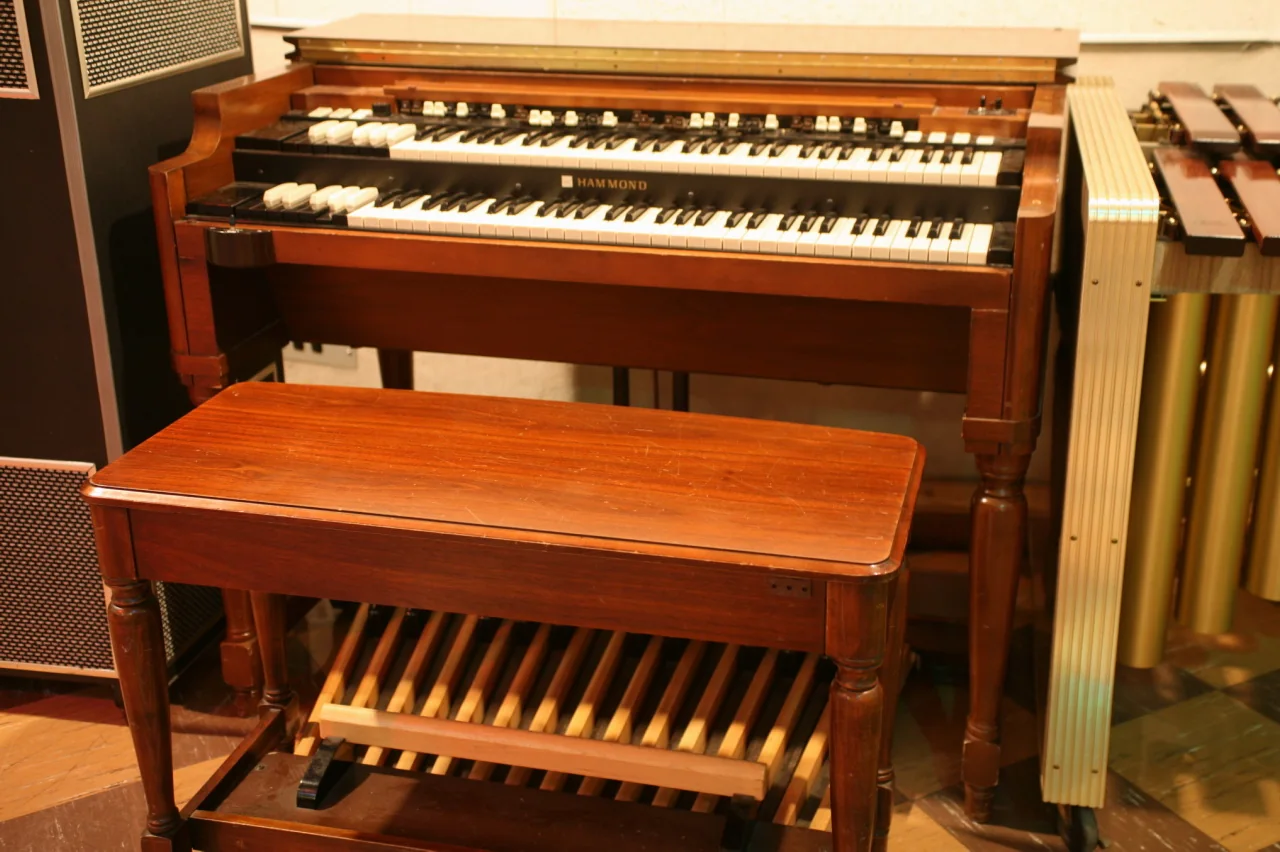
The model in the photograph
The two manuals are called Swell and Great. Above them, sets of drawbars let the player combine harmonic pitches instead of choosing a single stored timbre. The wooden pedalboard adds bass notes, while the expression pedal continuously controls level.
A B-3 contains no loudspeakers of its own. It must feed an external cabinet—often a Leslie—which means the speaker system is part of the performance rather than an afterthought.
Photograph: “Hammond B3 at RCA Studio B” by Cliff, Wikimedia Commons, CC BY 2.0. Converted to WebP and resized.
From motor to music
The classic B-3 is additive: it starts with simple pitches and combines them. The keyboard does not trigger one finished voice; its multiple contacts connect the chosen drawbar harmonics.
A synchronous motor keeps the tonewheel generator rotating at stable speeds.
Toothed metal wheels pass electromagnetic pickups and generate near-sine-wave pitches.
Pressing a key connects the harmonic pitches represented by that manual’s drawbars.
Each drawbar determines how strongly one footage—and therefore one harmonic relationship—is heard.
The organ’s electrical signal reaches an amplifier or rotary Leslie speaker.
Nine harmonic faders
The numbers below a Hammond drawbar indicate organ-pipe footage. Pulling a bar outward increases that component from 0 to 8. A registration such as 888000000 is a recipe, not a volume setting for the whole organ.
The illustrated 888000000 registration strongly weights the lowest three components. It is only one starting point: players change registrations for bass, comping, bright chord stabs and cutting solo lines, sometimes moving drawbars during a performance.
The speaker is an instrument
A classic Leslie divides the signal between a rotating high-frequency horn and a rotating low-frequency drum or rotor. Their movement changes level, timbre and perceived pitch as the sound approaches and recedes from the listener or microphones.
The rotating horn projects higher frequencies around the room, creating a vivid cycle of approach and retreat.
A rotating drum below the amplifier produces a broader, weightier modulation in the lower range.
The slow setting creates width and breathing motion without turning every sustained chord into a dramatic effect.
Acceleration into fast rotation is itself a musical gesture, often timed to a chorus, entrance or climax.
Hands, feet and physical gesture
Rock Hammond is not simply an organ preset with distortion. The characteristic vocabulary comes from registrations, articulation, speaker-speed changes and the way a player distributes rhythm and harmony across two manuals.
Sliding the palm across the waterfall-style keys produces a broad, noisy attack that can launch or punctuate a phrase.
The B-3’s touch-response percussion emphasises the second or third harmonic, giving single-note lines a more immediate front edge.
Pushing the preamp, amplifier or recording chain adds compression and harmonic density while the drawbar identity remains audible.
Listening anatomy
Listen for the relationship between organ and ensemble: accompaniment, countermelody, bass, lead voice or a wall of sustained harmony.
Matthew Fisher stated that the recording used a Hammond M-100 rather than a B-3. Its organ part does not merely fill chords beneath the vocal; it carries a second, defining narrative line.
Read the band guide → Emerson, Lake & Palmer · 1970Hear Hammond function as rhythm section, lead instrument and orchestral mass inside a trio with no permanent guitarist.
Read the band guide → Yes · 1971Tony Kaye’s organ locks into guitar and bass figures, adding attack and sustained glue without stopping the ensemble’s motion.
Read the band guide → Caravan · 1971David Sinclair shows the warmer Canterbury route: organ as lyrical colour, long-line development and quietly gathering force.
Read the album guide → Uriah Heep · 1972Listen for distorted organ reinforcing riffs and vocal harmony, widening the band without simply doubling the guitar.
Explore heavy prog → Deep Purple · 1970Jon Lord drives Hammond through amplification at hard-rock volume, making keyboard and guitar equal sources of attack and distortion.
Explore progressive hard rock →Three keyboard worlds
They may stand beside one another on a progressive-rock stage, but their sound starts in completely different places.
| Instrument | Sound source | Player shapes | Characteristic motion |
|---|---|---|---|
| Hammond organ | Rotating electromagnetic tonewheels | Harmonics with drawbars, percussion, vibrato and expression | Rotary-speaker movement and continuous sustain |
| Mellotron | Prerecorded magnetic tape strips | Track choice, phrasing and finite note duration | Tape instability and recorded attacks |
| Analogue synthesizer | Voltage-controlled electronic circuits | Waveform, pitch, filter, envelope and modulation | Designed modulation and continuously changing timbre |
Sources and verification
Specifications and operating principles were checked against Hammond’s own history and manuals. The six historical listening examples were checked against official artist, band or catalogue sources; the listening commentary remains original RetroForge analysis.
Quick answers
They control the level of nine harmonic pitch relationships. Combining them lets the player build the organ’s timbre continuously.
No. Physical rotors produce changing direction, level, tone and Doppler-related pitch motion in the room. Microphone placement also changes the recorded result.
Multiple mechanical key contacts do not close at exactly the same instant. The resulting transient became a valued part of the attack rather than something players wanted entirely removed.
No. The console requires an external speaker system, commonly a Leslie cabinet or another amplifier arrangement.