Oscillator
Creates a repeating waveform. Keyboard voltage commonly controls pitch; additional oscillators can be detuned or set to intervals.

RetroForge Instrument Guide
Electricity organised into pitch, colour and movement: the musician designs the instrument while playing it.
First, recognise the system
In a modular instrument, each panel performs a limited job. Patch cables decide which control voltage or audio signal goes where. A keyboard may supply pitch and gate information, but the sound itself is built across the cabinet.
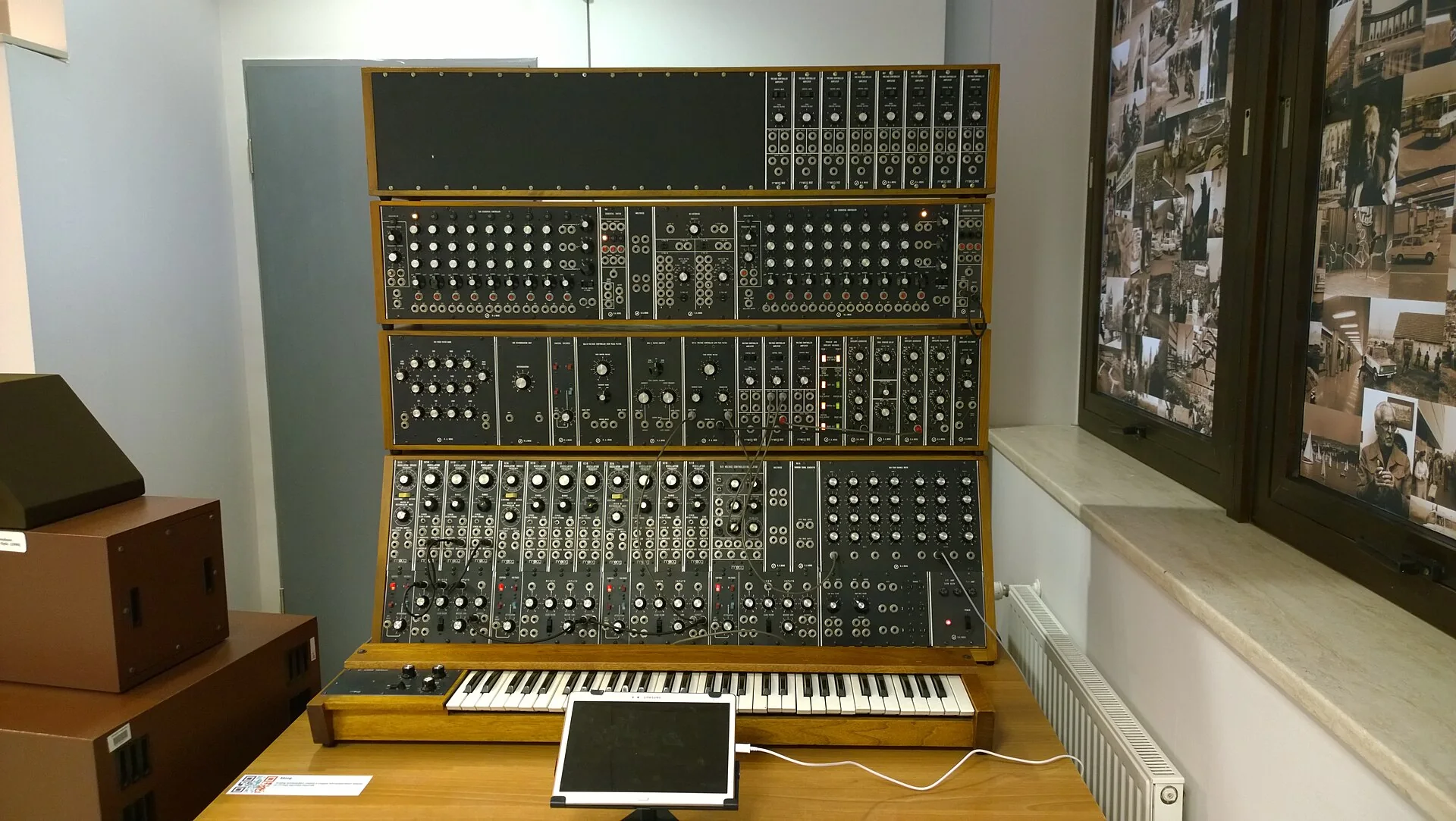
The system in the photograph
The panels contain oscillators, filters, envelope generators, amplifiers, mixers, sequencer controls and utility modules. Their arrangement does not dictate one fixed signal path; patching determines the instrument.
This flexibility made early modular systems powerful but demanding. The Minimoog later normalled a practical version of the signal chain behind a compact front panel, allowing players to reach repeatable sounds without repatching a large cabinet.
Photograph: “1973 Moog modular synthesizer” by Attila Szász, Wikimedia Commons, CC BY-SA 4.0. Converted to WebP and resized.
The subtractive signal path
Many classic analogue instruments use subtractive synthesis. An oscillator supplies a harmonically rich waveform; a filter removes or emphasises parts of that spectrum; an amplifier controls the final level.
Creates a repeating waveform. Keyboard voltage commonly controls pitch; additional oscillators can be detuned or set to intervals.
Attenuates frequencies above or below a cutoff point. Resonance emphasises frequencies around that point.
Controls how much signal passes. An envelope usually opens and closes it over the life of each note.
The designed signal reaches amplification, effects or tape, where performance and production continue shaping it.
The raw materials
Waveform is not a genre or finished tone. It determines the harmonic material available before filtering, envelopes, modulation, performance and production reshape it.
Rich in both even and odd harmonics; a bright starting point for brass-like, string-like and cutting lead sounds.
A 50% square wave contains odd harmonics. Changing the pulse width produces a different harmonic balance, including even harmonics, before the filter.
Softer than saw or square, with rapidly diminishing odd harmonics and a clearer sense of the fundamental pitch.
The simplest periodic waveform, containing a fundamental without upper harmonics; useful alone or as a modulation source.
A note has a shape
ADSR names four stages—attack, decay, sustain and release. It can control loudness, filter cutoff or another destination, allowing the same oscillator to become a pluck, swell, stab or sustained drone.
A short attack produces an immediate edge; a long attack creates a fade-in even when the key is struck sharply.
Decay measures the movement from the initial maximum toward the sustain level while the key remains held.
Sustain is a level, not a time. It continues until the key or gate signal ends.
A short release stops quickly; a long release lets the sound trail after the key is released.
Voltage as movement
A control voltage can alter another module continuously. The destination and depth matter as much as the source: a slow oscillator sent to pitch creates vibrato; the same source sent to filter cutoff creates repeating timbral motion.
Small modulation adds expressive movement. Greater depth turns pitch into a repeating sweep rather than a stable note.
The oscillator can remain fixed while the filter repeatedly opens and closes the spectrum.
Step values control oscillator pitch while a clock sets the rate, separating the pattern’s notes from its tempo.
Architectures changed the music
“Analogue synthesizer” covers instruments with very different performance limits. Those limits changed composition: monophonic leads, modular sequences and polyphonic pads do not ask the same things of a player.
Buchla built the first Series 100 modules from 1963. Moog catalogued voltage-controlled modules in 1965 and presented complete modular systems as synthesizers in 1967.
Instruments such as the Minimoog placed a normalled subtractive path behind one panel and keyboard, making touring and repeatable performance practical.
The five-voice Prophet-5, introduced in 1978, joined analogue polyphony to programmable patch memory. Instruments built around these capabilities changed the scale of harmony and the speed of moving between sounds.
Listening anatomy
Follow function rather than brand mythology: is the synth a lead voice, a repeating clock, a source of noise, a bass instrument or the environment containing everything else?
Listen for electronic timbre serving a clear musical image: motion, machinery and travel organised into an unusually accessible long form.
Read the album guide → Tangerine Dream · 1974The sequencer behaves as a structural engine while filters, tuning and tape-based colour keep the pattern from feeling mechanically fixed.
Read the album guide → Popol Vuh · 1970Florian Fricke treats the Moog modular as an environment of original forms rather than a machine for imitating an orchestra.
Read the album guide → Pink Floyd · 1975Hear filtered electronic motion and sustained keyboard tone operate as atmosphere, transition and thematic framing.
Read the album guide → Rush · 1977Synthesizer colour expands the trio’s architecture while bass, guitar and drums remain the music’s physical centre.
Read the album guide → Yes · 1972Rick Wakeman places Minimoog lines beside Hammond, Mellotron and piano, giving each keyboard family a distinct job.
Read the album guide →Three keyboard worlds
A synthesizer can approximate aspects of both neighbours, but its native strength is not imitation. It exposes the components of sound as parameters a musician can connect and move.
| Instrument | Sound begins with | Primary shaping tools | Characteristic constraint |
|---|---|---|---|
| Analogue synthesizer | Electronic oscillators, noise or external signals | Filters, envelopes, amplifiers, modulation and patch routing | Architecture and available control paths |
| Hammond organ | Electromagnetic tonewheels | Harmonic drawbars, percussion, chorus-vibrato and Leslie | Fixed harmonic footage system |
| Mellotron | Prerecorded magnetic tape | Track choice, key phrasing and arrangement | Finite tape duration |
Sources and verification
Definitions and historical claims were checked against museum, foundation and manufacturer materials. The signal diagrams are simplified teaching aids; listening notes are original RetroForge analysis.
Quick answers
Not necessarily. “Analogue” usually describes the primary audio-generation or processing path. Later instruments may combine analogue sound circuits with digital scanning, patch memory or control.
Audio signals are intended to be heard. Control voltages alter a parameter such as pitch, cutoff or level, although modular systems can sometimes use signals across those categories creatively.
Producing one complete oscillator-filter-amplifier voice for every simultaneous note required much more circuitry. Early portable designs therefore concentrated one powerful voice behind one keyboard.
No. Subtractive synthesis is only one method, and even within it oscillators, noise, modulation, feedback and external audio can produce very different starting material.
Curated paths into the people, records, events and ideas that give this subject its wider musical context.