

Overview
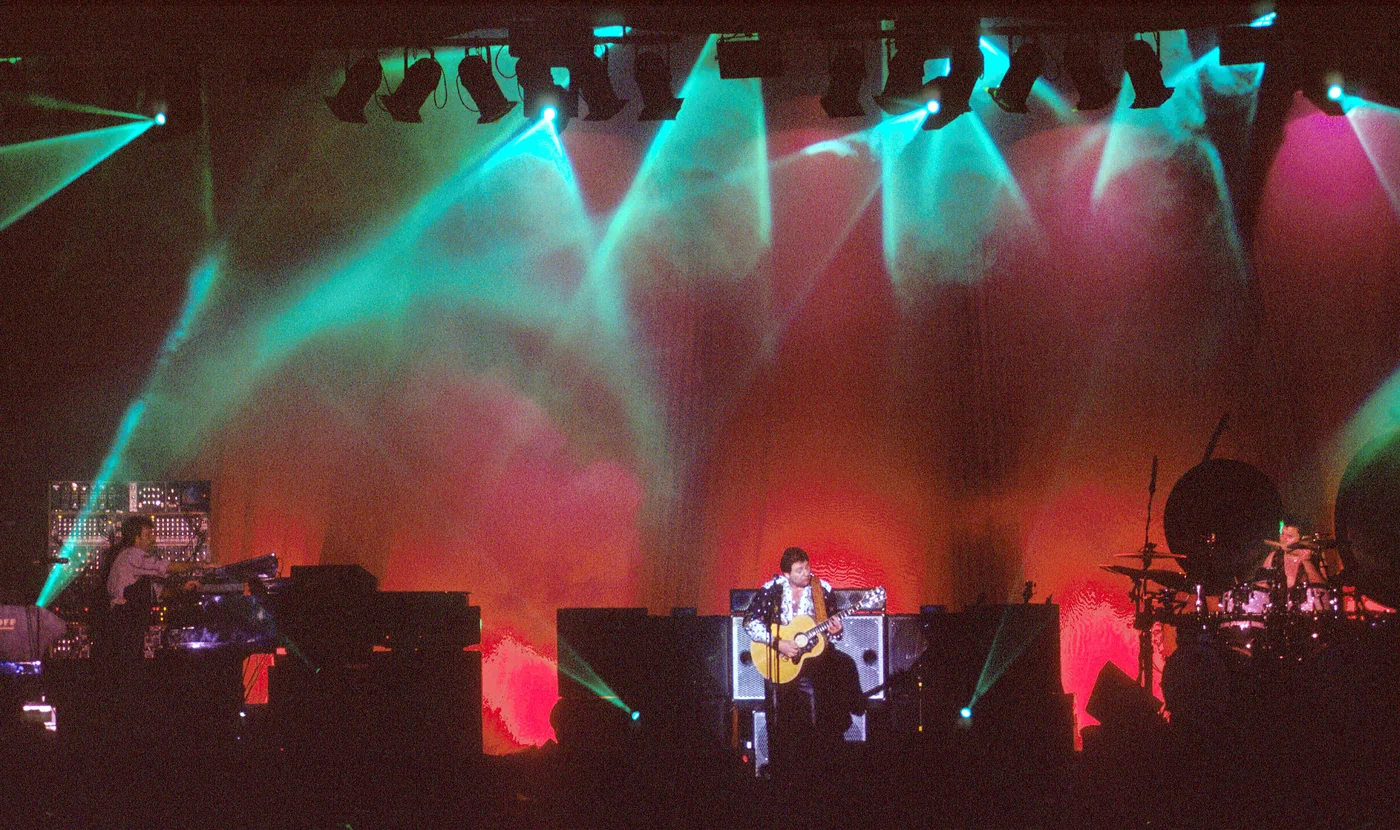
Emerson, Lake & Palmer formed in London in 1970 by combining Keith Emerson's keyboard-led work in the Nice, Greg Lake's singing, bass and production experience with King Crimson, and Carl Palmer's drumming in Atomic Rooster. The trio replaced a conventional guitar front line with Hammond organ, piano and early synthesisers, while Lake's voice and Palmer's percussion kept the music physical.
The scale was matched by immediate results. Their self-titled debut reached number four in Britain; Tarkus became their only UK number-one album; and the live Pictures at an Exhibition, Trilogy and Brain Salad Surgery all reached the British Top Three. Adaptation, original composition, acoustic song and stage spectacle were not separate sidelines but parts of one trio identity.
Formation & History
Emerson and Lake began working together early in 1970 and invited Palmer to rehearse after considering other drummers. ELP played an initial concert in Plymouth before appearing at the Isle of Wight Festival on 29 August. The official history treats that festival performance as the group's breakthrough, while Carl Palmer recalls an audience hearing unreleased material and responding strongly. The debut was recorded at Advision Studios with Lake as producer and Eddy Offord as engineer.
The group moved quickly. Tarkus was recorded during a break in the first tour; Pictures at an Exhibition preserves a Newcastle City Hall performance from 26 March 1971; and Trilogy followed in 1972. ELP founded Manticore Records in 1973 and released Brain Salad Surgery on the label that December. The 1974 California Jam and the triple live album Welcome Back My Friends to the Show That Never Ends document the touring scale of this period.
After an extended pause, the double album Works Volume 1 returned in 1977 with one side for each member and a fourth for the trio. Parts of the subsequent North American tour used an orchestra and choir, but that model was expensive and short-lived. Works Volume 2 assembled earlier unreleased recordings, and the group entered an indefinite hiatus soon after Love Beach in 1978.
The original trio reunited for Black Moon and a 1992–93 world tour. In the Hot Seat followed in 1994; four more years of touring ended with a permanent split in 1998. Emerson, Lake and Palmer played together once more for their 40th anniversary at the High Voltage Festival in London on 25 July 2010.
Sound & Style
ELP's core sound depends on three sharply separated roles. Emerson moves between piano, Hammond organ, Clavinet and Moog synthesisers, often carrying harmony, bass-like figures and lead lines at once. Lake alternates electric bass with acoustic and electric guitar, and his voice can reduce the scale for songs such as “Lucky Man” or “From the Beginning.” Palmer uses tuned percussion, rapid snare articulation and changing metres to make Emerson's structures move rather than merely display complexity.
The classical material is transformed rather than reproduced intact. Pictures at an Exhibition selects and rearranges Mussorgsky, adding Lake's “The Sage,” group-written passages and “Nut Rocker.” “The Barbarian” reworks material by Bartók; “Hoedown” and “Fanfare for the Common Man” recast Copland through electronic timbre and trio momentum. On Brain Salad Surgery, Emerson's treatment of Ginastera's “Toccata” sits beside Lake's acoustic writing and the nearly thirty-minute original “Karn Evil 9.”
The albums also resist a single formula. Tarkus places a twenty-minute seven-part suite beside compact character pieces, Trilogy exposes solo piano and acoustic guitar, and Works Volume 1 separates the members before reuniting them. The contrast between written architecture and live physicality—not sheer size alone—is what makes the trio recognisable.
Essential Albums
Tarkus
1971Recorded at Advision during a break in ELP's first tour, Tarkus devotes side one to a 20:59, seven-part original suite. Emerson's organ and synthesiser figures establish recurring material, Lake supplies vocal sections and the “Battlefield” contribution, and Palmer maintains continuity through changing metres. Side two changes scale through “Jeremy Bender,” “Bitches Crystal,” “The Only Way” and the loose studio finale “Are You Ready, Eddy?” The album reached number one in Britain for one week.
Key tracks: Tarkus: i. Eruption / ii. Stones of Years / iii. Iconoclast / iv. Mass / v. Manticore / vi. Battlefield / vii. Aquatarkus · The Only Way · Are You Ready Eddy?
Open album guide → View on Amazon →Brain Salad Surgery
1973Released by Manticore in December 1973, Brain Salad Surgery places four shorter tracks before “Karn Evil 9” crosses the original LP boundary and continues through three impressions. “Jerusalem” adapts Hubert Parry, “Toccata” reworks the fourth movement of Alberto Ginastera's First Piano Concerto, and “Still…You Turn Me On” narrows the texture to Lake's songcraft. H. R. Giger designed the sleeve and the ELP logo associated with it.
Key tracks: Jerusalem · Karn Evil 9: 1st Impression, Part 1 · Karn Evil 9: 3rd Impression
Open album guide → View on Amazon →Recorded at Newcastle City Hall on 26 March 1971, this live album rearranges selected movements from Mussorgsky's piano suite rather than presenting it whole. Recurring “Promenade” sections connect Emerson's organ-led adaptations with Lake's original “The Sage,” the group-written “Blues Variation” and “The Curse of Baba Yaga,” and the closing “Nut Rocker.” Audience sound and exposed trio transitions make live risk part of the arrangement. It reached number three in Britain.
Key tracks: Promenade · Blues Variation · The Great Gates of Kiev / Nutrocker
Open album guide → View on Amazon →Affiliate note: Amazon links on this page may earn RetroForge Records a small commission, at no extra cost to you.
Deeper Cuts
Trilogy
1972Recorded at Advision with Eddy Offord, Trilogy moves from the three-part “The Endless Enigma” through solo piano, Lake's acoustic “From the Beginning,” the compact “Living Sin” and the electronic momentum of “Abaddon's Bolero.” It reached number two in Britain, while “From the Beginning” became ELP's highest-charting US single.
Open album guide → View on Amazon →Works Volume 1
1977The double album assigns its first three sides to Emerson, Lake and Palmer respectively, then reunites the trio on side four. Emerson contributes a three-movement piano concerto; Lake works with orchestra and lyricist Peter Sinfield; Palmer presents percussion, big-band and adaptation pieces. The shared side includes “Fanfare for the Common Man” and “Pirates.”
Open album guide → View on Amazon →Black Moon
1992ELP's first studio album with the original trio since 1978 uses a denser early-1990s production while retaining the division between Emerson's keyboards, Lake's voice and bass, and Palmer's percussion. The title track responds to the Gulf War; “Paper Blood” and “Affairs of the Heart” favour compact song form, while “Changing States” and “Close to Home” give Emerson instrumental space.
Open album guide → View on Amazon →Why They Still Matter
ELP made progressive rock commercially visible without reducing its formal ambition. Official Charts records seven UK Top-10 albums between the 1970 debut and Works Volume 1, while “Fanfare for the Common Man” reached number two as a single. Those results belong to music built from a side-long original suite, a live Mussorgsky adaptation, acoustic ballads, electronic experiments and a triple live album—not to one repeatable radio formula.
The catalogue remains useful because it shows what three musicians can do when arrangement replaces conventional instrumentation. Emerson's keyboards carry orchestral and guitar-like functions; Lake gives the structures voice, bass weight and moments of restraint; Palmer makes metre and timbre dramatic. The final 2010 performance closes the group's chronology, but the contrast between composition and physical execution remains audible in both the studio records and the live archive.
Sources & Further Reading
Connected archive routes
Explore This Band
Continue through the RetroForge knowledge graph
Curated paths into the people, records, events and ideas that give this subject its wider musical context.
Genres and scenes
Sounds and instruments
- Hammond Organ
Festivals
- California Jam 1974: Rock Television at Speedway Scale
- Isle of Wight 1970: The Colossal Festival at the Edge of an Era
- Isle of Wight Festival 1968–1969: Before the Half-Million Crowd