The key goes down
The player’s finger moves a pressure pad and a rubber pinch roller into position.

RetroForge Instrument Guide
An orchestra stored on tape: recognisable flutes, strings and choirs made uncanny by motors, springs and an eight-second limit.
First, recognise the machine
The classic Mellotron does not generate a tone. Each key starts a recording of a real instrument or voice held on magnetic tape. What reaches the loudspeaker is therefore part performance, part recording and part mechanical transport.
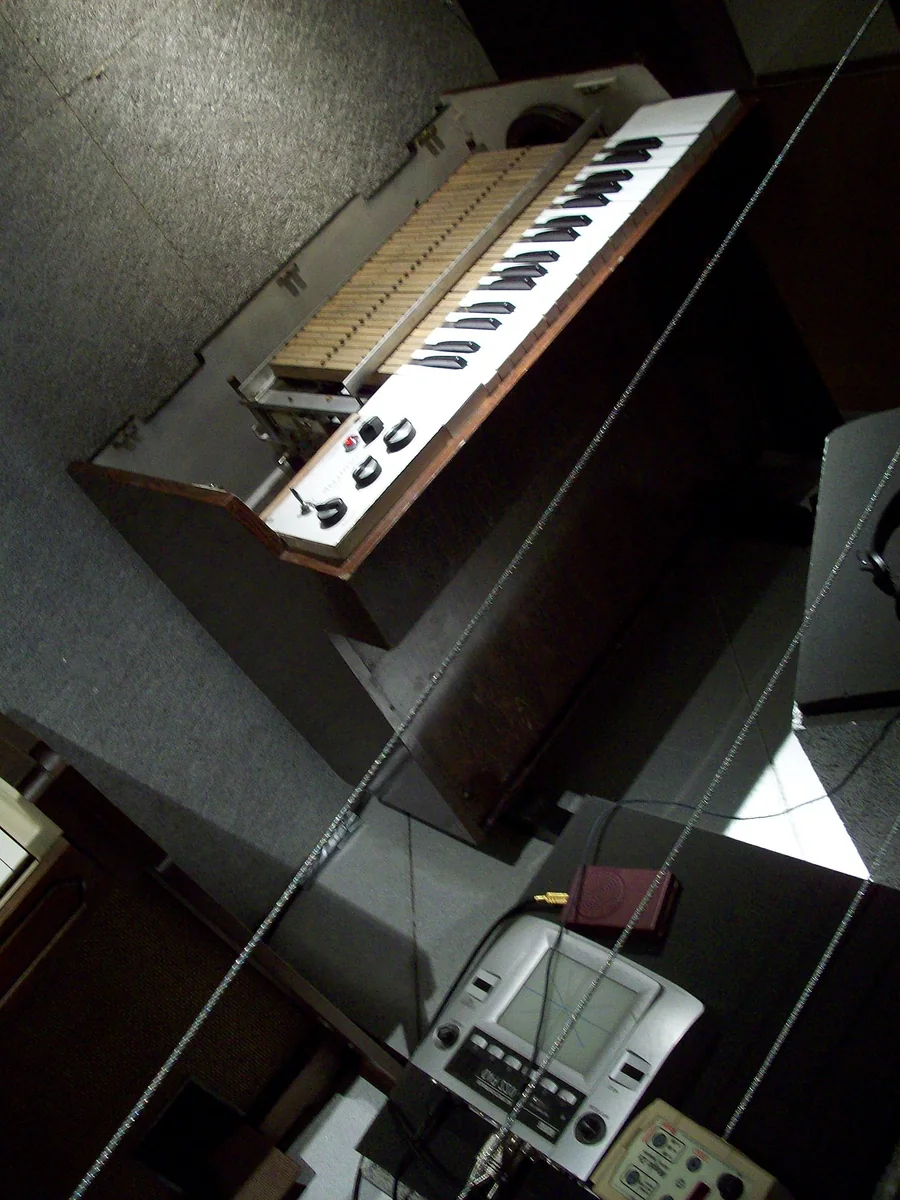
The model in the photograph
With the lid removed, the M400’s logic becomes visible. Behind the keyboard sits the removable tape frame. Beneath every key is a small transport that brings one strip of tape into contact with its playback head.
The compact, single-manual M400 replaced the larger dual-manual format of earlier Mellotrons. Its removable frame also made changing the available sound set more practical.
Photograph: “Mellotron (1972) playing” by Andrew Garton, Wikimedia Commons, CC BY-SA 2.0. Converted to WebP and resized.
One key, one miniature tape machine
This simplified path shows the functional sequence. It is an explanatory diagram, not a scale engineering drawing.
The player’s finger moves a pressure pad and a rubber pinch roller into position.
The pinch roller presses that key’s tape strip against the continuously rotating capstan.
The capstan pulls the strip forward at a steady speed across its playback head.
A prerecorded flute, string, choir or other sound is converted into an electrical signal.
The signal passes through the instrument’s electronics to an amplifier or recording desk.
Inside the tape frame
An M400 tape carries three parallel recorded tracks. The selector places the playback heads over track A, B or C; positions between two tracks allow neighbouring sounds to be blended.
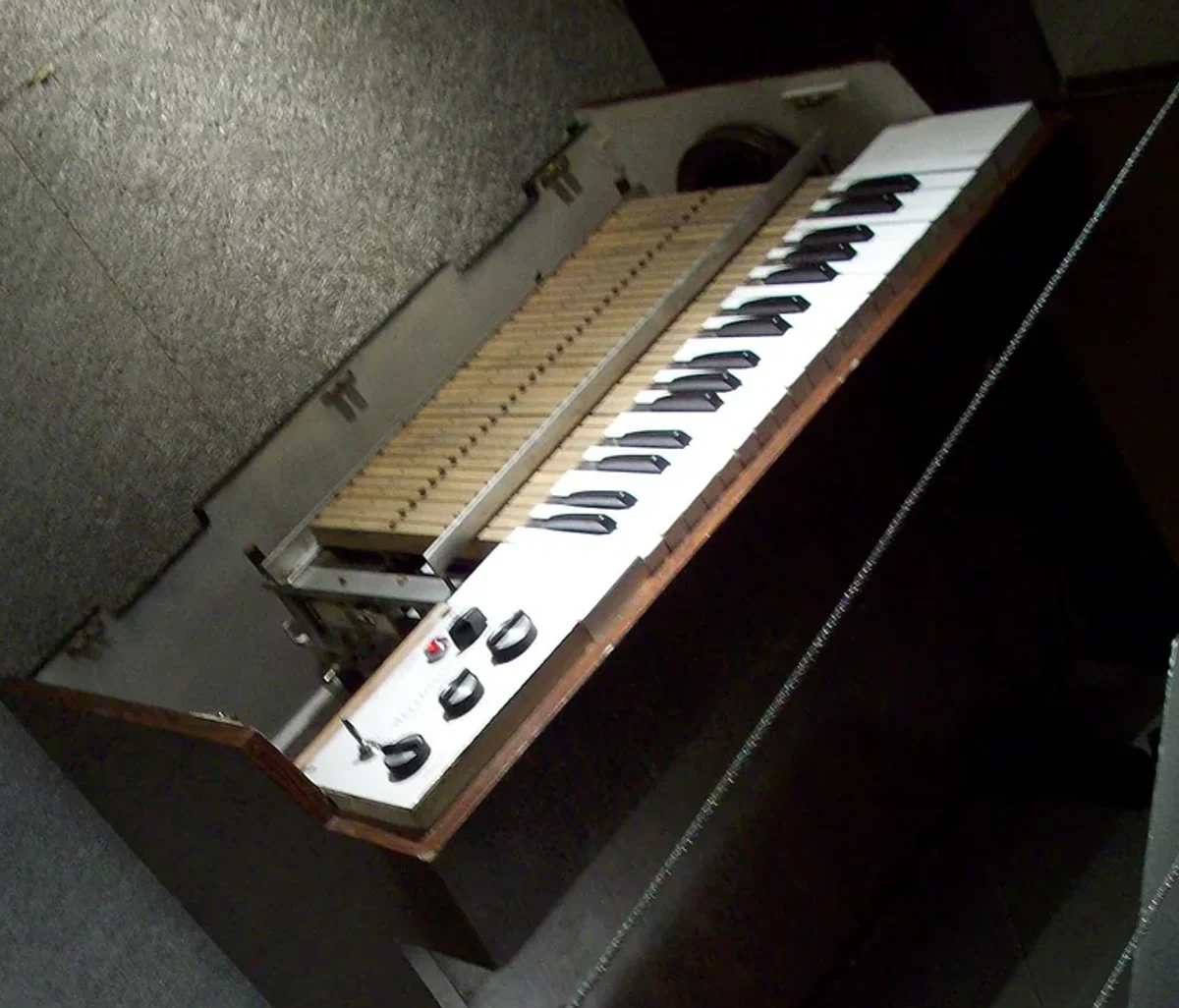
The exact sound set depends on the installed frame. This is why “the Mellotron sound” is not a single preset: the identity comes from the source recording, the chosen track and the way the tape transport reproduces it.
Why it sounds alive
A modern sampler can hide the act of playback. The Mellotron makes it audible. Its limitations are not incidental defects around the sound; they shape how the player phrases and how the listener perceives scale, distance and unease.
Each key contains the attack and timbre of the originally recorded performer. A chord stacks those separate recorded moments rather than producing one neutral electronic envelope.
Because a note cannot continue indefinitely, players release and retrigger keys, stagger chord tones or leave space before the tape runs out.
Tape transport, adjustment and wear can introduce small fluctuations. The result sits between a stable keyboard pad and a remembered acoustic performance.
The tape and playback system soften detail and emphasise texture. Strings become mass; choir becomes atmosphere; flute becomes unusually intimate.
Playing the limitation
The instrument rewards arrangement rather than constant coverage. A Mellotron can dominate a mix, so its strongest entrances often mark a threshold: the widening of a chorus, the return of a theme or the moment a small ensemble becomes architectural.
Block chords turn separate tape recordings into a broad ensemble. Close voicings feel dense; open voicings leave air around the grain of the tapes.
A flute or cello line exposes the character of individual notes. Phrasing becomes more vocal because every new key begins another recorded event.
Skilled playing disguises—or deliberately reveals—the time limit. Releasing a note sends its tape home; a fresh press begins the recording again.
From rooms to removable frames
The Mellotron belongs to a longer tape-keyboard history. Harry Chamberlin developed instruments in the United States before the British Mellotron line appeared; later models reorganised the same basic idea for studios and touring musicians.
Harry Chamberlin’s tape-replay keyboards established the principle: prerecorded instrumental performances placed under direct keyboard control.
The large dual-manual Mellotron became associated with studios, pop experimentation and the first wave of orchestral rock, despite its size and mechanical demands.
A compact 35-note manual and removable tape frame made the instrument more practical. This is the white model most closely associated with progressive rock stages.
Listening anatomy
Do not listen only for “old strings.” Follow where the Mellotron enters, how long it stays and what changes around it. These examples show flute, choir and string tapes taking very different structural roles.
Listen to the opening flute figure: intimate and recognisable, yet too even and self-contained to feel like a flautist standing in the room.
Open the 1967 story → King Crimson · 1969Follow how Mellotron strings enlarge “Epitaph” and the title track. The instrument is not decoration; it supplies weight, dread and architectural scale.
Read the album guide → Genesis · 1972Listen for entrances that alter the size of the scene. Tony Banks uses sustained colour to frame transitions inside already theatrical arrangements.
Read the album guide → Yes · 1972Hear the tape sonority beside organ and synthesizer. Its grain provides a different kind of sustained mass inside a fast-moving ensemble.
Read the album guide → Tangerine Dream · 1974Notice how Mellotron timbres hover between the sequenced electronics and an imagined acoustic landscape, making the music feel both physical and remote.
Read the album guide → The Moody Blues · 1967Compare Mike Pinder’s keyboard colour with the album’s orchestral passages. The boundary between rock group, tape replay and orchestra becomes part of the arrangement.
Continue exploring →Three keyboard worlds
All three can sustain notes from a keyboard, but they begin from different physical principles. That difference affects attack, duration, pitch behaviour and the role each instrument tends to occupy in an arrangement.
| Instrument | Where the sound begins | How long a note lasts | What to listen for |
|---|---|---|---|
| Mellotron | A prerecorded performance on magnetic tape | About eight seconds before the tape must reset | Recorded attacks, grain, wavering pitch and orchestral or choral colour |
| Hammond organ | Electromagnetic tonewheels, shaped with drawbars | As long as the key remains held | Stable tone, harmonic control, key click and rotating-speaker movement |
| Analogue synthesizer | Electronic oscillators and/or filters | Determined by the player and envelope settings | Designed waveforms, filter motion, modulation and continuously reshapeable tone |
Sources and verification
The mechanism and model descriptions were checked against manufacturer history, technical documentation and the photograph record. The six listening examples were checked against official artist or band sources and a contemporary Tony Banks interview. Their descriptions of scale, atmosphere and structural role are original RetroForge listening commentary.
Quick answers
No. A classic Mellotron reproduces prerecorded performances from magnetic tape. It can occupy a similar keyboard role to a synthesizer, but the way it creates sound is fundamentally different.
The playable recording on each strip lasts roughly eight seconds. Releasing the key allows a spring to return the tape to its starting position.
No. The installed tape frame determines the available set, and each strip can hold three parallel tracks. The M400 selector chooses one track or blends adjacent tracks.
Because the classic sound is more than an orchestral recording. Recorded attacks, finite duration, tape bandwidth and mechanical playback all influence the player’s phrasing and the listener’s sense of texture.
Curated paths into the people, records, events and ideas that give this subject its wider musical context.