

Overview
Caravan formed in Canterbury in 1968 from four former members of the Wilde Flowers: Pye Hastings, David Sinclair, Richard Sinclair and Richard Coughlan. Their early records joined compact, dryly humorous songs to jazz harmony, Hammond organ and extended instrumental forms. Richard Sinclair's light baritone and melodic bass gave the original quartet one identity; Hastings's writing and voice gave it another.
The catalogue does not tell one unbroken stylistic story. In the Land of Grey and Pink captures the original quartet at its most balanced, while Waterloo Lily moves towards electric-piano jazz after David Sinclair's departure. Later lineups brought in Geoffrey Richardson's viola and multi-instrumental colour, new bassists and different keyboard players. That ability to absorb personnel changes without losing Hastings's melodic centre is central to Caravan's history.
Formation & History
Hastings, the two Sinclair cousins and Coughlan had all passed through the Wilde Flowers before establishing Caravan in 1968. The self-titled debut appeared as the group's brief association with Verve was ending; a move to Decca's Deram imprint preceded If I Could Do It All Over Again, I'd Do It All Over You and In the Land of Grey and Pink. Those records expanded the quartet's short-song writing into suites without separating the two approaches.
David Sinclair left after In the Land of Grey and Pink. Steve Miller replaced him for Waterloo Lily, bringing a more piano-led jazz character while Richard Sinclair remained on bass and vocals. Richard then departed; by For Girls Who Grow Plump in the Night, Hastings and Coughlan were working with bassist John G. Perry, viola player Geoffrey Richardson and the returning David Sinclair. Subsequent albums changed the keyboard and bass chairs again, with Mike Wedgwood and Jan Schelhaas among the important later members.
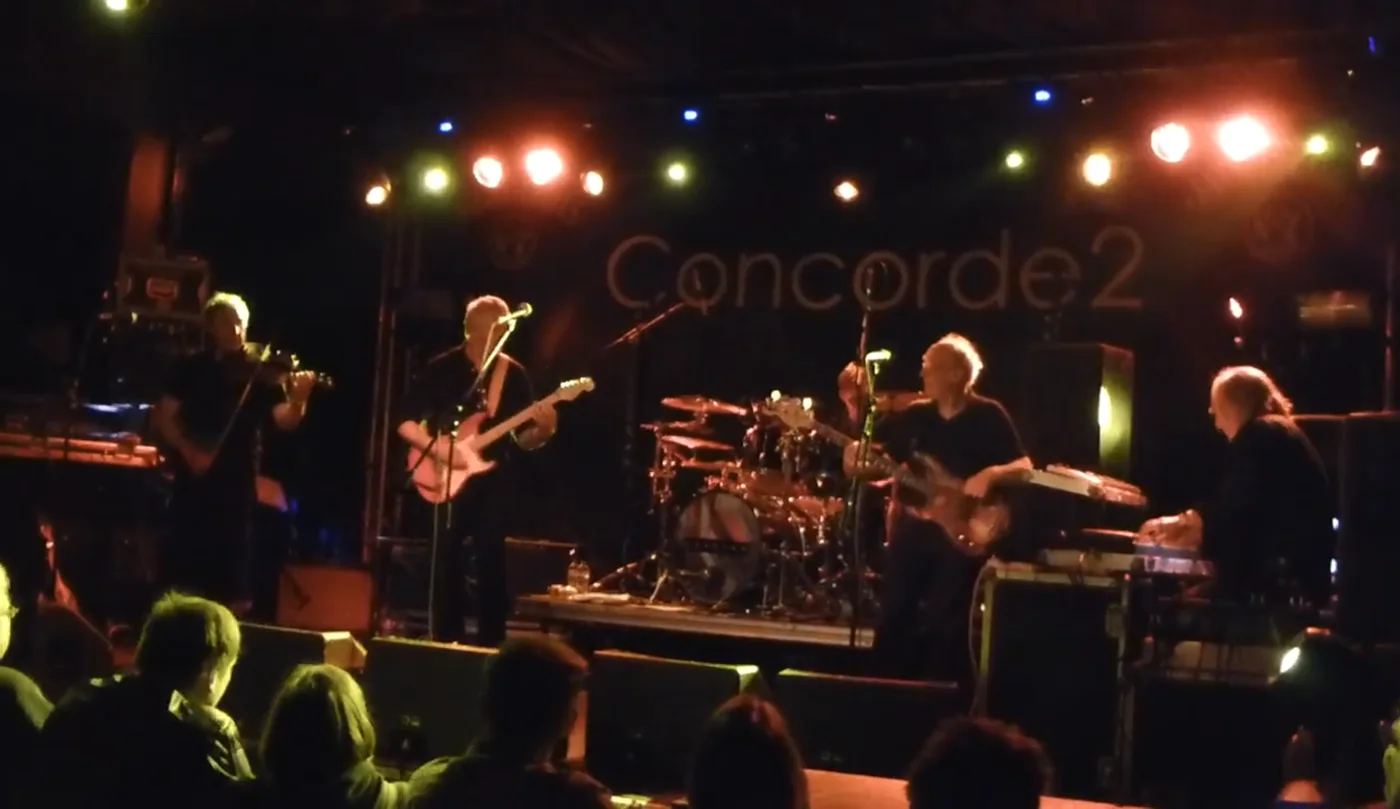
Caravan's activity has included breaks, reunions and further studio work rather than one continuous lineup. Coughlan's illness curtailed live plans after 2005; the band resumed performances with drummer Mark Walker, and Coughlan died in 2013. The studio catalogue continued through Paradise Filter and It's None of Your Business, released in 2021.
Sound & Style
On the original-quartet albums, David Sinclair's Hammond organ can function as chordal bed, fuzz-toned lead voice or the engine of a long instrumental sequence. Richard Sinclair's mobile bass and relaxed lead vocals contrast with Hastings's more direct singing and guitar writing, while Coughlan keeps the changing sections connected. Jimmy Hastings, Pye's brother, adds flute and saxophone to several recordings without becoming a permanent member.
Personnel changes altered the palette in audible ways. Steve Miller's Wurlitzer electric piano gives Waterloo Lily a leaner, more openly jazz-based surface. Geoffrey Richardson's viola, flute and guitar broaden the arrangements from For Girls Who Grow Plump in the Night onward, and later records distribute the singing and writing across different combinations of Hastings, Richardson, Wedgwood, David Sinclair and Schelhaas. Caravan's continuity therefore lies less in one fixed instrument sound than in the recurring connection between memorable vocal lines and spacious ensemble passages.
Essential Albums
The final 1970s album by the original quartet balances four concise first-side songs with David Sinclair's side-long "Nine Feet Underground". Richard Sinclair sings three of the shorter pieces and plays the central bass role; Jimmy Hastings supplies flute and saxophone. It is the clearest single introduction to the contrast between Caravan's songcraft and extended ensemble writing.
Key tracks: Golf Girl · In the Land of Grey and Pink · Nine Feet Underground
Open album guide → View on Amazon →A rebuilt Caravan with John G. Perry on bass, Geoffrey Richardson on viola and the returning David Sinclair on keyboards. Pye Hastings supplies most of the writing, from the linked "Memory Lain, Hugh / Headloss" opening to the closing suite, while Richardson and the orchestral arrangement add colours unavailable to the original quartet.
Key tracks: Memory Lain, Hugh / Headloss · C’Thlu Thlu · L’Auberge du Sanglier / A Hunting We Shall Go / Pengola / Backwards / A Hunting We Shall Go (reprise)
Open album guide → View on Amazon →The second album places compact pieces beside two multi-part performances: "Can't Be Long Now / Françoise / For Richard / Warlock" and "With an Ear to the Ground / You Can Make It / Martinian / Only Cox / Reprise". The original quartet is joined by Jimmy Hastings on flute and saxophone, establishing the scale and instrumental vocabulary developed further in 1971.
Key tracks: If I Could Do It All Over Again, I'd Do It All Over You · Can't Be Long Now / Françoise / For Richard / Warlock · Hello Hello
Open album guide → View on Amazon →Affiliate note: Amazon links on this page may earn RetroForge Records a small commission, at no extra cost to you.
Deeper Cuts
Waterloo Lily
1972Recorded after David Sinclair left, with Steve Miller's Wurlitzer electric piano pushing the still-present Richard Sinclair, Hastings and Coughlan towards a more overt jazz-rock language. "The Love in Your Eye" preserves the long-form side of the band inside this changed keyboard texture.
Open album guide → View on Amazon →Cunning Stunts
1975Mike Wedgwood replaces John G. Perry, David Sinclair contributes substantially before departing again, and three band members share lead vocals. Concise songs sit beside the extended "Dabsong Conshirtoe", making the album a record of both lineup stability and imminent change.
Open album guide → View on Amazon →Jan Schelhaas takes the keyboard chair after David Sinclair's exit. The five-piece lineup, supported by selected guests, favours nine shorter tracks and a four-part comic sequence rather than another side-long suite, while Richardson's multi-instrumental role keeps the arrangements mobile.
Open album guide → View on Amazon →Why They Still Matter
Caravan make the Canterbury scene legible as a network of musicians rather than a rigid genre. Their history connects the Wilde Flowers to Soft Machine, Delivery and Hatfield and the North, while the records themselves show how personnel circulation could change a band's emphasis without erasing its identity.
The six albums highlighted here also resist the idea that Caravan can be reduced to one celebrated 1971 record. The original quartet, the jazzier Waterloo Lily lineup and the Richardson-era group each solve the balance between songs and instrumental development differently. Listening across those transitions reveals a catalogue built through revision, not repetition.
Sources & Further Reading
Caravan — official biography — formation, lineup changes and the band's later history.
Caravan — official discography — album sequence and later studio releases.
Caravan — All Recordings — chronological recording and release reference.
Richard Sinclair — notes on Caravan — first-person context for the debut and original quartet.
Connected archive routes
Explore This Band
Continue through the RetroForge knowledge graph
Curated paths into the people, records, events and ideas that give this subject its wider musical context.
Genres and scenes
- Canterbury Scene
- Progressive Rock