

Edition timeline
The first fairground weekend
A folk-rock label covers a much wider bill of psychedelic, blues, roots and Indian classical music.
Crowd pressure and performance mythology grow
The Doors, Jefferson Airplane, Janis Joplin and other Bay Area networks attract attention beyond San Jose.
The second edition expands to three days
Hendrix, Chuck Berry, Santana and a broad touring bill increase scale and complexity.
The experiment does not become a stable series
Other Bay Area and national festival models absorb attention while the fairground returns to ordinary uses.
Why this event matters
This series is a page about credibility. The festival boom created opportunities for promoters, but posters, contracts and counterculture expectations did not always align. The documented anchor for this section is First edition: 18–19 May 1968 at Santa Clara County Fairgrounds / Family Park, San Jose. That fact is kept separate from later legend, because programmes, press reports, film and participant memory answer different questions. San Jose belonged to the wider Bay Area live ecosystem but stood outside the familiar San Francisco narrative. Santa Clara County Fairgrounds became an important regional rock site. The documented anchor for this section is Second edition: 23–25 May 1969 at the same general fairgrounds complex. That fact is kept separate from later legend, because programmes, press reports, film and participant memory answer different questions. The fairground was neither Monterey nor Golden Gate Park. Its civic setting connected the event to San Jose’s rapidly expanding suburban youth culture. The documented anchor for this section is Bob Blodgett was the promoter. That fact is kept separate from later legend, because programmes, press reports, film and participant memory answer different questions. The strong 1968 programme was accompanied by reports of a serious drug-related medical emergency. Contemporary and specialist archival evidence is more reliable here than later inflated totals. The documented anchor for this section is 1968 performers documented in multiple sources include The Doors, Jefferson Airplane, Big Brother & the Holding Company with Janis Joplin, Country Joe and the Fish, Taj Mahal, Ravi Shankar and others; Grateful Dead also performed despite not appearing on some promotional material. That fact is kept separate from later legend, because programmes, press reports, film and participant memory answer different questions.

1969: advertising versus reality
Advertising, bookings and actual appearances diverged in 1969. Performers are therefore described as advertised, booked or confirmed only where the surviving evidence supports that distinction. The documented anchor for this section is The 1968 event became notorious for drug-related medical emergencies, especially PCP-related incidents in later accounts. That fact is kept separate from later legend, because programmes, press reports, film and participant memory answer different questions. Jimi Hendrix and Santana give 1969 real historical weight even without every advertised act appearing. The documented anchor for this section is 1969 advertising became controversial because some advertised artists were not firmly booked; poster billing and confirmed performance are therefore distinguished. That fact is kept separate from later legend, because programmes, press reports, film and participant memory answer different questions. The second year’s experience was shaped by the existence of a free rival festival nearby, creating an unusual split in festival culture. The documented anchor for this section is Jimi Hendrix did perform in 1969; the festival also included Santana before the band’s debut album and Woodstock breakthrough. That fact is kept separate from later legend, because programmes, press reports, film and participant memory answer different questions. The 1968 medical emergency and the rivalry of 1969 raised questions about promoter responsibility, production and crowd welfare that extend beyond the music. The documented anchor for this section is A rival Aquarian Family Festival ran nearby at San Jose State during the same 1969 weekend. Later participant/specialist histories describe it as a free counter-event organised partly in protest against the commercial festival and its advertising; The relationship requires attribution rather than treatment as an uncontested institutional fact. That fact is kept separate from later legend, because programmes, press reports, film and participant memory answer different questions.
.jpg)
What happened afterward
There was no third Northern California Folk-Rock Festival. The Aquarian counter-event is part of why the second edition makes such an interesting endpoint. The documented anchor for this section is First edition: 18–19 May 1968 at Santa Clara County Fairgrounds / Family Park, San Jose. That fact is kept separate from later legend, because programmes, press reports, film and participant memory answer different questions. Posters and handbills are common in collector archives, but precisely because advertising was controversial they must never be treated as proof that every name performed. The documented anchor for this section is Second edition: 23–25 May 1969 at the same general fairgrounds complex. That fact is kept separate from later legend, because programmes, press reports, film and participant memory answer different questions. These festivals show the Bay Area festival ecosystem becoming contested between commercial promoters and free/communal alternatives. The story is not just psychedelic abundance; it is an argument over what a festival should be and who should control it. The documented anchor for this section is Bob Blodgett was the promoter. That fact is kept separate from later legend, because programmes, press reports, film and participant memory answer different questions. The surviving poster is evidence of what was advertised, not automatic proof of who performed. That difference makes this festival a useful lesson in reading popular-music archives. The documented anchor for this section is 1968 performers documented in multiple sources include The Doors, Jefferson Airplane, Big Brother & the Holding Company with Janis Joplin, Country Joe and the Fish, Taj Mahal, Ravi Shankar and others; Grateful Dead also performed despite not appearing on some promotional material. That fact is kept separate from later legend, because programmes, press reports, film and participant memory answer different questions.


Follow the festival beyond the field
Timeline
Related genres
More routes will be connected as the archive grows.
Related band guides
More routes will be connected as the archive grows.
Explore by sound
More routes will be connected as the archive grows.
Essential listening
Sources and further reading
- 1968 festival performance recordThe Doors Performance History · accessed 23 July 2026
- San Jose outdoor rock festivals 1967–1969Rock Prosopography 101 · accessed 23 July 2026
- The Electric Flag and the 1968 festivalMike Bloomfield: An American Music Story · accessed 23 July 2026
- Santa Clara County FairgroundsThe Fairgrounds · accessed 23 July 2026
- Festival and period artist image sourcesWikimedia Commons · accessed 23 July 2026
Image credits5 licensed images
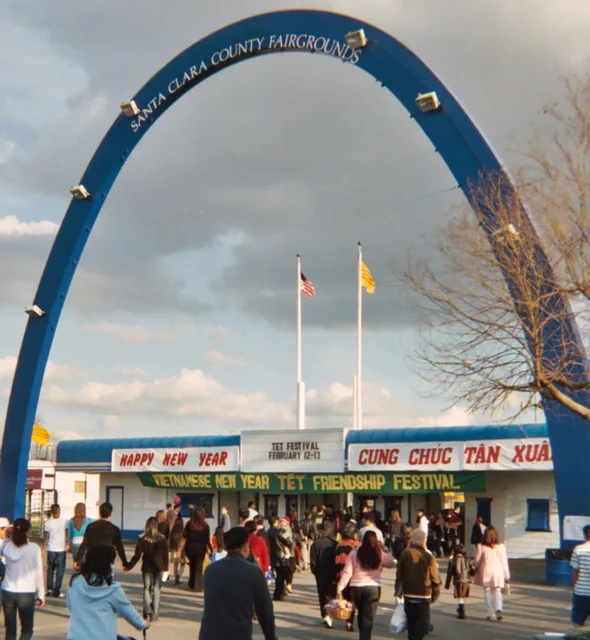
The Santa Clara County Fairgrounds entrance during a later community festival. It documents the continuing fairground site, not its appearance during the Northern California Folk-Rock Festival — Unknown creator — Wikimedia Commons — CC BY 2.0 · source record · CC BY 2.0
Converted to WebP and resized; no generative or compositional alterations.
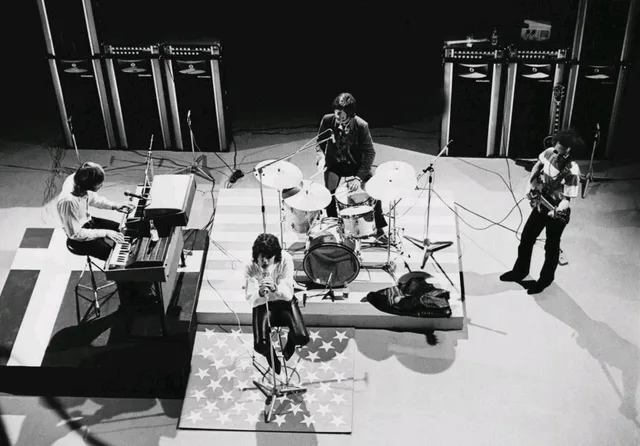
The Doors performing for Danish television in 1968. This period image supplies lineup context for the first San Jose edition without claiming to show the fairgrounds stage — Polfoto/Jan Persson — Wikimedia Commons — Public domain · source record · Public domain
Converted to WebP and resized; no generative or compositional alterations.
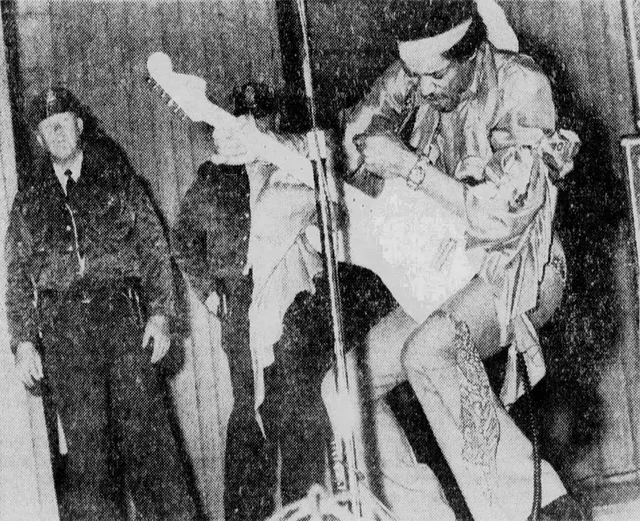
Jimi Hendrix performing in Memphis in 1969. The contemporary newspaper photograph provides artist context for his San Jose appearance and is not a Northern California festival image — James Shearin — Wikimedia Commons — Public domain · source record · Public domain
Converted to WebP and resized; no generative or compositional alterations.
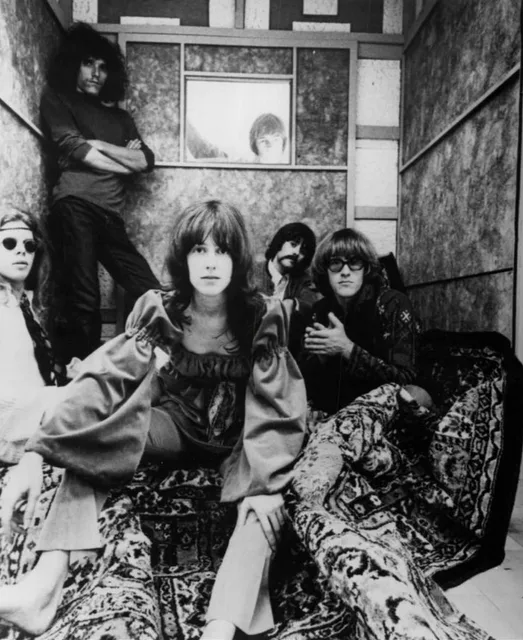
Jefferson Airplane in a 1967 publicity photograph. The band represents the Bay Area network that linked the fairground experiment to the wider psychedelic scene — RCA Records/photographer: Herb Greene — Wikimedia Commons — Public domain · source record · Public domain
Converted to WebP and resized; no generative or compositional alterations.
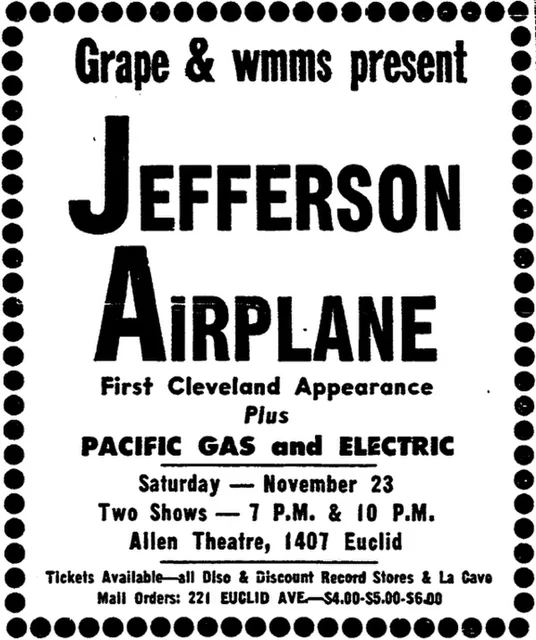
A 1968 Jefferson Airplane concert advertisement. It is used as contemporary touring context, not as a poster for the Northern California Folk-Rock Festival — Grape, Pacific Gas and Electric, WMMS, et al. — Wikimedia Commons — Public domain · source record · Public domain
Converted to WebP and resized; no generative or compositional alterations.