
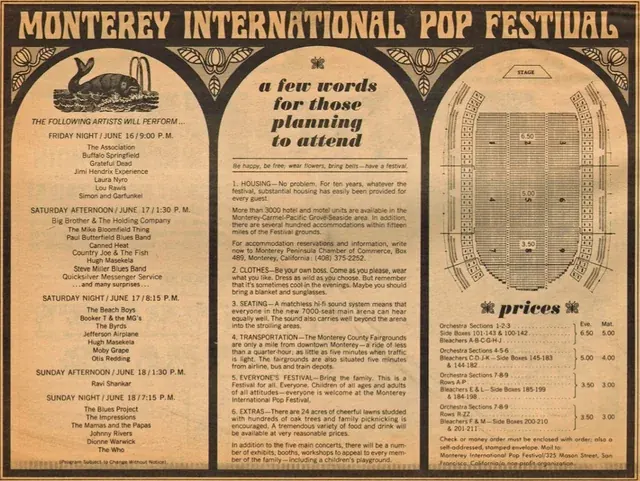

Why this event matters
Monterey did not invent the outdoor music festival, and it was not the first large gathering built around popular music. Its importance lies elsewhere. The organisers treated contemporary pop as a culture broad enough to support a serious international programme, professional stage management, charitable purpose and documentary record. Instead of presenting one local scene for its established followers, Monterey placed several scenes beside one another and allowed the contrasts to become the story.
That arrangement changed reputations. The Jimi Hendrix Experience and The Who arrived with British momentum but without an equivalent American public profile. Otis Redding entered a rock festival environment without surrendering the discipline and force of Southern soul. Ravi Shankar was not reduced to a decorative sign of “Eastern” fashion: his long Sunday performance demanded a different kind of attention. Janis Joplin, appearing with Big Brother and the Holding Company, became one of the film's decisive presences. Monterey mattered because a performance could travel outward from the fairgrounds through cameras, recordings, press reports and memory.
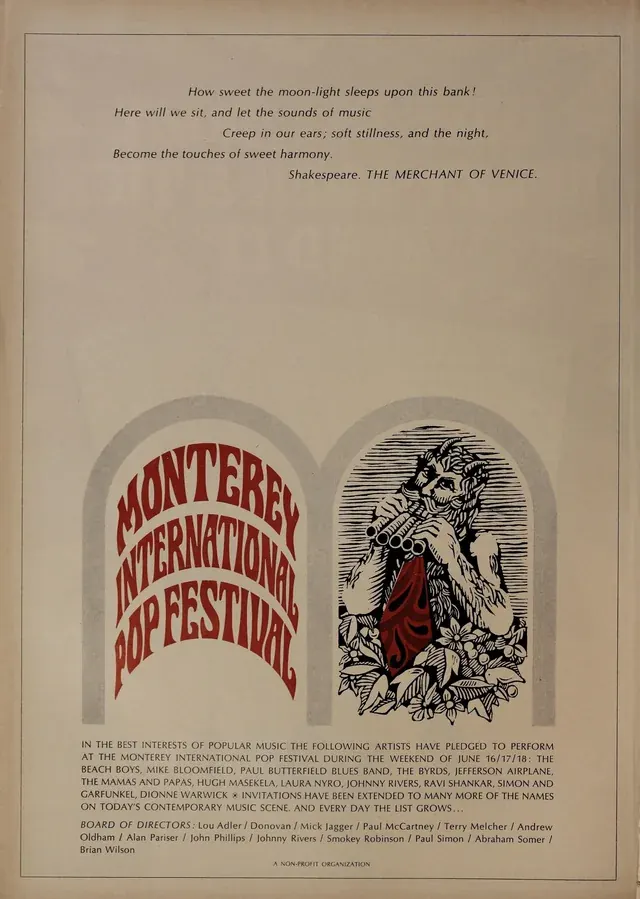

Before the gates opened
The festival emerged at a moment when the record business could no longer treat rock as a sequence of disposable singles and touring packages. San Francisco's ballrooms had developed their own ecology of promoters, light shows, extended performances and communal audiences. Los Angeles supplied another network: musicians, television, studios and people who understood publicity. Monterey brought these worlds together through a board and production team that included figures from inside the music industry rather than positioning the event entirely outside it.
The distinction is important. Monterey's countercultural aura was real, but so was its organisation. Most artists waived conventional performance fees, while travel and accommodation expenses were covered; Ravi Shankar was a documented exception. Profits were intended for the festival foundation's charitable work. The programme, press operation and filming were planned, even when negotiations and last-minute decisions remained messy. Publicist Derek Taylor was part of the core planning group and helped shape the festival's press operation. This was not a spontaneous crowd that happened to find a stage. It was an attempt to build an institution for a musical culture whose institutions had not yet caught up with its ambitions.
The place and the people
The Monterey County Fairgrounds offered something later rural festivals often lacked: an existing arena, controlled entrances and basic infrastructure. The audience could still dress, move and behave in ways that press coverage associated with the emerging counterculture, but the event did not need to create an entire town from bare farmland. That relative containment helped the music remain central. It also made the festival legible to cameras. Performers could be framed against a stage rather than disappearing into an unmanageable landscape.
Monterey sat at the edge of the Summer of Love rather than functioning as a simple advertisement for it. The audience encountered musicians from Los Angeles, San Francisco, Britain, Memphis, Chicago and India. The bill made audible how incomplete any single story of 1967 would be. Psychedelia was present, but so were soul revue precision, blues-derived guitar spectacle, folk-rock songwriting, pop harmony and a classical tradition with its own time scale and discipline.

The musical programme
The line-up was not a neutral survey. Several major artists were absent, and the surviving film inevitably shaped which appearances became canonical. Still, the programme was unusually open. Simon and Garfunkel, The Association and The Mamas & the Papas represented highly visible American pop; Jefferson Airplane, Quicksilver Messenger Service and the Grateful Dead carried versions of the San Francisco scene; The Byrds and Buffalo Springfield connected folk rock to newer forms; Booker T. & the M.G.'s backed Otis Redding in a set grounded in the Stax sound.
The British performances were built around compression and theatre. The Who's destructive finale and Hendrix's burning guitar have often been allowed to stand for the whole festival, but their impact depended on contrast. They appeared in a weekend that also made room for Laura Nyro, Hugh Masekela, Lou Rawls and the sustained attention of Ravi Shankar's set. Monterey's deepest lesson was not that one style had won. It was that a festival could create meaning by placing incompatible musical ideas in sequence.
Stage, sound and the camera
Modern festival production makes it easy to underestimate the difficulty of presenting this range in 1967. Amplification, changeovers and monitoring had to serve acts whose arrangements and stage volumes differed sharply. The surviving performances do not document a frictionless system. They document musicians adapting to a shared platform. That practical problem—how to make unlike acts work through the same stage—became one of the central engineering questions of later festival culture.
D. A. Pennebaker's film did more than preserve highlights. Editing gave the event a second architecture. Close views of faces, hands, instruments and audience attention could communicate an intimacy unavailable to many people inside the arena. The film did not reproduce the full weekend and should not be mistaken for a complete record. It created a persuasive route through the event, and that route became inseparable from Monterey's historical reputation.

What happened afterward
The careers most visibly accelerated by Monterey did not all move in the same direction. Hendrix became a major American attraction; The Who expanded their US audience; Joplin's presence pushed her toward a new level of recognition; Redding's performance became a central part of his posthumous public memory after his death later that year. These outcomes tempt hindsight. The useful historical point is not that Monterey “discovered” artists who had no previous lives. It is that the festival concentrated attention and provided a durable medium through which that attention could spread.
The charitable foundation outlived the weekend, an unusual continuation of the organisers' stated purpose. Later festivals borrowed parts of Monterey's model but often did so at much larger scale and under harsher logistical conditions. Woodstock expanded the temporary community; Isle of Wight tested the limits of mass attendance; commercial touring eventually normalised the multi-act event. Monterey remained distinctive because its size, programme and documentation briefly stayed in balance.
Films, recordings and surviving documents
Monterey Pop is the best-known document, but it is only one layer of the record. Pennebaker's team shot far more material than could fit one feature, and later editions restored additional performances. Audio releases likewise separate particular artists from the weekend and allow close listening without reproducing the sequence heard in the arena. Publicity photographs, newspaper advertisements and foundation records answer different questions: how the festival presented itself, how it was sold and how its charitable purpose continued.
These sources should not be forced into agreement. A film edit values dramatic rhythm. A programme records intention before delays or substitutions. A photograph freezes one chosen instant and often gives the stage more visual order than an audience member experienced. Reading them together makes the archive stronger because each medium reveals the limits of the others.

What the archive cannot show
The dominant archive favours artists caught by professional cameras and later judged historically important. It says less about routine labour, minor performances, queues, transport, food and the many hours when nothing iconic happened. It also favours the sightlines of photographers with access. The weekend remembered through close-ups was experienced by most people from much farther away.
That imbalance is not a reason to reject the film or famous images. It is a reason to describe them accurately. Monterey's visual clarity can make the festival seem inevitable and perfectly curated. In reality it depended on negotiation, technical compromise and decisions made under time pressure.
Legacy
Monterey is best understood as a junction. It joined underground credibility to music-industry skill, live event to documentary cinema, local scenes to an international bill, and performance to charitable structure. None of those combinations was wholly new. Their concentration over one weekend was. The festival offered a working demonstration that rock culture could be curated without being made uniform.
Its mythology should still be handled carefully. The famous guitar fire was one performance gesture, not a summary of an entire generation. The Summer of Love did not begin or end at a fairground gate. What survives is more useful than a slogan: evidence of musicians and organisers discovering that a festival could be an argument about what contemporary music had become.
Follow the festival beyond the field
Timeline
Related genres
Related band guides
Explore by sound
Essential listening
RetroForge Echo
Hear a Fictional Archive Response
These modern RetroForge releases echo part of the festival’s musical vocabulary; they are not historical festival recordings.
Sources and further reading
- Monterey International Pop Festival FoundationMonterey International Pop Festival Foundation · accessed 23 July 2026
- 50th Anniversary Community Stories ProjectCity of Monterey · accessed 23 July 2026
- The Complete Monterey Pop FestivalThe Criterion Collection · accessed 23 July 2026
- How TIME Covered the Original Monterey Pop FestivalTIME · accessed 23 July 2026
- Monterey International Pop Festival archive entryThe Who · accessed 23 July 2026
Image credits5 licensed images
An early advertisement for Monterey Pop — Unknown photographer — Wikimedia Commons — Public domain · source record · Public domain
Converted to WebP and resized; no generative or compositional alterations.
A 1967 publicity image for the Monterey International Pop Festival, part of the event's carefully organised presentation of a new pop generation — Monterey International Pop Festival — Wikimedia Commons — Public domain · source record · Public domain
Converted to WebP and resized; no generative or compositional alterations.
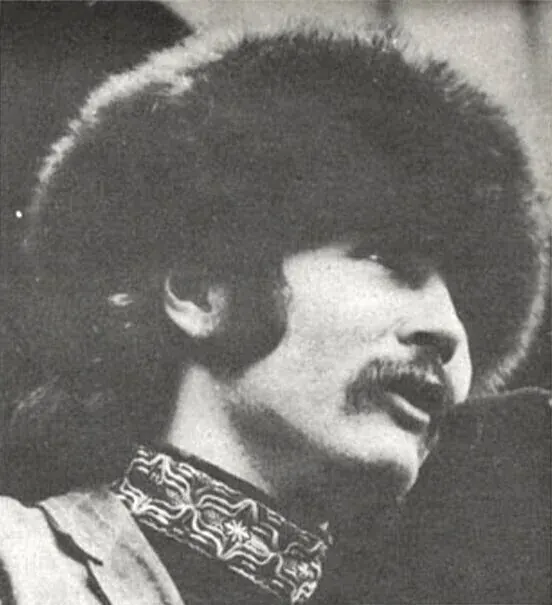
David Crosby at Monterey — Unknown photographer — Wikimedia Commons — Public domain · source record · Public domain
Converted to WebP and resized; no generative or compositional alterations.
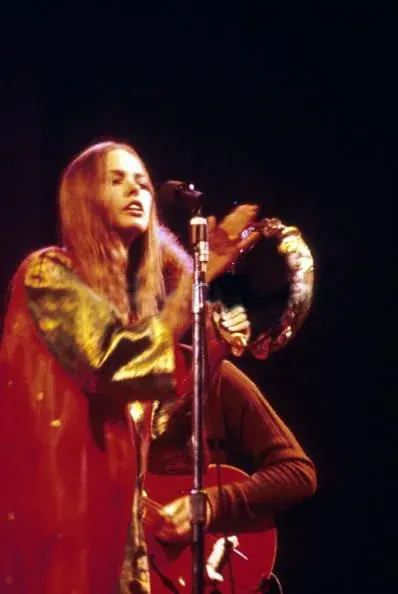
Michelle Phillips at Monterey in 1967 — Unknown photographer — Wikimedia Commons — Public domain · source record · Public domain
Converted to WebP and resized; no generative or compositional alterations.
Marty Balin of Jefferson Airplane at Monterey, where the San Francisco scene met a much wider public — Michael Albov (mikegoat) — Wikimedia Commons — CC BY 2.0 · source record · CC BY 2.0
Converted to WebP and resized; no generative or compositional alterations.