

Overview
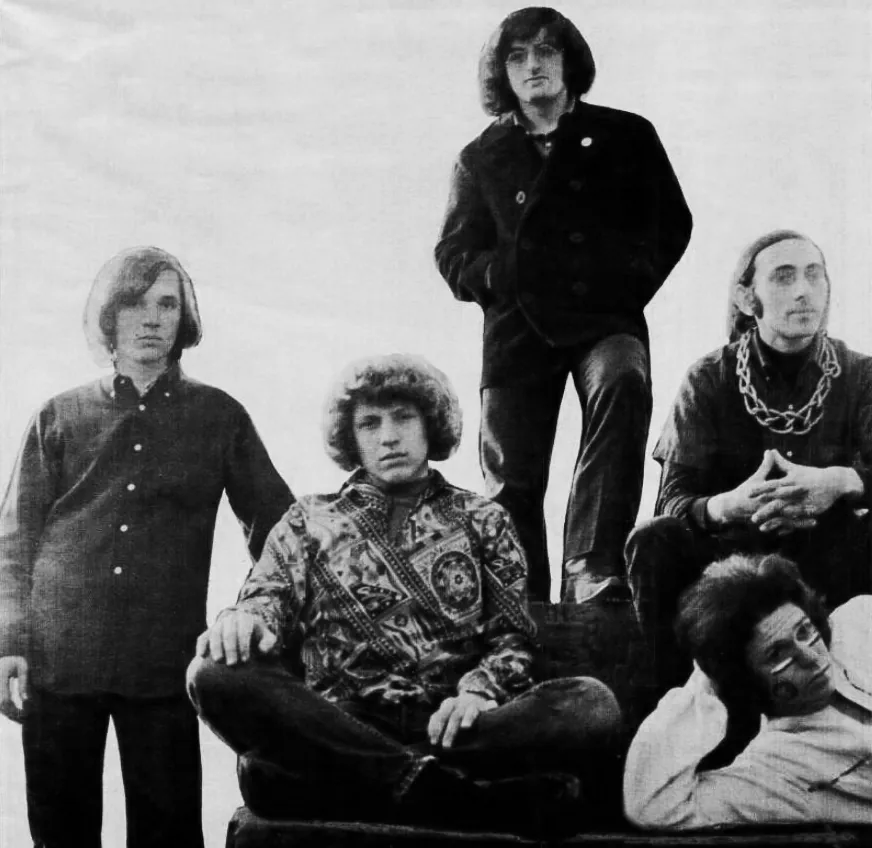
Country Joe and the Fish began in Berkeley around Rag Baby, the political magazine Country Joe McDonald edited with Eugene "ED" Denson. A four-song "talking issue" in 1965 included two recordings by the loose group that first used the name; a second EP followed in 1966. The electric quintet that reached Vanguard joined topical songwriting to acid rock, blues, folk-derived song forms and ensemble improvisation.
The catalogue is broader than its protest-band reputation. McDonald wrote much of the early material, but Barry Melton, David Bennett Cohen, Bruce Barthol and Gary "Chicken" Hirsh gave the records their instrumental identity. By Together, writing and lead vocals were distributed more widely across the group.
Formation & History
Denson proposed the name. "Country Joe" referred to the nickname associated with Joseph Stalin, while "the Fish" drew on Mao Zedong's image of revolutionaries moving among the people as fish move through water. The first Rag Baby EP paired two group performances with two songs by Peter Krug; the second, issued in June 1966, documented the developing electric band.
The first stable Vanguard-era lineup comprised McDonald, Melton, Cohen, Barthol and Hirsh. Vanguard released Electric Music for the Mind and Body and I-Feel-Like-I'm-Fixin'-to-Die in 1967, followed by Together in 1968. Changing bassists, keyboard players and session groups shaped Here We Are Again and C.J. Fish.
Woodstock produced two distinct appearances: McDonald played a solo set on Saturday, including the "Fish Cheer" and "I-Feel-Like-I'm-Fixin'-to-Die Rag", while Country Joe and the Fish performed a separate band set on Sunday. The filmed solo performance became the familiar image, but it should not be mistaken for the band's own set. C.J. Fish ended the original run of Vanguard studio albums in 1970; live, compilation and later reunion releases followed.
Sound & Style
The early quintet worked through contrast. Cohen's organ and electric piano could hold a repeating figure while Melton's lead guitar and McDonald's rhythm guitar opened the arrangement into improvisation; Barthol and Hirsh supplied a rhythm section capable of moving between blues, march, waltz and loose psychedelic space. Instrumentals such as "Section 43" make that collective method audible without reducing the band to accompaniment for McDonald's lyrics.
"I-Feel-Like-I'm-Fixin'-to-Die Rag" uses a deliberately jaunty, old-time frame for a lyric that McDonald said targeted politicians, military leaders and the war industry rather than soldiers. Elsewhere, "Bass Strings", "Grace" and the pieces on Together show different balances of studio colour, group vocals and instrumental authorship. The sound changed with the personnel: the arranged session groups on Here We Are Again and Tom Wilson's clearer production on C.J. Fish are not interchangeable with the 1967 quintet.
Essential Albums
The eleven-track debut records the original quintet with producer Samuel Charters. "Section 43" gives the group an extended instrumental centre, while "Super Bird", "Not So Sweet Martha Lorraine" and "Grace" move between satire, character song and studio-built psychedelia.
Key tracks: Flying High · Super Bird · Grace
Open album guide → View on Amazon →The second Vanguard LP places the title rag beside the quiet "Who Am I", McDonald's "Janis" and Melton's instrumental "Colors for Susan". Its range matters: topical satire is one part of a record that also uses chamber colour, blues, folk song and psychedelic guitar.
Key tracks: The Fish Cheer / I-Feel-Like-I'm-Fixin'-To-Die Rag · Janis · Colors for Susan
Open album guide → View on Amazon →Together
1968All five members receive writing credits across the third album, and several take lead vocals. "Rock and Soul Music", Cohen's "The Streets of Your Town" and Hirsh's "The Fish Moan" make the record a document of shared authorship rather than a McDonald-led protest set.
Key tracks: Rock and Soul Music · The Fish Moan · An Untitled Protest
Open album guide → View on Amazon →Affiliate note: Amazon links on this page may earn RetroForge Records a small commission, at no extra cost to you.
Deeper Cuts
Here We Are Again
1969Recorded across several late-1968 and early-1969 sessions, the fourth album retains McDonald, Melton and Hirsh while bassists and keyboard players change around them. Horn and string arrangements on selected tracks make that shifting construction audible.
Open album guide → View on Amazon →C.J. Fish
1970The fifth and final original Vanguard studio album uses a new five-person lineup: McDonald and Melton with Mark Kapner, Doug Metzner and Greg Dewey. Producer Tom Wilson gives its compact rock songs and two longer second-side pieces a clearer, more separated sound.
Open album guide → View on Amazon →Why They Still Matter
The group's archive connects independent political publishing, the Berkeley scene, five original-era studio albums and two separate Woodstock appearances. McDonald's own account of "I-Feel-Like-I'm-Fixin'-to-Die Rag" is especially useful because it identifies the institutions he meant to satirise and prevents the song from being reduced to a vague anti-soldier slogan.
The records also preserve several versions of the band rather than one fixed formula: the improvising 1967 quintet, the shared authorship of Together, the session-based construction of Here We Are Again and the new rhythm section on C.J. Fish. That documented musical evolution explains their continuing historical value more precisely than treating the Woodstock film clip as the whole story.
Sources & Further Reading
Concord — Country Joe & the Fish — the Rag Baby EP, Berkeley context and early group formation.
CountryJoe.com — discography — first-party chronology of the EPs, band albums and later releases.
CountryJoe.com — "How I Wrote the Rag" — McDonald's first-person account of the song's composition and targets.
CountryJoe.com — Woodstock set lists — separate solo and band programmes from the festival.
Associated Press — Country Joe McDonald obituary — death date and biographical summary.
Connected archive routes
Explore This Band
Continue through the RetroForge knowledge graph
Curated paths into the people, records, events and ideas that give this subject its wider musical context.