Santana emerged from San Francisco in 1966 and reached an international audience at Woodstock three years later. The group’s early records joined blues-based electric guitar and Hammond organ to a rhythm section in which drum kit, congas and timbales carried equal structural weight.
The name has covered changing lineups and musical directions, but the 1969–71 ensemble established the central vocabulary. Carlos Santana’s sustained guitar, Gregg Rolie’s organ and lead voice, David Brown’s bass, Michael Shrieve’s drums and the percussion of Michael Carabello and José “Chepito” Areas made groove a collective arrangement rather than a backing track.
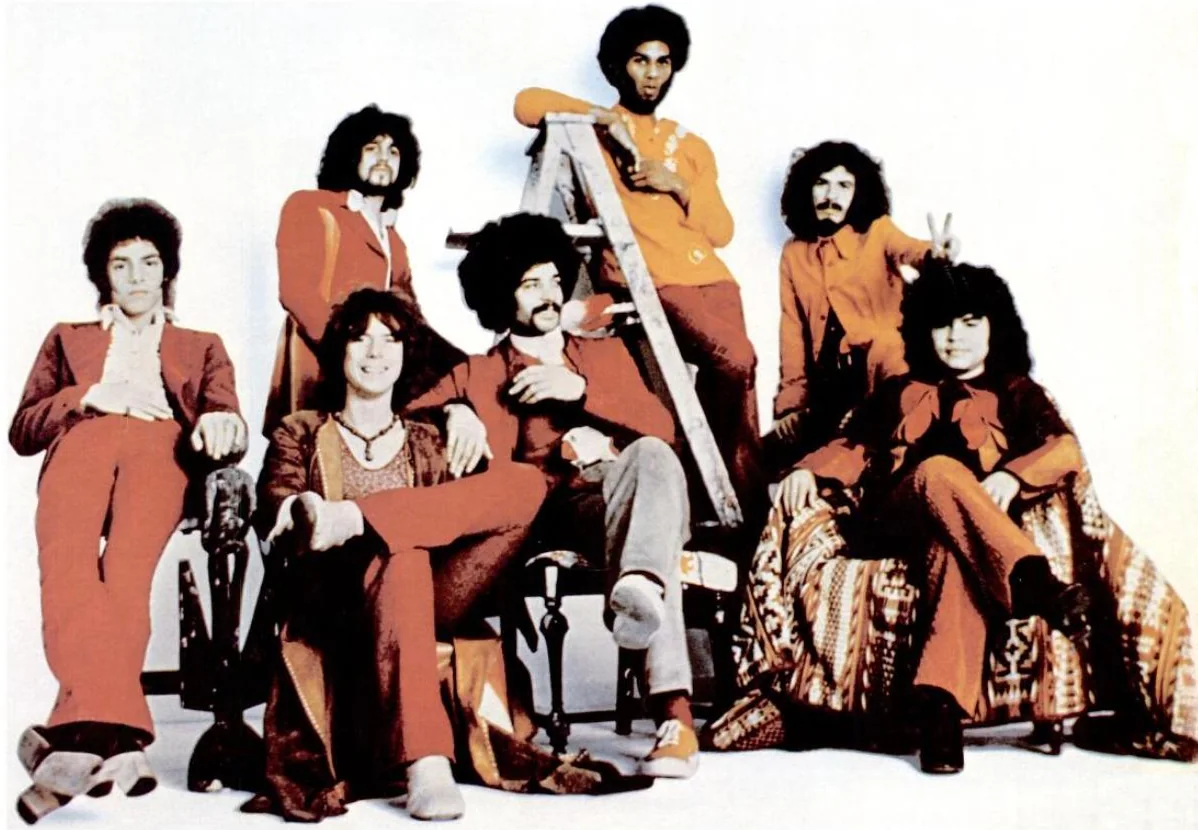
Santana in a 1971 Columbia Records publicity photograph.Photo: Columbia Records / Wikimedia Commons · Licensed under Public domain. Converted to WebP for this page.
Formation & History
Carlos Santana formed the Santana Blues Band in San Francisco in 1966. By 1969 the shortened name Santana identified a sextet signed to Columbia. The group recorded its debut in May, then performed at Woodstock on 16 August before the album’s release on 22 August. The filmed “Soul Sacrifice”, driven by Shrieve’s extended drum passage and the percussion section’s recurring figure, turned a band without an issued LP into one of the festival’s defining discoveries.
Abraxas and Santana III followed in 1970 and 1971; both reached number one in the United States. The third album added seventeen-year-old guitarist Neal Schon and percussionist Coke Escovedo to the expanding ensemble. It was the last album by the Woodstock-era core before rapid personnel changes. Caravanserai then moved toward jazz fusion and a largely instrumental, more spacious design. Santana continued through further lineups and collaborations, with the early group reunited in part for Santana IV in 2016.
Sound & Style
The early arrangements divide motion among several players. Brown and Shrieve establish the rock and jazz foundation while Carabello’s congas and Areas’s timbales create independent accents around it. Rolie’s Hammond organ can supply a clipped rhythmic vamp, a sustained harmonic bed or a solo voice. Carlos Santana often answers with long, singing notes whose space and sustain contrast with the denser percussion.
Abraxas makes the method especially clear. “Black Magic Woman” passes from Rolie’s organ and vocal into “Gypsy Queen”, where percussion and modal guitar take over; Tito Puente’s “Oye Como Va” keeps a syncopated vamp in continuous motion beneath organ and guitar solos; “Samba Pa Ti” removes the vocal altogether and lets melody grow over a patient groove. On Santana III, Schon’s second guitar and the enlarged percussion team produce a darker, more crowded attack without erasing the internal conversation.
Essential Albums
1969
Santana
Columbia · Original 1969 release
Recorded at Pacific Recording in May 1969, the debut documents the pre-Woodstock sextet. “Waiting” moves from organ-led introduction to guitar statement, “Evil Ways” gives Rolie a concise vocal and organ showcase, and the studio “Soul Sacrifice” compresses the group’s live improvising language into an album sequence. Its nine tracks already balance short songs with percussion-led instrumentals.
The second album opens with Michael Carabello’s atmospheric “Singing Winds, Crying Beasts” before joining Peter Green’s “Black Magic Woman” to Gábor Szabó’s “Gypsy Queen”. Tito Puente’s “Oye Como Va” and the instrumental “Samba Pa Ti” reveal different uses of repetition: one communal and syncopated, the other spacious and melodic. The Library of Congress added Abraxas to the National Recording Registry in 2015.
Key tracks: Singing Winds, Crying Beasts · Black Magic Woman/Gypsy Queen · Samba Pa Ti
Neal Schon’s second guitar and Coke Escovedo’s percussion enlarge the classic lineup on its final studio album. “Batuka” runs directly into “No One to Depend On”, turning a percussion-and-guitar opening into a tightly arranged vocal track; “Toussaint L’Overture” pushes the ensemble through sharp breaks; “Everything’s Coming Our Way” offers a lighter close before the percussion feature “Para Los Rumberos”.
Key tracks: Batuka · No One to Depend On · Everything’s Coming Our Way
Caravanserai (1972) is the decisive next step. Vocals recede, pieces connect through ambience and instrumental transitions, and Tom Rutley, Doug Rauch, Neal Schon and several percussionists help redirect the group toward jazz-rock fusion. It is not a lesser sequel to the first three albums but a change in the organising principle.
The Woodstock “Soul Sacrifice” remains the clearest film of the early band’s live mechanics: repeating bass and percussion figures support guitar, organ and Shrieve’s drum feature without freezing the performance into a fixed studio arrangement. Live at the Fillmore 1968, released in 1997, reaches further back and shows how that collective method sounded before the Columbia debut.
Santana changed what a commercially successful rock rhythm section could contain. Congas and timbales were not added colour: they helped determine song form, transitions and improvisational space. The first three albums place that rhythmic design inside concise singles as well as extended instrumentals, while Carlos Santana’s tone gives the changing ensemble an immediately recognisable melodic centre.
The history also resists a single frozen “classic” sound. Caravanserai exchanged much of the early vocal-rock framework for fusion; later decades moved through further lineups and collaborations; Supernatural created a major return to the charts in 1999. The Rock & Roll Hall of Fame inducted the six members of the Woodstock-era lineup in 1998, recognising an ensemble achievement rather than guitar alone.
RetroForge Records publishes original music and independent editorial guides. This historical band guide is not affiliated with the artist, labels or rights holders. No unlicensed album artwork is reproduced.