
Overview
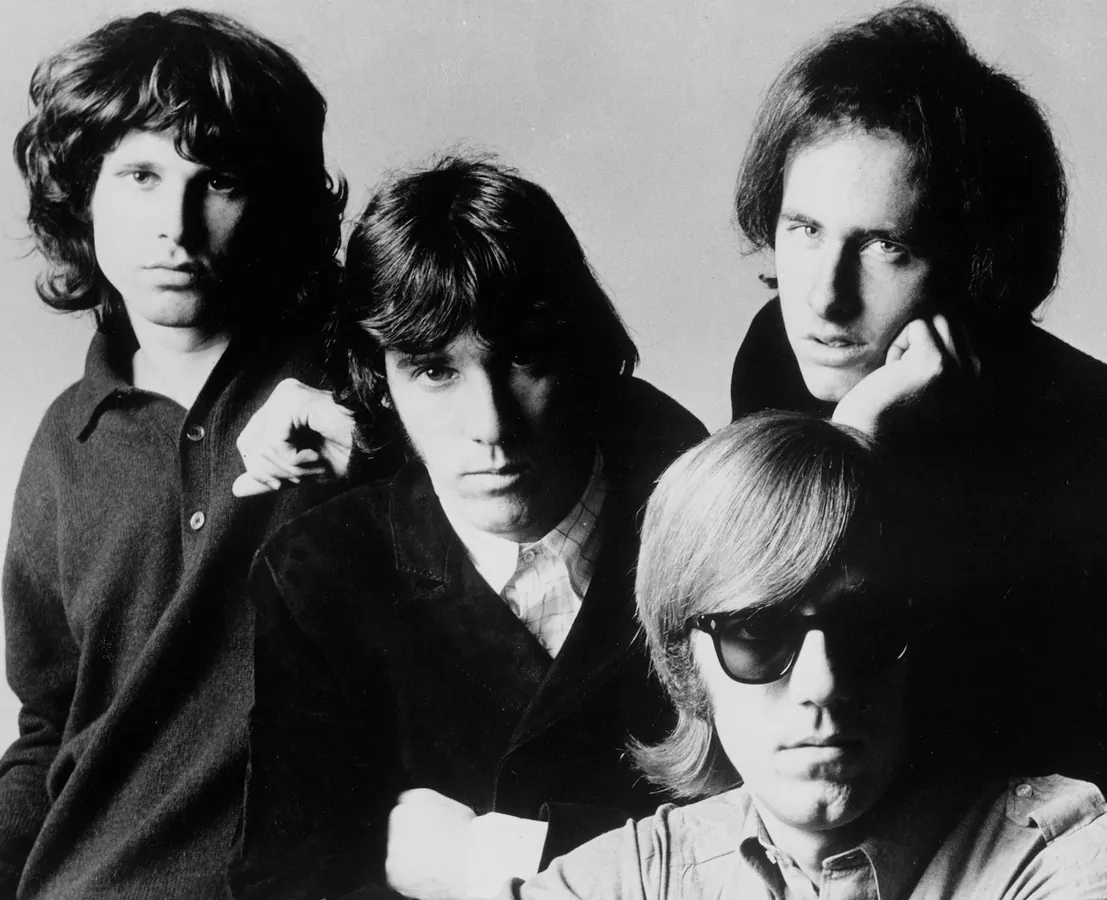
The Doors joined concise singles to extended pieces in which blues, jazz, flamenco, theatre and studio experiment could occupy the same record. Jim Morrison's baritone and image made him the focal point, but the band's identity depended equally on Ray Manzarek's keyboards, Robby Krieger's guitar and John Densmore's responsive drumming. The classic quartet had no permanent bass guitarist: Manzarek supplied keyboard bass onstage, while several recordings used session bassists.
Formation & History
Morrison and Manzarek had met as UCLA film students and reconnected on Venice Beach in the summer of 1965. Morrison first joined Manzarek's Rick and the Ravens; Densmore and Krieger, who had played together in the Psychedelic Rangers, completed the familiar quartet. Residencies at the London Fog and then the Whisky a Go Go gave them time to develop songs and long-form arrangements before Elektra signed them in 1966.
Between January 1967 and April 1971, Morrison, Manzarek, Krieger and Densmore released six studio albums, from The Doors through L.A. Woman. After Morrison died in July 1971, the other three continued as the Doors for Other Voices and Full Circle before the group ended in 1973. They reconvened to add music to Morrison's recorded poetry for An American Prayer, released in 1978.
Sound & Style
Manzarek divided his work between a Vox Continental organ, piano and keyboard bass; Krieger moved from flamenco-derived fingerstyle to bottleneck slide and electric blues; Densmore used jazz and bossa nova ideas to control tension rather than merely mark time. Morrison could move from close, conversational delivery to declamation, giving the arrangements room to expand and contract around the text.
The studio palette changed across the catalogue. Strange Days used eight-track recording, double-tracked guitar and an early Moog appearance; The Soft Parade placed brass and strings around several songs; L.A. Woman returned to a more direct blues ensemble with bassist Jerry Scheff and rhythm guitarist Marc Benno. Those additions matter: the Doors' sound was never simply four musicians captured without outside help.
Essential Albums
The Doors
1967Recorded in 1966 and released on 4 January 1967, the debut presents the band's club repertoire as a tightly sequenced album. Krieger's composition Light My Fire becomes a long organ-and-guitar vehicle, while the Willie Dixon cover Back Door Man anchors the record in blues and The End turns an eleven-minute performance into its closing dramatic arc.
Key tracks: Break On Through (to the Other Side) · Light My Fire · The End
Open album guide → View on Amazon →Strange Days
1967Released on 25 September 1967, Strange Days used the larger budget and eight-track facilities earned by the debut's success. The title song's Moog textures, Krieger's bottleneck part on Moonlight Drive and the layered guitar of When the Music's Over give early material a more deliberately constructed studio setting.
Key tracks: Strange Days · Moonlight Drive · When the Music's Over
Open album guide → View on Amazon →L.A. Woman
1971The sixth and final studio album with Morrison strips back the orchestral direction of The Soft Parade. Recorded with Jerry Scheff on bass and Marc Benno on rhythm guitar, it moves from the compressed drive of The Changeling and Love Her Madly to the extended title track, then closes with the electric-piano rainscape of Riders on the Storm.
Key tracks: The Changeling · L.A. Woman · Riders on the Storm
Open album guide → View on Amazon →Affiliate note: Amazon links on this page may earn RetroForge Records a small commission, at no extra cost to you.
Deeper Cuts
The Soft Parade
1969The Soft Parade is the catalogue's clearest break with the stripped quartet sound. Brass and string arrangements shape Tell All the People, Touch Me and Wishful Sinful, while the title suite remains an episodic band performance. The contrast explains both the album's ambition and its long-running reputation as the group's most polarising Morrison-era record.
Open album guide → View on Amazon →Morrison Hotel
1970After the elaborate production of The Soft Parade, Morrison Hotel places the group back inside electric blues and hard-edged ensemble playing. Roadhouse Blues, Waiting for the Sun and Peace Frog connect a deliberately direct first side to the more atmospheric “Morrison Hotel” sequence.
An American Prayer
1978For An American Prayer, Manzarek, Krieger and Densmore composed and recorded music around Morrison's 1969 poetry recordings. Released seven years after his death, it is neither a conventional Doors studio album nor a live poetry document: montage, new accompaniment and selected earlier band performances create a posthumous hybrid.
Open album guide → View on Amazon →Why They Still Matter
The Doors' continuing importance rests on a collective language rather than Morrison's mythology alone. Krieger supplied major songs including Light My Fire, Touch Me and Love Her Madly; Manzarek made organ and keyboard bass structural voices; Densmore brought jazz dynamics into rock arrangements; Morrison treated the singer's text and physical presence as part of the composition.
Their 1993 Rock & Roll Hall of Fame induction recognised a catalogue that could hold concise hits and long theatrical pieces without separating them into different identities. The six Morrison-era studio albums document rapid change—from the debut's club-tested repertoire to eight-track psychedelia, orchestration, hard blues and the spacious final sessions—rather than one formula repeated across five years.
Sources & Further Reading
Connected archive routes
Explore This Band
Continue through the RetroForge knowledge graph
Curated paths into the people, records, events and ideas that give this subject its wider musical context.