

Overview
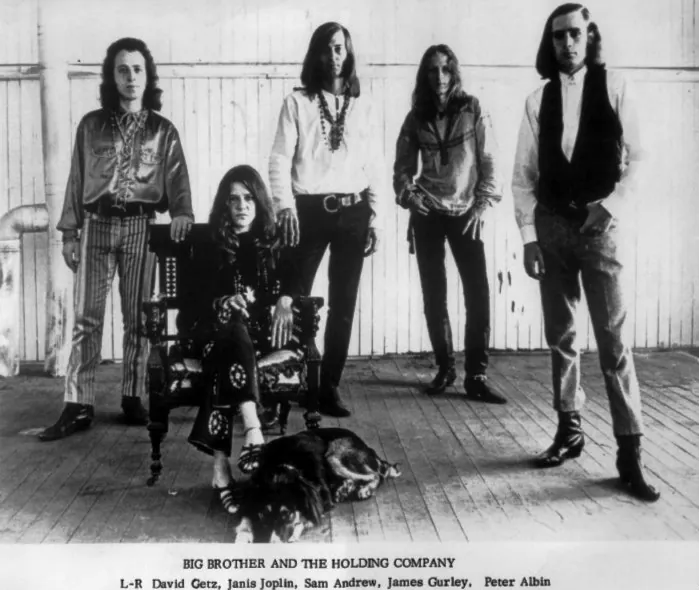
Big Brother and the Holding Company emerged from San Francisco's ballroom culture before Janis Joplin joined in 1966. Sam Andrew, James Gurley, Peter Albin and drummer Dave Getz had already developed a loud, collective form of psychedelic rock whose unstable guitar textures and electric-blues repertoire depended on interaction more than polish.
Joplin transformed the group's reach without turning the other musicians into anonymous accompanists. Their 1967 Monterey performances brought national attention; the 1968 Columbia album Cheap Thrills then joined six studio performances to one Winterland concert recording and became the band's commercial summit. After Joplin and Andrew left at the end of 1968, a re-formed Big Brother made two further Columbia albums before separating in 1972.
Formation & History
Peter Albin, Sam Andrew, James Gurley and drummer Chuck Jones formed the first lineup at the end of 1965. Dave Getz replaced Jones in early 1966, and Joplin joined later that year. The quintet worked the Avalon Ballroom, Fillmore and other Bay Area stages before the Monterey International Pop Festival in June 1967 placed Joplin and the band before a national audience. Mainstream released their self-titled debut that August, using concise recordings made largely in December 1966.
Columbia's John Simon produced the spring 1968 sessions for Cheap Thrills. Six selections were studio performances presented with concert ambience; only “Ball and Chain” came from an actual concert, recorded at Winterland Ballroom. Joplin and Andrew left in December 1968. Andrew, Albin, Gurley and Getz re-formed the group in late 1969 with Nick Gravenites, Kathi McDonald and David Schallock, recording Be a Brother and How Hard It Is before the 1972 split. Four core members reunited in 1987, after which changing lineups continued the band.
Sound & Style
Big Brother's Joplin-era sound places two contrasting electric guitars over Albin's bass and Getz's forceful, mobile drumming. Gurley stretches notes into feedback and distorted bends; Andrew more often supplies chord movement, riffs and vocal counterweight. Joplin does not merely sit above that texture: on “Combination of the Two,” “Piece of My Heart” and “Ball and Chain,” her phrasing pushes against the band's tempo, volume and open spaces.
The post-1969 lineup changes the balance. Schallock adds a third guitar, while Gravenites brings a blues- and soul-based songwriting voice and McDonald contributes featured vocals. Be a Brother distributes lead singing instead of installing a single Joplin substitute; How Hard It Is integrates Mike Finnigan's organ and piano more fully, moving the group toward soul-rock, boogaloo and tighter studio arrangements.
Essential Albums
Cheap Thrills
1968The seven-track Columbia breakthrough moves from Sam Andrew's shared-vocal opener through “Summertime” and “Piece of My Heart” to Big Mama Thornton's “Ball and Chain.” Producer John Simon recorded six performances in the studio and framed them with added audience sound; the closing track is the album's genuine concert recording, captured at Winterland. The contrast between constructed concert atmosphere and live tension is part of the record's design.
Key tracks: Combination of the Two · Piece of My Heart · Ball and Chain
Open album guide → View on Amazon →Recorded before Monterey and released afterward, the ten-track Mainstream debut compresses the band's stage repertoire into short studio arrangements. Bob Shad's clean production puts Joplin's early writing on “Women Is Losers” beside Peter Albin's “Caterpillar” and the group's adaptation of Moondog's “All Is Loneliness.” It documents the lineup clearly, even when it cannot reproduce the volume and improvisation of the ballroom shows.
Key tracks: Bye, Bye Baby · Women Is Losers · All Is Loneliness
Open album guide → View on Amazon →Be a Brother
1970The first post-Joplin album reunites Andrew, Albin, Gurley and Getz with guitarist David Schallock and producer-singer Nick Gravenites. Andrew and Gravenites divide most lead vocals, with Kathi McDonald featured within a broader guest circle. “Keep On,” “Joseph's Coat” and the title track present a working band built around shared voices, three guitars and socially observant blues-rock rather than imitation.
Key tracks: Keep On · Be a Brother · Sunshine Baby
Open album guide → View on Amazon →Affiliate note: Amazon links on this page may earn RetroForge Records a small commission, at no extra cost to you.
Deeper Cuts
How Hard It Is
1971The 1971 follow-up keeps the Andrew-Albin-Gurley-Getz-Schallock instrumental core while giving Mike Finnigan's keyboards and vocals a larger role. Soul-rock, boogaloo rhythm and the Nick Gravenites feature “Buried Alive in the Blues” distinguish it from both Cheap Thrills and the looser guest mosaic of Be a Brother.
Open album guide → View on Amazon →Live at the Carousel Ballroom 1968
recorded 1968Owsley Stanley recorded the band at San Francisco's Carousel Ballroom on 22–23 June 1968. The 2012 release presents thirteen performances from Sunday plus a Saturday “Call on Me,” preserving direct stereo sound without the added audience construction used on Cheap Thrills.
Open album guide → View on Amazon →Why They Still Matter
Cheap Thrills remains the clearest meeting point between Joplin's vocal command and the band's rough collective method. Its studio/live construction also makes it a revealing document of how a San Francisco ballroom group was translated into a major-label album without completely smoothing away the friction.
The later catalogue prevents the story from ending with one singer's departure. Be a Brother and How Hard It Is show the same instrumental nucleus reorganizing its roles around Gravenites, McDonald, Schallock and Finnigan. The Carousel archive, meanwhile, lets listeners compare the staged concert atmosphere of Cheap Thrills with the unvarnished balance of an actual 1968 room.
Sources & Further Reading
Big Brother and the Holding Company — official history
Big Brother and the Holding Company — official discography and lineup chronology
Sony Music — Sex, Dope & Cheap Thrills archival release notes
Library of Congress — Cheap Thrills National Recording Registry essay
Connected archive routes