
.jpg)
Edition timeline
Finland’s breakthrough festival
A homemade three-day event draws about 38,000 people to Ruissalo.
Success becomes a crisis
Attendance reaches roughly 100,000 and overwhelms fences, sanitation and organisation.
A radical reset
Political survival requires a moved site and a one-day, roughly eight-hour format.
Repetition becomes institution
The festival continues annually, professionalises and balances municipal limits with international ambition.
Why this series matters
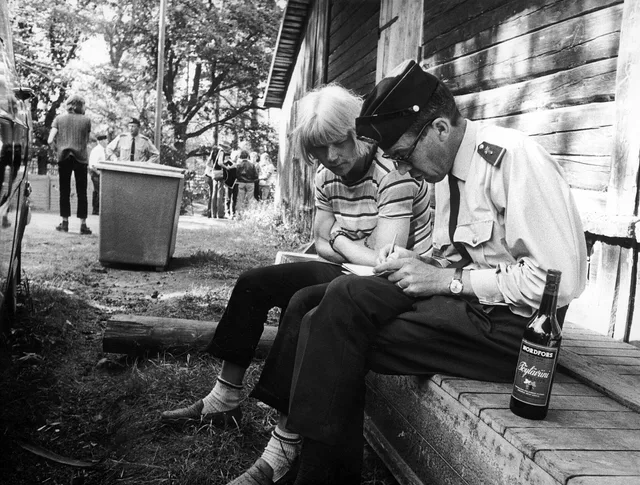
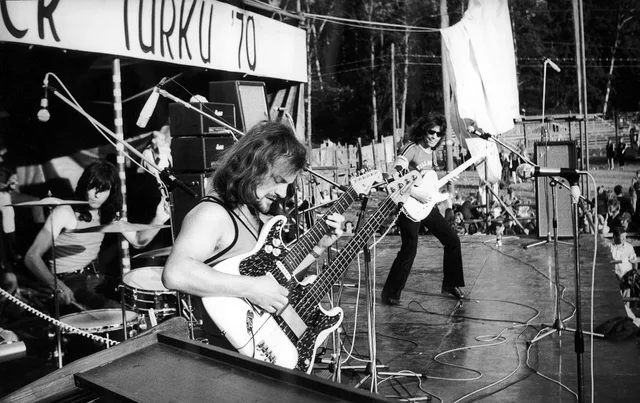
Ruisrock survived its own success. Many early festivals disappeared after one uncontrolled giant edition; Ruisrock drew about 100,000 in 1971, faced political extinction, contracted sharply and continued. That recovery makes the 1970s story more valuable than a single legendary bill. It documents counterculture becoming a Finnish institution through municipal negotiation, environmental restraint, repeat labour and the willingness to accept a smaller format after dramatic growth. Youth-oriented radio and access to current international music were limited in Finland. Students and young enthusiasts argued that contemporary rock belonged beside Turku’s established cultural programming, eventually winning institutional support for an event on Ruissalo. The initiative was homemade but not culturally isolated. British progressive and rock acts, Finnish groups and folk musicians could occupy one programme, giving local audiences direct access to sounds otherwise encountered chiefly through imported records. Ruissalo supplied shoreline, trees and a strong sense of escape while remaining directly connected to Turku. That combination distinguished it from both a remote farm and a hard urban arena. The natural landscape became part of Ruisrock’s identity and a recurring political constraint. Mass attendance brought trampling, waste, traffic and pressure to a valued environment, ensuring that site permission could never be separated from cultural ambition. The first three-day festival expected only a few thousand and drew about 38,000 according to Yle. Argent, Family, Blue Mink and Colosseum joined Finnish performers including Wigwam and folk musicians. Contemporary Finnish Heritage Agency photographs show dancing, simple stage structures and relaxed crowds rather than an industrial entertainment compound. The enthusiastic reception for Finnish folk demonstrated that Ruisrock was not merely an imported British-rock package but a place where local traditions could meet new youth culture.
.jpg)
1971: success becomes a threat
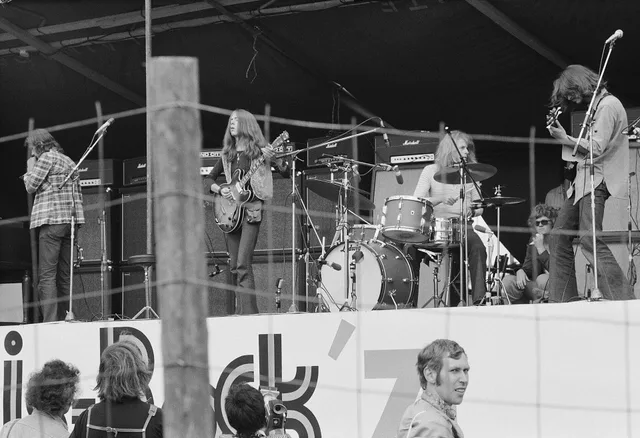
The second edition reached roughly 100,000 visitors. Fence breaches, overloaded sanitation, drug incidents, assaults and general disorder appear across Finnish retrospective sources. The scale transformed the meaning of community: what felt open and homemade in 1970 became difficult to govern when attendance nearly tripled. The crisis was organisational and political, not simply moral panic. Turku had to decide whether a valuable cultural experiment was compatible with public safety and Ruissalo’s environment. Ruisrock’s early programme connected Finnish progressive musicians such as Tasavallan Presidentti and Wigwam to visiting British and international acts. Later 1970s bookings included hard-rock and classic-rock names such as Status Quo, Uriah Heep, Nazareth and Chuck Berry, though each belongs to a specific year. Audience experience shifted from 1970 discovery through 1971 overload toward a more controlled annual ritual with familiar access and expectations. City debate came close to ending the festival. Permission for 1972 arrived after serious controversy, with the site moved within Ruissalo and the event reduced to one day of roughly eight hours. That reset is the central institutional decision. Smaller was not an admission that Ruisrock lacked importance; it was the mechanism that kept the festival alive. Yle notes that the one-day model then continued for years instead of immediately chasing the lost 1971 scale. Annual repetition allowed organisers to adjust fencing, sound, entrances, sanitation and relations with the city. The programme retained Finnish performers while attracting international progressive and hard-rock acts. Financial pressure and municipal debate did not vanish, but the festival became expected rather than shocking. Professionalisation here did not mean abandoning youth culture. It meant converting memory and mistakes into routines that could be rebuilt on Ruissalo every summer.

Films, recordings and surviving documents
Ruisrock has one of this archive’s strongest visual records. The Finnish Heritage Agency and Finna preserve item-level metadata and reusable images, while Yle holds news, performance and retrospective material. The five photographs on this page carry CC BY 4.0 licences and show the actual festival in 1970 and 1971. Their specificity allows crowd, stage and musician history to be illustrated without substituting generic period imagery. Ruisrock depended on a city permitting mass youth culture in a sensitive landscape. Funding, policing, transport, site damage and political legitimacy recurred throughout the decade. Unlike a purely private promoter able to move after conflict, the festival built identity through negotiation with Turku and Ruissalo. Its survival demonstrates that governance was not a constraint outside festival culture; it became one of the mechanisms through which that culture learned continuity. The first Ruisrock could be described as Finland’s answer to the international festival boom. By the decade’s end that comparison was insufficient. Repeated Finnish audiences, local performers, municipal arguments and shared memories created a tradition with its own rhythm. The festival no longer needed Woodstock as its primary reference. It had developed a national musical ecosystem and a place-specific public identity rooted in Ruissalo. By 1979 Ruisrock had survived the boom-and-bust pattern that destroyed many contemporaries. Longevity was not automatic background; it was the decade’s historical achievement. The festival learned that contraction could be creative, that municipal legitimacy mattered and that international bookings worked best beside Finnish culture rather than instead of it. Its continuing existence makes those early decisions visible as the foundation of one of Europe’s most durable rock institutions.


Follow the festival beyond the field
Timeline
Related genres
Related band guides
More routes will be connected as the archive grows.
Explore by sound
Essential listening
Sources and further reading
- Endless enjoyment from rock!Finnish Heritage Agency · accessed 23 July 2026
- Ruisrock changed Finnish historyYle · accessed 23 July 2026
- Ruisrock was Finland’s WoodstockYle Elävä arkisto · accessed 23 July 2026
- Fifty years of RuisrockYle · accessed 23 July 2026
- Ruisrock, peace and loveYle Elävä arkisto · accessed 23 July 2026
Image credits5 licensed images
Ruisrock’s first edition on Ruissalo island in August 1970, photographed by the Finnish Heritage Agency — V. K. Hietanen — Wikimedia Commons — CC BY 4.0 · source record · CC BY 4.0
Converted to WebP and resized; no generative or compositional alterations.
A second contemporary view of the first Ruisrock, documenting how the island landscape and audience occupied the same frame — V. K. Hietanen — Wikimedia Commons — CC BY 4.0 · source record · CC BY 4.0
Converted to WebP and resized; no generative or compositional alterations.
Tasavallan Presidentti at Ruisrock in 1971, showing Finnish progressive rock inside the international festival programme — Keijo Laajisto — Wikimedia Commons — CC BY 4.0 · source record · CC BY 4.0
Converted to WebP and resized; no generative or compositional alterations.
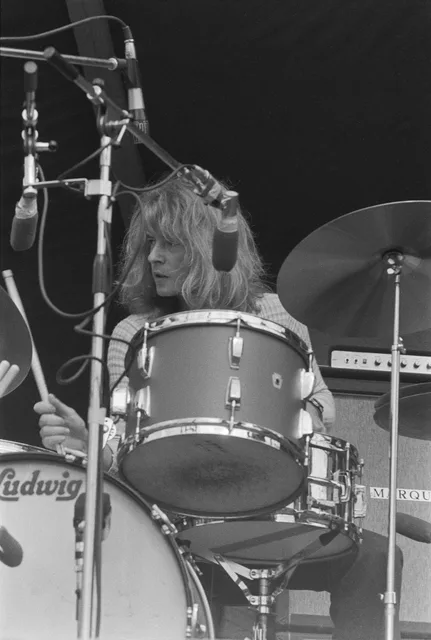
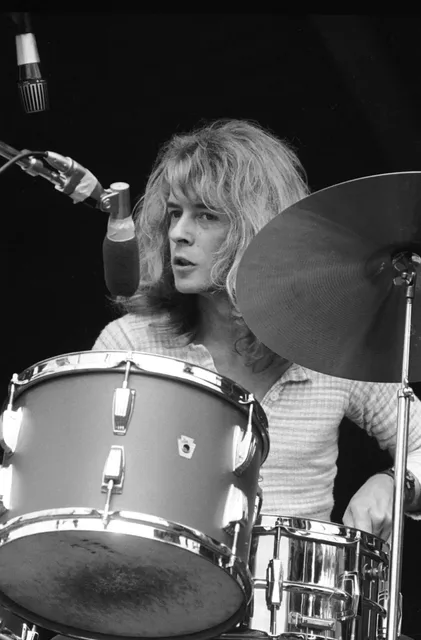
Vesa Aaltonen at Ruisrock in 1971, a period image from the festival’s rapidly expanding second year — Heikki Innanen — Wikimedia Commons — CC BY 4.0 · source record · CC BY 4.0
Converted to WebP and resized; no generative or compositional alterations.
A second contemporary view of Vesa Aaltonen at Ruisrock 1971, documenting the stage as well as the performer — Esa Pyysalo — Wikimedia Commons — Public domain · source record · Public domain
Converted to WebP and resized; no generative or compositional alterations.