The Riff Is a Horizon
Repetition establishes scale instead of demanding quick resolution.
Psychedelic Rock Family
Loose heavy rock shaped by dry guitar tone, open terrain and the communal experimentation associated with California’s Palm Desert scene.
The Sound
Desert rock is tied to a real regional lineage, not merely to lyrics about sand. It grew around the Palm Desert scene, where informal outdoor performances, punk directness, psychedelic space and heavy riffs met without becoming one strict formula.
The result often feels drier and more mobile than doom: low-tuned weight, roomy drums and riffs that leave air around themselves. It overlaps heavily with stoner rock, but the names are not perfect synonyms.
When the Dunes Begin to Breathe is the closest RetroForge route because of its terrain, scale and heavy psychedelic movement. Its fictional 1969 setting predates the later desert-rock scene, so the page does not rewrite that history.
What You’ll Hear
How It Works
Desert rock is shaped as much by space and dryness as by guitar tone. Repeated riffs, broad drums and unhurried pacing create a horizon around the band. The music can be heavy, but its power often comes from leaving room for heat, distance and silence to register.
Listen to the relationship between motion and stasis. A riff may circle for several minutes while tone, feedback and percussion slowly change the temperature. The landscape is not a literal requirement; it is a way of organising sound so that every event feels exposed.
Useful distinction: Boundary line: desert rock overlaps with stoner rock and heavy psychedelia, but its defining quality is spacious, repetitive atmosphere rather than intoxication or doom-laden weight.
Repetition establishes scale instead of demanding quick resolution.
Gaps between sounds preserve heat, distance and exposure.
Fuzz, tremolo and feedback change the atmosphere around a stable pattern.
The groove moves forward without appearing hurried.
Historical Development
Desert rock refers most specifically to the network of musicians that developed around California's Palm Desert and neighbouring Coachella Valley communities. During the late 1980s and early 1990s, informal outdoor performances—later mythologised as generator parties—gave bands space to play loudly beyond club restrictions. Yawning Man's instrumental drift and Kyuss's immense low-end attack grew from that local environment.
The scene was held together by people and shared activity more than by one fixed sound. Musicians moved between bands, rehearsal rooms and later Desert Sessions projects; punk economy, heavy metal, psychedelia, blues and extended jamming all entered the vocabulary. Kyuss became its most internationally influential group, but reducing desert rock to one band or to stoner rock hides the scene's collaborative and stylistic breadth.
Queens of the Stone Age carried part of the lineage toward sharper, more concise songwriting, while Brant Bjork, Fu Manchu, Mondo Generator and the Desert Sessions preserved other combinations of groove and experimentation. The desert in desert rock is therefore historical as well as atmospheric. Dry guitar tone and open space can evoke the landscape, but participation in—or meaningful descent from—the Palm Desert network gives the term its strongest definition.
The Real-World Foundations
Not a ranking: six useful doors into the style.
The Palm Desert scene's low-end force, heat and trance-like groove reach a defining early form.
Long transitions and enormous guitar tone turn a heavy record into continuous terrain.
Fuzz, speed and skate-culture momentum show the broader Californian route around the scene.
Loose collaboration documents the scene as a network rather than a single stable band.
Unhurried groove and home-recorded warmth reveal the desert lineage at intimate scale.
Palm Desert connections enter a stranger, tighter and more widely heard modern rock language.
Closest RetroForge Route
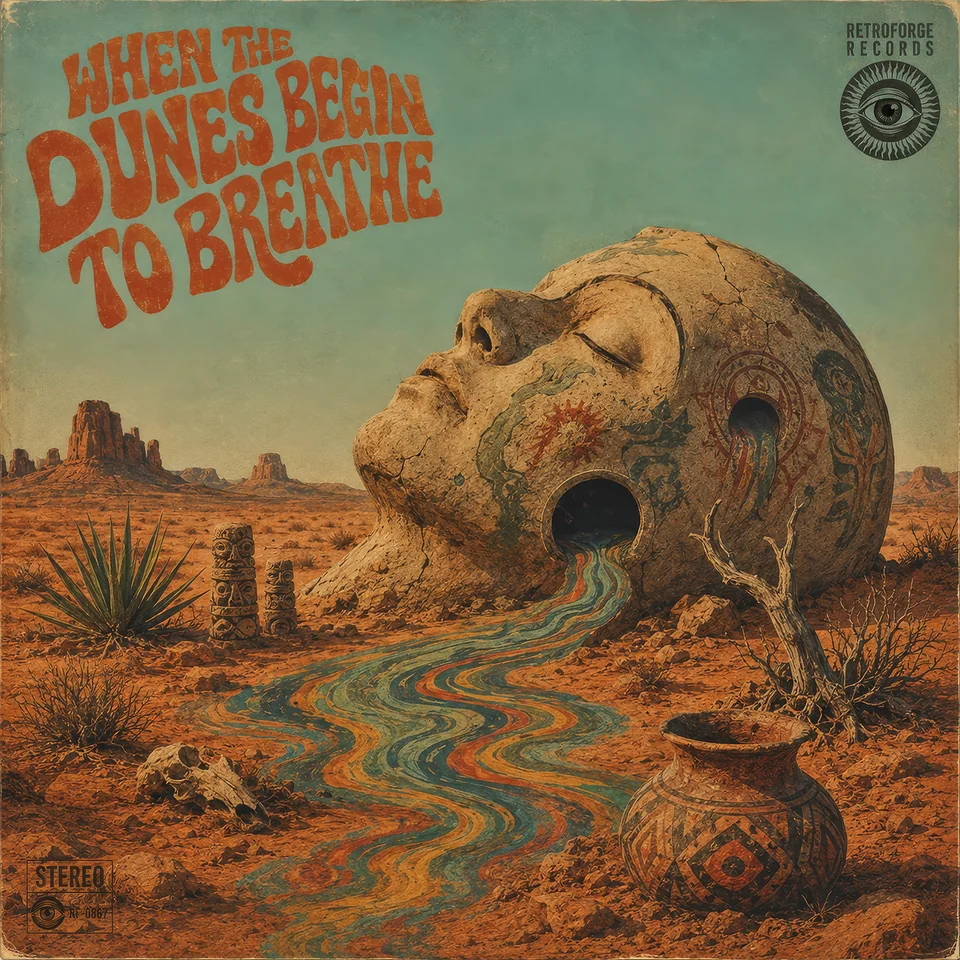
Adjacent: Psychedelic Stoner Rock
Desert imagery and heavy psych, presented as an adjacent route rather than false scene history.
Open the liner notes →Questions from the Record Room
No. They overlap, but desert rock is tied more specifically to the Palm Desert scene and its musical network; stoner rock developed more widely.
No. Landscape is part of the mythology, but shared musicians, local history and collaborative practice are more reliable markers.
Outdoor performances allowed young local bands to play loudly and experimentally outside ordinary venue systems, helping build a self-contained scene.
Research Trail
Deeper Discovery
Start with The Purple Sun Is Watching as a RetroForge companion, then return through Psychedelic Rock to place it inside the wider family.
Curated paths into the people, records, events and ideas that give this subject its wider musical context.