Low End Alters Scale
Bass and drums make the sound feel architectural.

Psychedelic Rock Family
Psychedelic atmosphere scaled through dense fuzz, low-end mass and repetition that turns weight into trance.
The Sound
Heavy psychedelic rock makes altered perception physical. Fuzz guitar occupies broad frequency space, bass carries nearly architectural weight and drums establish grooves sturdy enough to support long repetition. Unlike hard rock, the riff is not always a destination; it may be a platform from which texture and improvisation slowly change the room.
The style overlaps with acid rock, early heavy metal and later stoner rock. Acid rock often preserves more open improvisation and late-1960s blues looseness. Heavy psych can be slower, denser and more concerned with sustained atmosphere. The distinction is flexible, but the combination of weight and perceptual drift remains central.
Effective records leave air inside the mass. Echo trails, quieter passages and gradual filter movement prevent distortion from becoming a single unchanging wall.
What You’ll Hear
How It Works
Heavy psychedelia intensifies the low end, distortion and rhythmic force of psychedelic rock without surrendering its sense of altered space. Riffs can be massive, but echo, improvisation and sustained tone keep the music from becoming a closed wall.
The crucial movement is between density and drift. A band may lock into a slow, crushing figure, then let feedback or organ open a wider field around it. Weight becomes psychedelic when it changes the listener’s sense of scale and duration.
Useful distinction: Boundary line: heavy psych is not simply early metal. It retains open form, perceptual instability and the possibility that the riff may dissolve rather than conquer.
Bass and drums make the sound feel architectural.
Distortion occupies the room beyond the individual note.
Extended playing prevents heaviness from becoming static.
Spacious passages make each return feel physically larger.
Historical Development
Heavy psychedelic rock formed in the late 1960s as amplification, feedback and the repeated blues riff became capable of carrying the altered scale of psychedelia. Cream, the Jimi Hendrix Experience and Blue Cheer each approached that threshold differently: virtuoso improvisation, studio transformation and raw volume all helped turn the psychedelic trip into something physically overwhelming.
The style predates the settled borders between hard rock, heavy metal and acid rock. Iron Butterfly could place a long organ-led trance beside compact songs; Led Zeppelin made huge riffs coexist with acoustic and studio detail; Sir Lord Baltimore pushed speed and distortion toward early metal. What connects these records is not simply loudness but the use of weight to distort musical time and perception.
Later heavy-psych revivals recovered fuzz, open-ended jamming and analogue-sounding production without treating 1968 as a costume. The best work still allows the groove to breathe and the arrangement to drift. It differs from stoner psychedelia through its stronger connection to late-1960s acid rock, though the two routes naturally overlap.
The Real-World Foundations
Not a ranking: six useful doors into the style.
Extreme amplification and blues riffs make psychedelic rock feel dangerously physical.
Studio depth, feedback and improvisation reveal heaviness as colour, motion and space.
Organ, repetition and a side-long title track turn a heavy riff into psychedelic duration.
Massive guitar arrangements retain studio strangeness, dynamic contrast and blues-derived movement.
Speed, fuzz and high-impact drumming push heavy psychedelia toward early metal.
The full 1971 UK album preserves acid-rock looseness inside a hardening heavy sound; an abridged German edition had appeared in 1970 as Leaf Hound.
Start Here
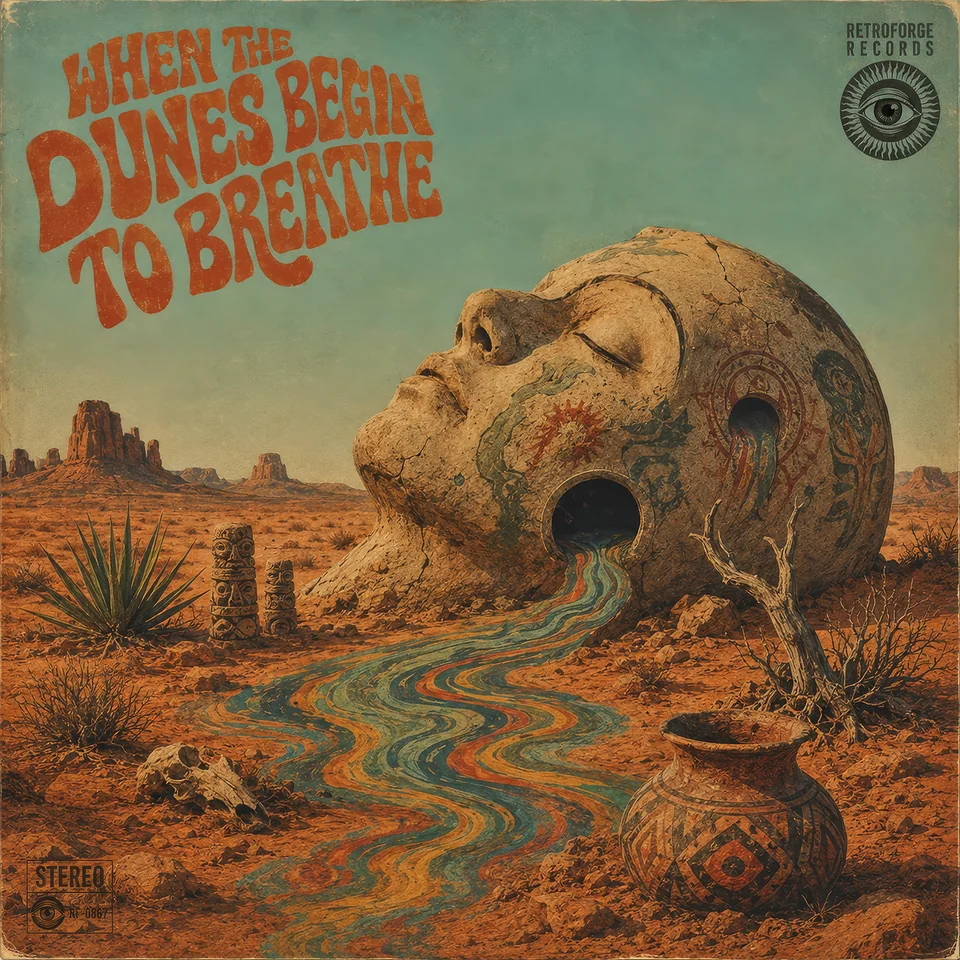
1969 · Psychedelic Stoner Rock
Desert weight, long fuzz movement and a landscape gradually becoming alive.
Open the liner notes →Questions from the Record Room
No. The histories overlap, but heavy psychedelia retains more improvisation, altered studio space and acid-rock looseness.
No. Modern bands can use the same principles—fuzz, repetition, dynamic space and exploratory form—without copying period production.
Heavy psychedelia grows directly from acid rock and blues-based experimentation; stoner psychedelia usually places more emphasis on patient groove and later doom-derived weight.
Research Trail
Related Styles
Deeper Discovery
Start with The Purple Sun Is Watching as a RetroForge companion, then return through Psychedelic Rock to place it inside the wider family.
Curated paths into the people, records, events and ideas that give this subject its wider musical context.