

Overview
Pink Floyd changed identity more than once. Syd Barrett shaped the concise songs and open-ended improvisation of the first phase. After David Gilmour joined in 1968, Gilmour, Roger Waters, Richard Wright and Nick Mason developed a collective language through film scores, extended live pieces and increasingly controlled studio work. Waters became the principal lyricist and conceptual force during the 1970s, but the records still depended on Gilmour's melodic guitar, Wright's harmony and Mason's patient sense of scale. After Waters left in 1985, Gilmour led a third phase that produced two further studio albums and large tours. Treating the history as several overlapping formations explains the catalogue better than dividing it into only two bands.
Formation & History
Waters, Wright and Mason met while studying architecture at Regent Street Polytechnic and played in several earlier line-ups. Barrett joined the group that became Pink Floyd in 1965 and supplied its name, combining the names of blues musicians Pink Anderson and Floyd Council. By autumn 1966 the band was central to London's underground circuit, using projections, lighting and extended pieces at venues including the UFO Club. EMI released the Barrett-led debut The Piper at the Gates of Dawn in August 1967. David Gilmour joined in January 1968; the five-man arrangement lasted only a handful of performances before the band continued without Barrett.
The quartet reached its most collaborative and commercially successful period from Meddle through The Dark Side of the Moon and Wish You Were Here. Waters's authorship then became increasingly dominant on Animals, The Wall and The Final Cut; Wright left during the making of The Wall, and Waters departed after The Final Cut. Gilmour and Mason continued Pink Floyd, with Wright returning first as a supporting musician and then as a member. The classic four reunited once at Live 8 in 2005. Wright died in 2008; The Endless River later reworked material from the 1993 Division Bell sessions as a tribute to him. In 2022 Gilmour and Mason released “Hey Hey Rise Up” with Andriy Khlyvnyuk to support humanitarian relief in Ukraine.
Sound & Style
Early Pink Floyd placed Barrett's compact, image-rich songs beside performances that stretched through feedback, Farfisa organ, tape delay and spatial movement. The post-Barrett quartet kept that attention to space but changed its grammar. Mason could hold a slow pulse without making it inert; Wright moved between piano, Hammond organ, Farfisa, synthesisers and vocal harmony; Gilmour built guitar parts around sustain, bends and melodic economy. Waters's bass often remained deliberately plain while his writing linked private fear to institutions, war, class and the pressures of the music business.
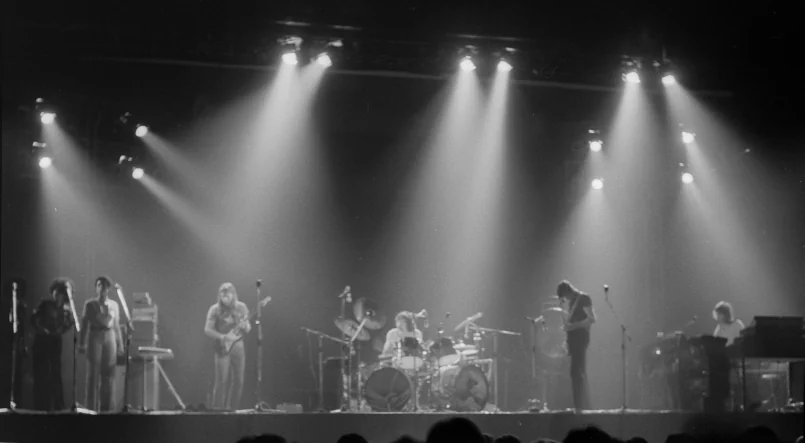
The studio became an instrument rather than a polishing stage. Tape loops, musique-concrète effects, spoken voices, synthesiser sequences and carefully designed transitions turned individual songs into album-length arguments. Onstage, quadraphonic sound, circular screens, inflatables and architectural sets expanded the same concern with scale. The spectacle matters, but the contrast beneath it matters more: long stretches of patience make a single guitar entrance, vocal change or sound effect carry unusual weight.
Essential Albums
The only Pink Floyd album to feature Barrett throughout joins concise character songs to the live group's long-form language. Norman Smith's production keeps “Lucifer Sam”, “Matilda Mother” and “Bike” sharply outlined, while “Interstellar Overdrive” lets guitar, organ, bass and drums pull away from song form. The UK album does not include the contemporary single “See Emily Play”; later editions and the original US configuration have different boundaries.
Key tracks: Astronomy Domine · Interstellar Overdrive · Bike
Open album guide → View on Amazon →Developed in concert before the final Abbey Road sessions, the album turns ten linked pieces into a cycle about time, labour, money, death and mental pressure. Tape loops, synthesisers, clocks, interviews and Alan Parsons's engineering support transitions that rarely feel decorative. “Time” gives Wright and Gilmour space for both voices, “Money” makes an uneven metre immediate, and “Eclipse” gathers Waters's recurring concerns into a communal close.
Key tracks: Speak to Me · Money · Eclipse
Open album guide → View on Amazon →Wish You Were Here
1975Absence connects the record's two subjects: Barrett's distance from his former band and the machinery of a record business that can empty art of human contact. The two halves of “Shine On You Crazy Diamond” frame the album; “Welcome to the Machine” replaces a rhythm section with processed synthesis, while Roy Harper's guest vocal makes “Have a Cigar” sound like an industry voice speaking from inside the package. The title track restores acoustic closeness without resolving the loss.
Key tracks: Shine On You Crazy Diamond (Part 1–5) · Wish You Were Here · Have a Cigar
Open album guide → View on Amazon →Affiliate note: Amazon links on this page may earn RetroForge Records a small commission, at no extra cost to you.
Deeper Cuts
Animals
1977Two earlier concert pieces became “Dogs” and “Sheep” inside Waters's social allegory, with “Pigs (Three Different Ones)” between them and the brief “Pigs on the Wing” framing the LP. Gilmour's guitar and co-writing on “Dogs” keep the long first side musically mobile; the second side makes Wright's keyboards, vocoder and processed animal sounds part of a colder political landscape.
Open album guide → View on Amazon →The Final Cut
1983The last Pink Floyd studio album with Waters and the only one made without Wright, it develops unused material from The Wall into a postwar sequence shaped by the Falklands conflict and memories of Waters's father. Michael Kamen's orchestration and the Holophonic sound design make its restraint cinematic; Gilmour's guitar appears selectively rather than defining the arrangements.
Open album guide → View on Amazon →Obscured by Clouds
1972Recorded in roughly two weeks near Paris for Barbet Schroeder's film La Vallée, this soundtrack returns to compact songs while the band was already performing an early Dark Side suite. Gilmour and Wright share writing and vocals across “Burning Bridges”, “Mudmen” and “Stay”; “Free Four” brings Waters's mortality and war themes into unusually direct pop form.
Open album guide → View on Amazon →Why They Still Matter
Pink Floyd's importance rests on several achievements that do not belong to one leader. Barrett's writing remains foundational to British psychedelic rock; the classic quartet demonstrated how material could be revised in public performance before becoming a tightly sequenced studio album; the Waters-led concept records joined personal memory to large political structures; and the later Gilmour-led band showed the catalogue could continue through a different balance of authorship. The Dark Side of the Moon remains the longest-charting album in Billboard 200 history, but longevity alone does not explain the influence. The deeper legacy is a method: sound, image, staging and sequence can all carry the same idea without sacrificing memorable songs.
Connected archive routes
Explore This Band
Sources and further reading
- Pink Floyd official biography — formation, personnel changes, Live 8 and the major creative periods.
- Official 1968 timeline — the five-piece performances and transition from Barrett to Gilmour.
- The Piper at the Gates of Dawn — original UK programme, recording period and production.
- The Dark Side of the Moon — live development, sessions and original ten-track sequence.
- Wish You Were Here — absence, industry critique, Barrett and Hipgnosis artwork.
- Animals — the earlier concert pieces, Orwellian concept and five-track programme.
- Obscured by Clouds — the La Vallée commission and two-week French session.
- The Endless River — the 1993 source sessions and tribute to Richard Wright.
- Pink Floyd official news archive — “Hey Hey Rise Up” and its humanitarian purpose.
Continue through the RetroForge knowledge graph
Curated paths into the people, records, events and ideas that give this subject its wider musical context.
Genres and scenes
- Psychedelic Rock
Sounds and instruments
- Hammond Organ