Before Psychedelia: A Living Black Tradition
Country blues developed in African American communities across the American South during the early twentieth century. Smithsonian Folkways describes a music rooted in everyday life, local performance and expressive freedom; its structures could be fluid rather than locked to a textbook twelve-bar pattern. The Delta was important, but it was one region within a wider field of country-blues and songster traditions.
Migration and electrification changed that field before the psychedelic era. In northern cities, amplified guitars, bass, drums, harmonica and saxophone supported new forms of urban blues. Musicians including Muddy Waters, Howlin’ Wolf, John Lee Hooker and Albert King therefore belong to the history that made late-1960s blues-rock possible, not to a primitive preface that rock later completed.
Revival, Reissues and British Blues-Rock
Collectors, festivals and labels brought country-blues performers and older recordings to new audiences during the 1950s and 1960s. Smithsonian Folkways notes that reissues and renewed touring revived careers while introducing the music internationally. That circulation enlarged the audience, but it did not transfer authorship of the underlying language to the rock groups that learned from it.
Cream formed one influential British route through that material. Eric Clapton, Jack Bruce and Ginger Baker treated the trio as a three-way conversation, extending songs onstage and drawing on blues, jazz improvisation and rock volume. Disraeli Gears then brought fuzz, wah-wah and Felix Pappalardi’s production into a more tightly shaped studio record.
Hendrix Makes the Circuit an Instrument
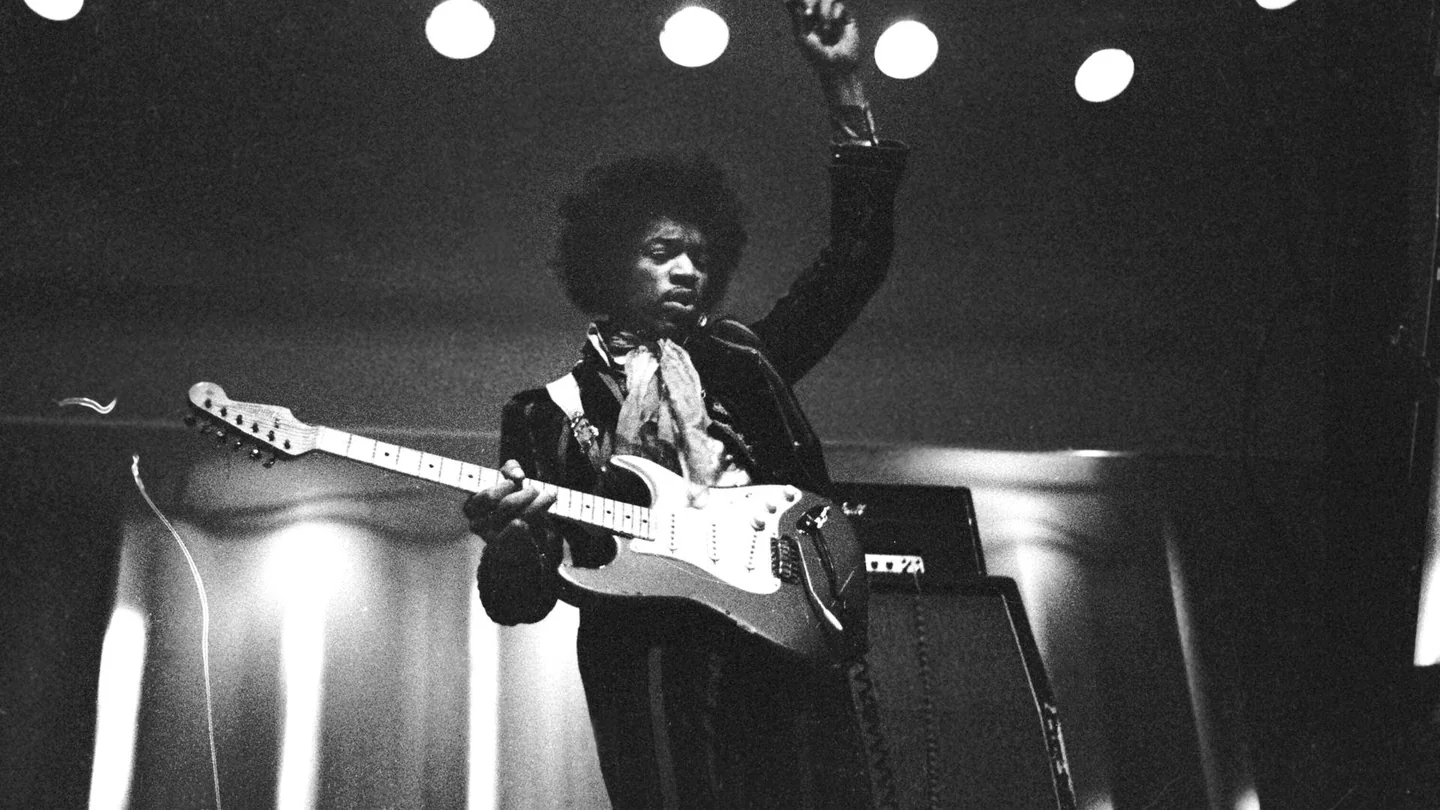
The Jimi Hendrix Experience joined blues phrasing to feedback, extended improvisation and a radically enlarged recording space. The Rock & Roll Hall of Fame documents the group’s use of panning, backmasking and phasing; Hendrix’s official session archive records edit sections for “1983… (A Merman I Should Turn to Be)” and hands-on tape flanging for “Gypsy Eyes.”
This was more than decoration placed over a finished guitar part. Touch, amplifier, effects, tape and stereo position formed one connected instrument. At the same time, Hendrix continued to perform recognisable blues forms: experiment and tradition coexist in the work rather than occupying separate stages of a simple progression.

Length Is Not the Definition
Extended solos became a visible feature of the style, but duration alone proves little. A long blues performance can remain conventional, while a concise recording can become psychedelic through feedback, stereo movement, altered timbre or an unstable sense of space. The useful question is what expansion does to the material, not how many minutes it lasts.
The rhythm section is equally important. Bass and drums can change harmony, density and scale beneath a solo instead of merely waiting for it to end. Organ, harmonica and vocal phrasing may keep the music close to blues practice even when guitar and production pull the apparent room outward.
Five Records, Five Different Routes
Hendrix’s Electric Ladyland makes the studio part of the composition. Cream’s Disraeli Gears compresses blues-derived riffs and psychedelic colour into songs. The Groundhogs’ Split pushes a British blues foundation toward heavier progressive form; Robin Trower’s Bridge of Sighs foregrounds sustained tone and atmosphere; Funkadelic’s Maggot Brain places long-form guitar inside a funk collective.
These are listening points, not a claim that every record belongs inside one rigid category. Compare how each balances inherited phrasing, rhythm, amplification, studio space and formal length. The differences prevent “psychedelic blues” from collapsing into a synonym for any loud guitar jam.
Imagined Landscapes and the RetroForge Route
Later heavy psych and stoner blues often move the music into imagined swamps, deserts, highways or abandoned rooms. Reverb, tremolo, close drums and dense low frequencies can suggest humidity or dust, but scenery cannot substitute for musical substance: a swamp title does not create blues phrasing, and fuzz alone does not create psychedelic development.
Dustveil Communion follows an acid-rock route through fuzz, blues-derived movement and psychedelic colour. Where the Water Won’t Move slows that vocabulary into slide guitar and swamp atmosphere. Both are original RetroForge works in conversation with this history; neither claims to reproduce the communities that created the blues.
Sources and Further Reading
This article uses the sources below for blues history, band history and documented studio practice. Genre boundaries and listening descriptions are editorial interpretations and are identified as such in the text.