Bends Carry Memory
Expressive pitch remains the human centre inside altered production.

Psychedelic Rock Family
Blues form entering altered space: slide guitar, deep pocket, organ mist and repetition that turns the familiar uncanny.
The Sound
Psychedelic blues keeps the emotional grammar of the blues while changing its sense of time and place. Repeated guitar figures, vocal calls and slow harmonic movement remain recognisable, but fuzz, echo, organ drones and modal improvisation stretch the frame around them.
Unlike acid rock, which often pushes toward raw speed or free-form intensity, psychedelic blues may stay patient and grounded. The rhythm section can sit far behind the beat while slide guitar and voice drift across it. Production creates a second landscape: swamp air, tape decay, distant percussion or a room that seems larger than the band inside it.
The strongest examples respect the blues as more than a convenient scale. Tension, repetition and response carry the music. Psychedelia changes how those elements are perceived rather than replacing them with surface effects.
What You’ll Hear
How It Works
Psychedelic blues keeps the expressive vocabulary of blues—bent notes, repeated figures, call and response, bodily groove—while changing the space and duration around it. Echo stretches a phrase, fuzz obscures the edge of a guitar and improvisation opens the form beyond familiar turnaround logic.
The blues remains the anchor. Listen for how far the music travels and what still brings it home. A single bass figure or vocal cadence can preserve identity while the surrounding arrangement enters unfamiliar, dreamlike or threatening territory.
Useful distinction: Boundary line: blues-scale soloing over psychedelic production is not always enough. The underlying blues grammar must remain audible and consequential.
Expressive pitch remains the human centre inside altered production.
Open form delays familiar resolution without erasing its pull.
Bass and drums maintain physical contact during extended drift.
Fuzz, tremolo and echo make old phrases occupy new space.
Historical Development
Psychedelic blues begins with recognisable blues materials—bent notes, repeated riffs, vocal strain and a rhythm section built around feel—then alters their scale and atmosphere. The British blues boom supplied technically ambitious players, while American musicians brought direct links to electric blues, soul and regional traditions. Psychedelia allowed both groups to treat the blues less as a repertoire and more as raw material.
The transformation could happen in several ways. Studio effects made a guitar line appear to circle the listener; modal passages suspended the normal harmonic destination; long performances shifted attention from lyrics to interaction. Fleetwood Mac could remain spacious and lyrical, Canned Heat could settle into boogie, and Hendrix could make the boundary between melody and noise disappear.
The style matters because it preserves emotional directness inside experimental form. Even at its most abstract, the guitar still sounds like a voice and the groove still carries bodily weight. Later blues rock often retained the loudness while losing that sense of altered space; psychedelic blues is strongest when both dimensions remain audible.
The Real-World Foundations
Not a ranking: six useful doors into the style.
Blues touch and radical studio colour coexist inside unusually concise arrangements.
Studio construction and live improvisation reveal two sides of psychedelic blues.
Boogie, amplified blues and the extended Refried Boogie meet on one sprawling set.
Peter Green's restraint and Danny Kirwan's melodic imagination create a haunted, spacious form.
British blues becomes heavier, conceptual and structurally unstable.
A later descendant sustains the style through thick guitar tone, slow groove and atmospheric space.
Start Here
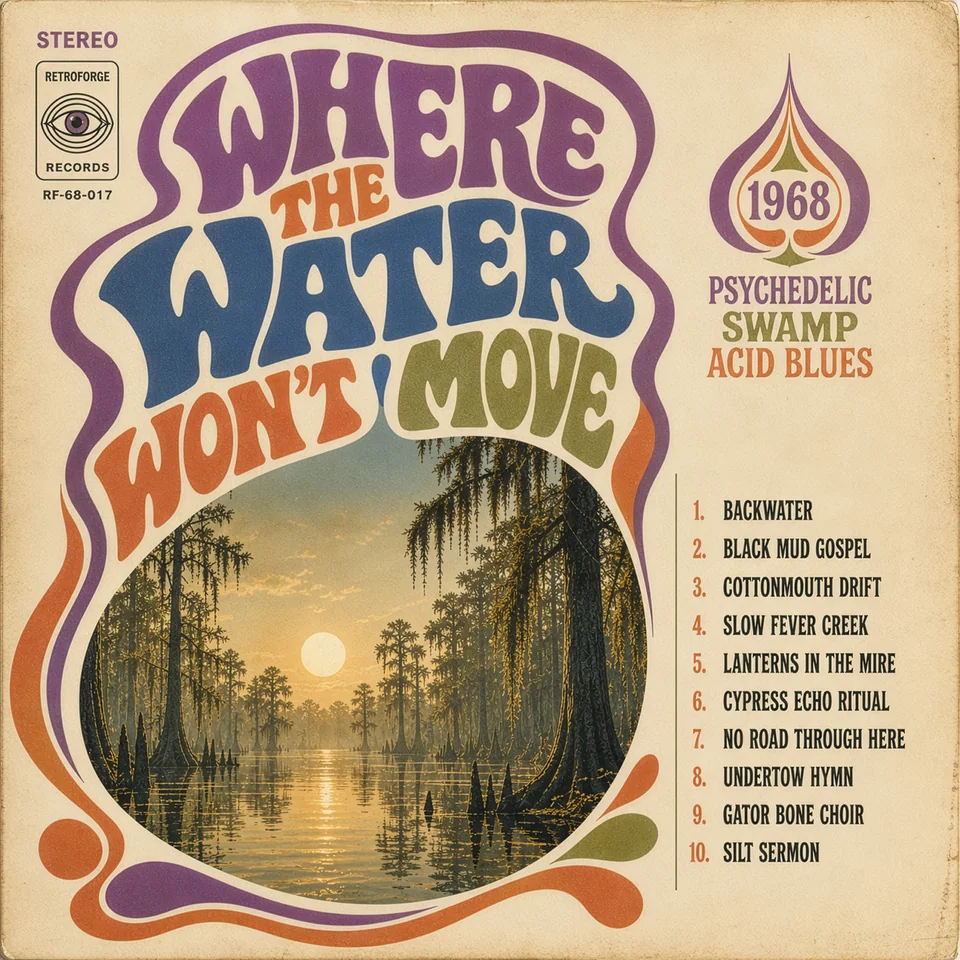
1968 · Swamp Acid Blues
Slide guitar, low organ, slow groove and a swamp that listens back.
Open the liner notes →Research Trail
Questions from the Record Room
Psychedelic blues uses altered texture, modal drift, unusual form or studio space as structural elements rather than simply playing blues louder.
No. Guitar is common, but organ, voice, bass, percussion and production can create the same transformation.
Axis: Bold as Love offers the broadest introduction; Then Play On shows the quieter and more haunted side.
Related Styles
Deeper Discovery
Start with Eyes Behind My Eyes as a RetroForge companion, then return through Psychedelic Rock to place it inside the wider family.
Curated paths into the people, records, events and ideas that give this subject its wider musical context.