
Overview
Van der Graaf Generator built progressive rock around an unusual centre of gravity. Peter Hammill's songs and sharply changing vocal delivery sit inside Hugh Banton's organ and bass-pedal foundation, David Jackson's saxophones and flutes, and Guy Evans's highly responsive drumming. Guitar is present—Hammill plays it throughout the catalogue—but the classic quartet does not depend on a permanent lead guitarist or conventional bass player. That leaves harmony, low end and instrumental attack free to change roles inside a song.
Formation & History
Peter Hammill and Chris Judge Smith formed the first version at Manchester University in 1967 with organist Nick Pearne. After moves, personnel changes and an equipment theft, that group dissolved. Hammill then recorded what began as a solo project with Hugh Banton, bassist Keith Ellis and drummer Guy Evans; Mercury released The Aerosol Grey Machine under the Van der Graaf Generator name in 1969 as part of the arrangement that freed Hammill from his contract.
On Charisma, Hammill, Banton and Evans were joined by saxophonist and flautist David Jackson and bassist Nic Potter. Potter left during the sessions for H to He, Who Am the Only One; Banton covered bass guitar in the studio and bass pedals onstage, establishing the quartet heard on Pawn Hearts. Exhaustion and financial pressure ended that phase in 1972. The same four musicians re-formed in 1975, recording Godbluff, Still Life and World Record. Banton and Jackson then departed; the shorter-named Van der Graaf continued with returning bassist Nic Potter, violinist Graham Smith and later cellist Charles Dickie until the 1978 split.
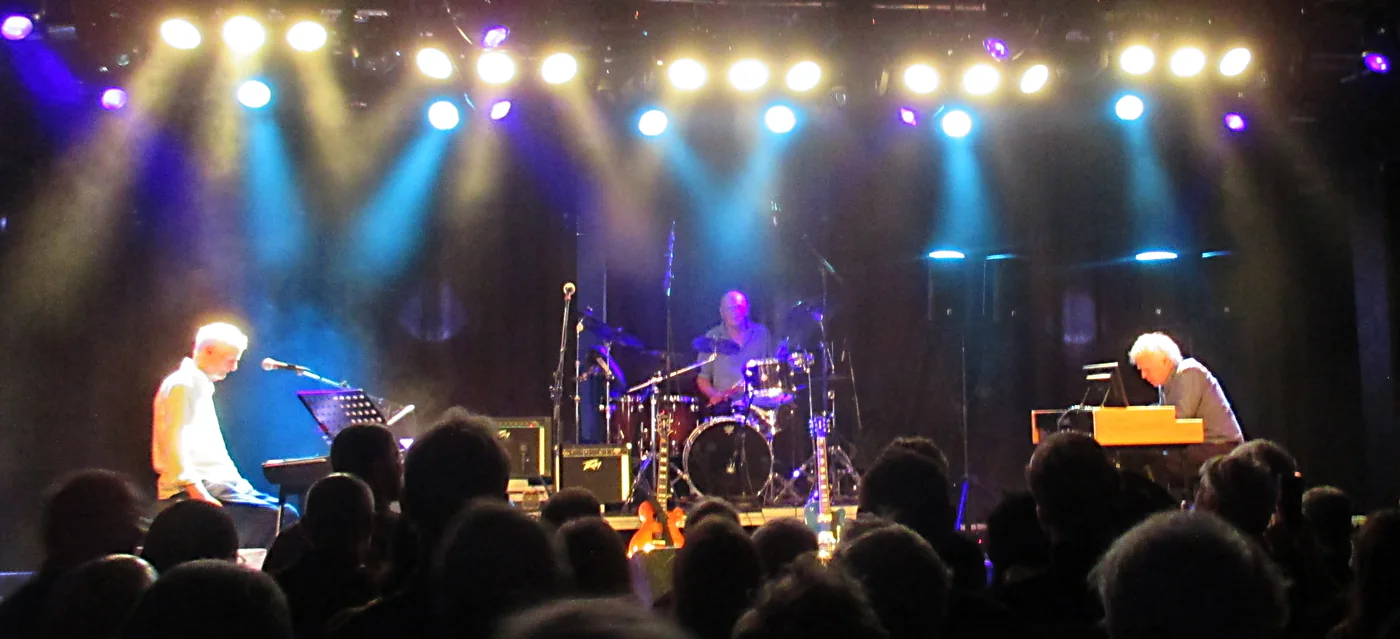
The classic quartet announced a reunion in November 2004, released Present in 2005 and played together that year. Jackson left after the reunion performances. Hammill, Banton and Evans continued as a trio, making four further studio albums through Do Not Disturb in 2016 and performing as recently as 2022.
Sound & Style
Banton's modified organs can supply chords, distorted weight and low frequencies at once; after Potter's departure he combined bass pedals with studio bass guitar. Jackson often plays two saxophones simultaneously and routes the reeds through amplification and effects, moving between melody, chordal mass and noise. Evans does not simply underline odd metres: cymbal colour, rolls and displaced accents continually reshape the ensemble's density. Hammill moves among voice, piano and guitar, sometimes allowing a quiet line to carry as much structural force as a shouted climax.
The arrangements are therefore less guitarless than role-fluid. “Killer” drives through a recurring ensemble riff; “Man-Erg” interrupts its piano-led song with violent instrumental blocks; the side-long “A Plague of Lighthouse Keepers” was assembled in the studio from linked sections. The 1975 return is leaner and more playable onstage, while the post-2005 trio makes the missing saxophones part of its design by giving Hammill's guitar and Banton's organ more exposed space.
Essential Albums
Pawn Hearts
1971Three compositions fill the original UK album. “Lemmings (Including Cog)” repeatedly rebuilds its opening material instead of settling into a verse-chorus form; “Man-Erg” places a piano-led song around a ferocious central ensemble passage. Side two is the twenty-three-minute “A Plague of Lighthouse Keepers,” whose ten linked sections were assembled through overdubbing and editing. Robert Fripp contributes guitar, but the record's identity remains in the collision of Banton's organ, Jackson's treated reeds, Evans's percussion and Hammill's voice, piano and guitar.
Key tracks: Lemmings (Including Cog) · Man-Erg · A Plague of Lighthouse Keepers
Open album guide → View on Amazon →The five-track album catches a lineup changing during the sessions. Nic Potter plays bass on “Killer,” “The Emperor in His War Room” and “Lost” before leaving; Banton takes bass guitar on “House with No Door” and “Pioneers Over c,” while Robert Fripp guests on “The Emperor.” That transition sharpens the contrast between the direct recurring riff of “Killer,” the exposed piano and voice of “House with No Door,” and the long science-fiction narrative of “Pioneers Over c.”
Key tracks: Killer · The Emperor in His War Room · Pioneers Over C
Open album guide → View on Amazon →Still Life
1976The second album after the 1975 reunion is not a comeback document but a tightly sequenced five-song record. “Pilgrims” opens in measured, almost hymn-like motion; the title track examines immortality through a restrained organ-led setting; “La Rossa” turns desire and self-reproach into one of the quartet's most volatile performances. “My Room” creates a quieter interior before “Childlike Faith in Childhood's End” closes the album in an extended argument rather than a conventional resolution.
Key tracks: Pilgrims · Still Life · La Rossa
Open album guide → View on Amazon →Affiliate note: Amazon links on this page may earn RetroForge Records a small commission, at no extra cost to you.
Deeper Cuts
Godbluff
1975The first studio record after the 1975 reunion contains only four long pieces: “The Undercover Man,” “Scorched Earth,” “Arrow” and “The Sleepwalkers.” Written for the restored Hammill–Banton–Jackson–Evans quartet and developed for performance, it is leaner than the studio-built Pawn Hearts without sacrificing abrupt metre, reed distortion or dynamic shock.
Open album guide → View on Amazon →World Record
1976The final studio album by the classic quartet before Banton and Jackson left. “When She Comes” and “A Place to Survive” are comparatively direct, while the twenty-minute “Meurglys III, The Songwriters Guild” gives Hammill's electric guitar an unusually large structural role. The closing “Wondering” offers a spacious counterweight to the record's harder centre.
Open album guide → View on Amazon →Vital
1978Recorded at the Marquee on 16 January 1978 by the violin-and-bass incarnation billed as Van der Graaf. Hammill, Evans, Potter, Smith and Dickie are joined by guest David Jackson; Hugh Banton is absent. The surviving saxophone sound had to be recovered largely from spill after Jackson's dedicated recording track failed, making the album both a forceful performance document and an imperfect technical record.
Open album guide → View on Amazon →Why They Still Matter
The catalogue records several genuinely different solutions to the same ensemble problem. The 1970–71 records remove a conventional rhythm-section hierarchy; the 1975 return converts studio complexity into music the quartet could reproduce onstage; the 1977 Van der Graaf lineup substitutes violin, bass and cello for the organ-and-saxophone axis; the post-2005 trio works without Jackson. That history is more useful than a loose roll-call of supposed influence.
The band's survival is also concrete rather than rhetorical. Present restored the classic quartet in 2005, four subsequent trio albums culminated in Do Not Disturb in 2016, and the group continued performing through 2022. Their importance lies in a method that remained open to subtraction and reinvention: Hammill's writing, Banton's re-engineered keyboard role and Evans's rhythmic responsiveness could persist without freezing one celebrated lineup.
Sources & Further Reading
Connected archive routes