IQ formed in 1981 and became a regular presence at London’s Marquee Club during the British progressive-rock revival of the early 1980s. Instead of remaining tied to that moment, the band built an independent catalogue whose major landmarks span three decades: The Wake in 1985, Subterranea in 1997 and The Road of Bones in 2014.
Their strongest records favour shadow, patience and accumulated pressure over brightly polished nostalgia. Peter Nicholls writes images of fractured identity and uncertain memory, while Mike Holmes builds guitar parts that can remain restrained for long stretches before becoming the emotional centre. The stability of that partnership has allowed the surrounding lineup and production technology to change without dissolving the band’s identity.
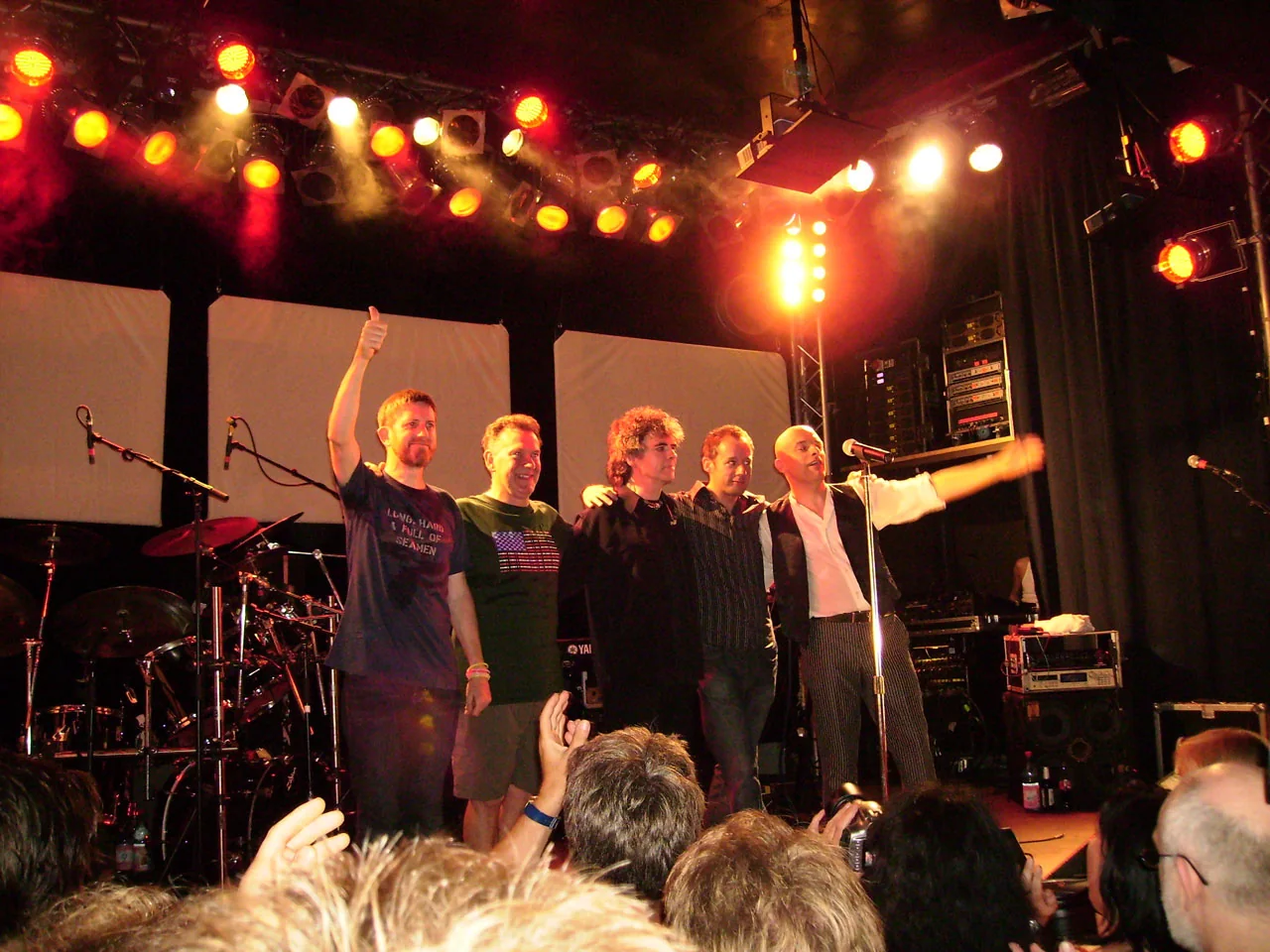
IQ in a licensed group photograph.Photo: Created by Viki Fabian. Placed here by Dr. Ombrax / Wikimedia Commons · Licensed under CC BY-SA 3.0. Converted to WebP for this page.
Formation & History
Guitarist Mike Holmes and keyboardist Martin Orford founded IQ in 1981. Bassist Tim Esau joined that year; vocalist Peter Nicholls and drummer Paul Cook completed the first recording lineup in 1982. After the cassette Seven Stories Into Eight, constant live work preceded the vinyl albums Tales from the Lush Attic (1983) and The Wake (1985).
Nicholls left at the end of a 1985 tour and Paul Menel sang on Nomzamo and Are You Sitting Comfortably?. Menel and Esau departed in 1990. Nicholls rejoined that same year, John Jowitt became bassist in 1991, and the renewed lineup released Ever in 1993. The band and its associates also established Giant Electric Pea, the independent label that first issued the 1991 live-and-rarities collection J’ai Pollette d’Arnu. The double concept album Subterranea followed in 1997 with a purpose-built multimedia stage presentation.
Cook left in 2005 and Orford in 2007. Mark Westworth played keyboards on Frequency (2009); Cook returned soon afterward. Westworth and Jowitt left at the end of 2010, and Neil Durant joined alongside the returning Esau in 2011. That five-person lineup—Nicholls, Holmes, Durant, Esau and Cook—made The Road of Bones (2014) and Resistance (2019) and remained the lineup presented by the official band site during its 2025 concert schedule.
Sound & Style
Mellotron colour, sustained guitar and recurring motifs build nocturnal, psychologically enclosed long forms.
Holmes uses sustained guitar tone and carefully delayed entrances rather than constant soloing. Keyboards move between Mellotron-like mass, piano and modern synthesis; the rhythm section gives long pieces a measured, almost tectonic growth. Nicholls's theatrical voice remains recognisable, but later albums use it with greater control. Recurring themes matter more than rapid technical change, making IQ's music feel architectural and psychologically enclosed.
Essential Albums
1985
The Wake
Sahara · Original 1985 release
The Wake gives early IQ its sharpest identity. Martin Orford's keyboards and Mike Holmes's guitar create a cold, dramatic frame for Peter Nicholls's imagery of mortality, performance and fractured selfhood. The title track, “Widow's Peak” and “The Magic Roundabout” move through linked moods without becoming one continuous suite. The production is leaner than the band's later records, which keeps the rhythmic turns exposed and the theatrical elements slightly dangerous. It remains the key document of the original lineup and a useful demonstration that early neo-prog was not simply cheerful symphonic revivalism.
Subterranea is IQ's most extensive narrative undertaking: a double album following a man released into a world he knows only through confinement and observation. Motifs recur across “Overture,” “Failsafe,” “The Narrow Margin” and the shorter connective songs, while the production maintains a consistent nocturnal atmosphere. The concept was developed for a full theatrical presentation, yet the record works because individual scenes have their own musical purpose. Its length is part of the experience rather than an automatic virtue. Hear it when ready for IQ's patient method on its largest canvas.
Key tracks: Overture · Failsafe · The Narrow Margin
The Road of Bones presents modern IQ with unusual weight and clarity. Neil Durant's keyboards deepen the low, ominous atmosphere, while the returned rhythm section of Tim Esau and Paul Cook lets long tracks develop without haste. The title song sustains dread through repetition and withheld release; “Without Walls” expands toward a large emotional resolution without losing its internal thread. A second disc broadens the original edition, but the core album is already complete. It proves the group did not need historical status to sound authoritative: this is late-career work with its own reason to exist.
Key tracks: The Road of Bones · Without Walls · Until the End
IQ turned neo-prog from a moment into a durable independent tradition.
IQ's importance lies in continuity without stasis. They preserved independent album-scale progressive rock through periods when the style received little mainstream support, then produced some of their strongest work decades after the first wave. The catalogue documents how neo-prog could mature into a darker modern language rather than endlessly restaging its youth.
RetroForge Records publishes original music and independent editorial guides. This historical band guide is not affiliated with the artist, labels or rights holders. No unlicensed album artwork is reproduced.