Porcupine Tree began as Steven Wilson's private studio fiction and became a band in stages. The early cassettes and first albums presented fragments of an imaginary psychedelic group's history; by December 1993 Wilson was performing the material with Richard Barbieri, Colin Edwin and Chris Maitland. From Signify onward, those musicians increasingly shaped the records as a working ensemble rather than simply reproducing Wilson's constructions.
The catalogue does not move along one straight stylistic line. Early releases combine psychedelic rock, ambient electronics and tape collage. Stupid Dream and Lightbulb Sun tighten the writing around compact songs, while In Absentia introduces Gavin Harrison and gives metal-derived guitar weight a larger structural role. The 2022 album Closure/Continuation is another distinct formation: Wilson, Barbieri and Harrison recorded as a trio, with Wilson also handling bass.
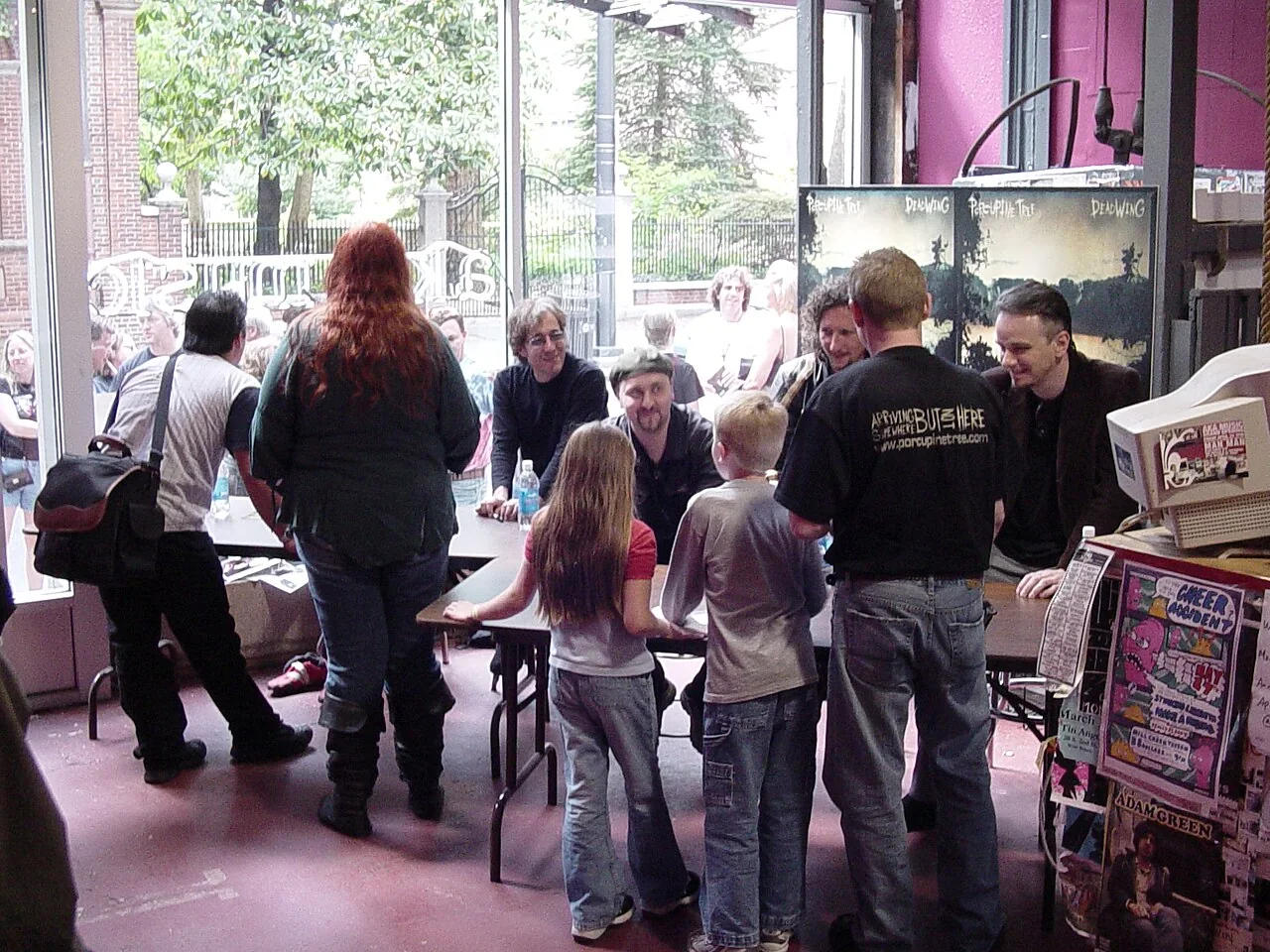
Porcupine Tree at a record-store appearance in Philadelphia, 21 May 2005.Photo: Alex Harden / Wikimedia Commons · Licensed under CC BY 2.0. Converted to WebP for this page.
Formation & History
Delerium assembled material from Wilson's Tarquin's Seaweed Farm and The Nostalgia Factory cassettes as On the Sunday of Life... in 1992. Up the Downstair followed in 1993, while “Voyage 34” was separated into its own release. The first Porcupine Tree concert took place at the Nags Head in High Wycombe on 4 December 1993 with Wilson, Barbieri, Edwin and Maitland. The Sky Moves Sideways documents the transition between the solo-studio and live-band identities; Signify, released in 1996, was the first studio album made with the band involved from the beginning.
Stupid Dream and Lightbulb Sun brought song form and vocal melody forward without discarding electronic space. Maitland left before In Absentia; Gavin Harrison's first studio album with the group was also its first on Lava and its clearest move toward progressive metal. The Wilson–Barbieri–Edwin–Harrison quartet continued through Deadwing, Fear of a Blank Planet and The Incident, then stopped after the 2010 touring cycle.
Wilson, Barbieri and Harrison completed Closure/Continuation in September 2021 and released it in June 2022. The official credits identify those three as performers and producers; Edwin did not participate. Randy McStine and Nate Navarro expanded the trio for the reunion concerts. The most recent shows took place during the limited 2022–2023 cycle, and the official tour page currently lists no upcoming events, so “present” would imply a continuity the public record does not establish.
Sound & Style
The early studio records use loops, spoken samples, sequencers, long guitar sustain and ambient transitions to make the album itself feel like the primary instrument. “Voyage 34” joins psychedelic narration to early-1990s ambient and trance processes; The Sky Moves Sideways expands recurring vocal and guitar material across two framing pieces. When the quartet became central, Edwin's fretless and fretted bass, Maitland's more explosive drumming and Barbieri's non-soloistic electronics changed the music from layered construction into ensemble conversation.
Wilson writes direct vocal melodies but often places them against uneasy detail: acoustic guitar can sit beside processed noise, Mellotron colour or a sharply gated metal riff. Harrison's precision permits rapid metric changes without turning the rhythm into display, while Barbieri usually works through timbre, filtering and atmosphere rather than conventional keyboard leads. Dynamic contrast is structural: the quiet passages do not merely delay the heavy sections but determine how large they feel when they arrive.
Essential Albums
2002
In Absentia
Lava · Original 2002 release
In Absentia is the decisive meeting point between Porcupine Tree's atmospheric past and its heavier future. “Blackest Eyes” places a severe opening riff beside bright vocal harmony, establishing contrasts that recur throughout the album. “Trains” makes nostalgia tactile through acoustic detail and rhythmic interruption; “The Sound of Muzak” turns a critique of standardised culture into an unusually graceful groove. Gavin Harrison's first studio appearance transforms the rhythmic precision, while Paul Northfield's engineering gives the band scale without flattening its quiet spaces. This is the most reliable starting point because nearly every major Porcupine Tree language is present.
Key tracks: Blackest Eyes · Trains · The Sound of Muzak
Fear of a Blank Planet is a compact song cycle about medicated numbness, screens, isolation and damaged adolescence. The title track moves with nervous efficiency, but “Anesthetize” provides the centre: long-form architecture passes from intricate pulse through crushing repetition to a detached final drift. Alex Lifeson and Robert Fripp appear without disturbing the band's identity. “Sleep Together” closes with electronic menace and a string arrangement that enlarges rather than decorates the song. The subject matter is intentionally uncomfortable, and the album's controlled, cold surface makes that discomfort harder to escape.
Key tracks: Fear of a Blank Planet · Anesthetize · Sleep Together
The Sky Moves Sideways belongs to the period when Porcupine Tree was shifting from Wilson's studio project into a band. Its title composition frames the album with long psychedelic movement, sequenced electronics, gliding guitar and recurring vocal motifs. “Stars Die” provides a more concise emotional focus, while “Moonloop” preserves the exploratory basis of the developing live group. Different editions and recording circumstances make the album less unified than later work, yet that porous quality is its attraction. It captures a modern 1990s studio imagination engaging space rock without treating the 1970s as a costume.
Key tracks: The Sky Moves Sideways Phase One · Stars Die · Moonloop
Porcupine Tree's importance lies less in “reviving” progressive rock than in reconnecting several scenes that were already active: 1970s album-scale composition, 1990s ambient electronics and alternative songcraft, and the controlled weight of turn-of-the-century metal production. The band could move among those languages without making every transition sound like a genre demonstration. A song such as “Trains” is memorable before its metric interruption is analysed; “Anesthetize” sustains a long form through changes of texture and pulse rather than virtuosity alone.
The three main formations also prevent the catalogue from becoming a single-author story. The Maitland quartet converted Wilson's studio project into a live ensemble; the Harrison quartet developed the best-known balance of melody, electronic space and heavy rhythm; the later trio made Closure/Continuation around a different low-end and compositional structure. That continuity through changed working methods is the lasting lesson: production, arrangement and performance can evolve together without requiring the band to imitate its own past.
RetroForge Records publishes original music and independent editorial guides. This historical band guide is not affiliated with the artist, labels or rights holders. No unlicensed album artwork is reproduced.