Marillion brought long-form, emotionally direct progressive rock to a large 1980s audience without reducing it to a revival of the previous decade. Their early work paired Fish’s densely written, theatrical lyrics with Steve Rothery’s sustained guitar lines, Mark Kelly’s keyboards, Pete Trewavas’s melodic bass and, from Fugazi onward, Ian Mosley’s patient, powerful drumming. Misplaced Childhood reached number one in the UK while retaining a continuous, carefully sequenced design.
Fish’s departure in 1988 did not end the group. Steve Hogarth joined during the preparation of Seasons End, released on 1 September 1989, and Marillion built a second identity based on subtler vocal acting, atmospheric arrangements and collective songwriting. Direct communication with listeners later changed the group’s practical future as well: fans financed a US tour, and the band used advance orders to support recording and promotion. Their history is therefore not one era prolonged indefinitely, but two substantial creative lives connected by the same instrumental core.
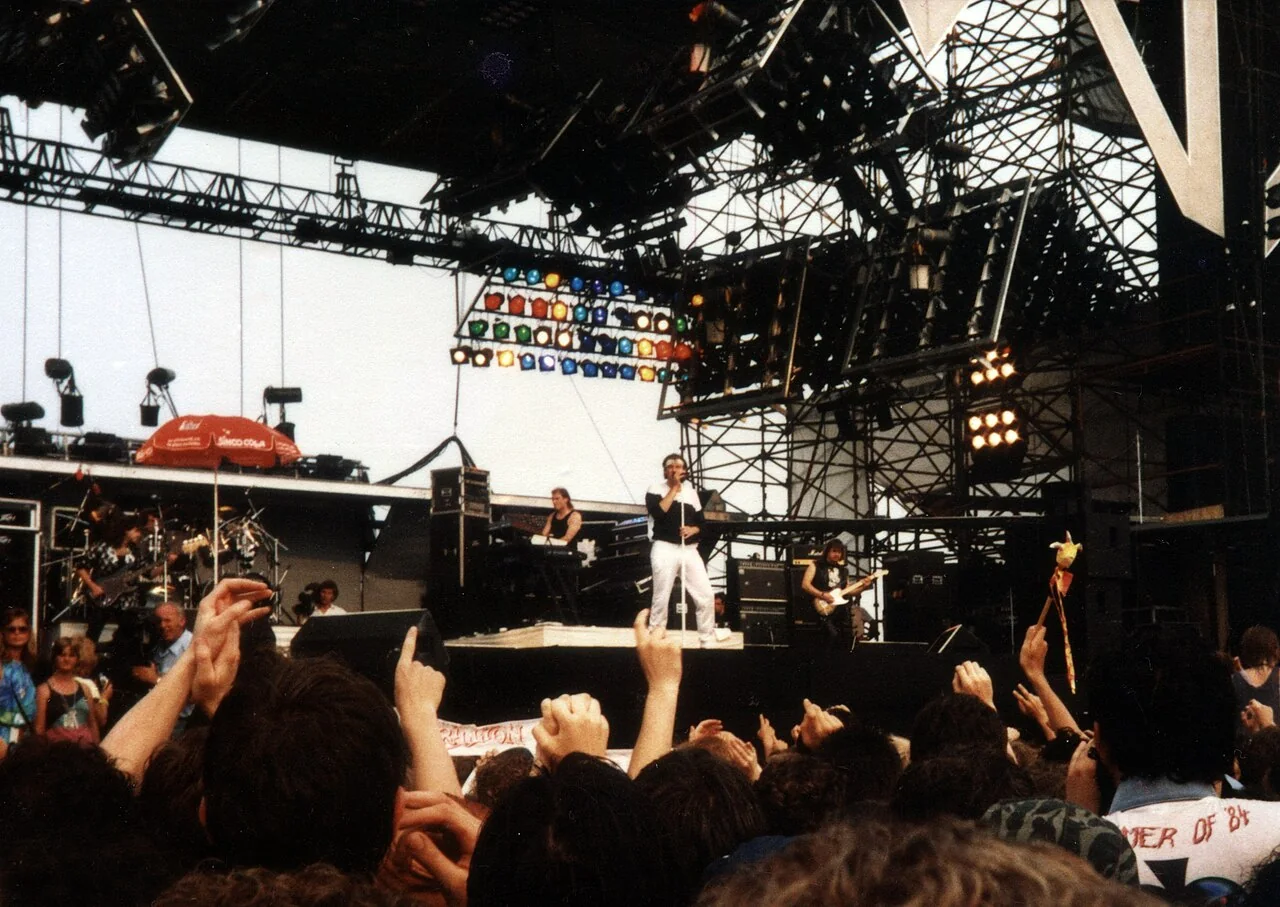
Marillion performing with Fish in Mannheim, Germany, 21 June 1986.Photo: Sir James / Wikimedia Commons · Licensed under CC BY-SA 3.0. Converted to WebP for this page.
Formation & History
The group began in Aylesbury in 1979 as Silmarillion. Guitarist Steve Rothery and drummer Mick Pointer were among the early members; singer and lyricist Fish joined in 1981, by which point the shortened name Marillion had been adopted. Mark Kelly and Pete Trewavas completed the lineup that recorded Script for a Jester’s Tear, released on 14 March 1983. Ian Mosley replaced Pointer after a succession of drummers and became the group’s permanent drummer during the making of Fugazi.
Misplaced Childhood, released on 17 June 1985, reached number one in the United Kingdom and brought the group its best-known singles, including “Kayleigh” and “Lavender.” Clutching at Straws became the final studio album with Fish, who left in 1988. Steve Hogarth arrived from How We Live in early 1989. Instead of imitating Fish, he helped redirect the band through Seasons End, Holidays in Eden and the darker, more spatially organised Brave.
The Hogarth, Rothery, Kelly, Trewavas and Mosley lineup has remained intact since 1989. In the late 1990s, an online fan appeal raised $60,000 for a United States tour. For Anoraknophobia in 2001, 12,000 advance orders helped finance both the recording and its launch. These initiatives did not replace the music, but they gave Marillion a durable way to make and promote records outside the conventional label cycle.
Sound & Style
Rothery’s guitar is central to both eras: he favours vocal-like bends, carefully placed notes and long melodic arcs over continuous technical display. Kelly’s keyboards create depth around those lines, while Trewavas and Mosley make irregular or extended structures feel natural. Under Fish, the arrangements often frame sharply observed characters and verbal puzzles; with Hogarth, space, texture and changes of emotional temperature become more prominent.
Marillion can write compact songs, but their strongest albums depend on recurrence. A phrase heard early may return with altered harmony or meaning much later, allowing narrative and music to develop together. The result is progressive rock defined less by instrumental excess than by patient dramatic architecture.
Essential Albums
1985
Misplaced Childhood
EMI · Released 17 June 1985
Misplaced Childhood is constructed as a continuous album rather than a set of unrelated songs. Childhood memory, adult damage, lost intimacy and recovery pass through recurring melodies that make “Pseudo Silk Kimono,” “Kayleigh,” “Lavender” and the long “Blind Curve” sequence parts of one emotional argument. Recorded at Hansa Studios in West Berlin with producer Chris Kimsey, it gives keyboards and guitar a polished scale without erasing the rhythm section’s movement. Its singles opened the door to a broad audience, but the record’s endurance comes from the way familiar hooks acquire new meaning inside the complete sequence.
Clutching at Straws replaces the dreamlike continuity of Misplaced Childhood with late-night rooms, touring fatigue and self-destruction. Fish’s recurring character Torch moves through bars, hotel spaces and collapsing relationships while the band answers with harder edges and colder keyboard colour. “Hotel Hobbies,” “Warm Wet Circles” and “That Time of the Night” form an opening sequence that feels both cinematic and trapped; “Sugar Mice” provides a quieter centre, and “The Last Straw” refuses an easy resolution. As the final Fish studio album, it documents a lineup under pressure while transforming that pressure into unusually coherent work.
Key tracks: Hotel Hobbies · Warm Wet Circles · Sugar Mice · The Last Straw
Brave is the album on which the Hogarth-era Marillion fully established its own scale. Built around the imagined life of a traumatised young woman found on the Severn Bridge, it uses field sound, silence, recurring motifs and long transitions to create an enclosed psychological world. Recorded partly at Château de Marouatte with producer Dave Meegan, the album moves from the menace of “Living with the Big Lie” and “Goodbye to All That” toward the fragile title track and the devastating “The Great Escape.” It demands uninterrupted listening, not because every section is dense, but because atmosphere and withheld information are fundamental parts of the narrative.
Key tracks: The Great Escape · The Hollow Man · Made Again
Marillion kept album-oriented progressive rock culturally visible across changing fashions without freezing it in a 1970s museum. Misplaced Childhood represents the commercial and conceptual peak of the Fish era; Brave proves the Hogarth lineup could make an equally committed statement in a very different emotional language.
Their independent operating model is also part of that history. The fan-financed US tour and the 12,000 advance orders for Anoraknophobia demonstrated that an established band could fund specific projects through a direct audience relationship. The loyalty surrounding Marillion is therefore not nostalgia alone: it reflects decades of communication, risk-taking and work made outside the usual boom-and-discard cycle.
RetroForge Records publishes original music and independent editorial guides. This historical band guide is not affiliated with the artist, labels or rights holders. No unlicensed album artwork is reproduced.