Iron Butterfly occupy the point where psychedelic rock becomes heavy, repetitive and physically overwhelming. Their reputation centres on "In-A-Gadda-Da-Vida," but the classic group’s significance also lies in the combination of Doug Ingle’s organ, dark modal writing and early hard-rock weight.
The familiar title track can overshadow a catalogue that records psychedelic rock becoming heavier without yet settling into later metal conventions. Doug Ingle’s organ supplies both low-end weight and church-like resonance; Ron Bushy’s drums favour a deliberate, ritual pulse; Lee Dorman and Erik Brann give the classic lineup a more flexible attack than the band’s reputation for blunt force suggests.
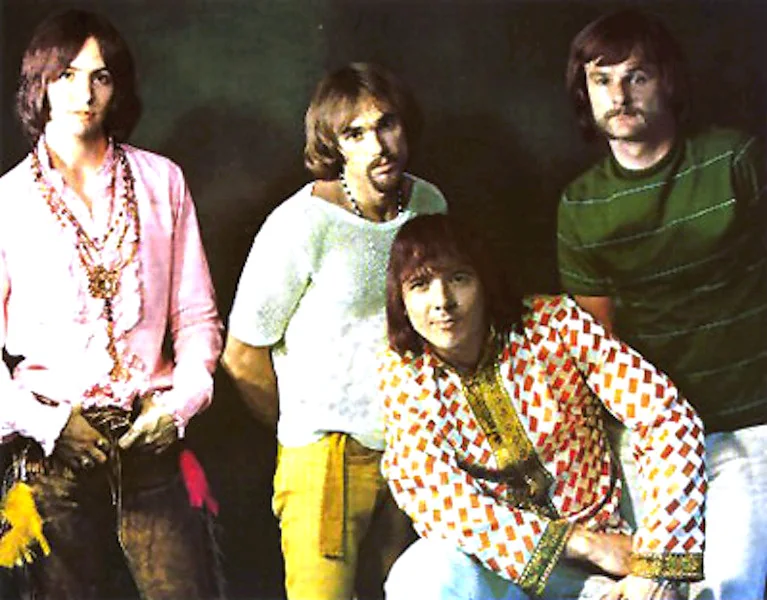
Iron Butterfly in a 1969 publicity photograph.Photo: The Iron Butterfly / Wikimedia Commons · Licensed under Public domain. Converted to WebP for this page.
Formation & History
Iron Butterfly formed in San Diego in 1966 and moved to Los Angeles. The lineup that recorded the debut Heavy comprised organist and singer Doug Ingle, drummer Ron Bushy, guitarist Danny Weis, bassist Jerry Penrod and singer and percussionist Darryl DeLoach. Touring strain led Weis, Penrod and DeLoach to leave. Guitarist Erik Brann and bassist Lee Dorman joined Ingle and Bushy for the second album.
That four-person lineup recorded In-A-Gadda-Da-Vida and Ball, both released in quick succession in 1968 and 1969. Brann left at the end of 1969. Mike Pinera and Larry “Rhino” Reinhardt brought a two-guitar configuration to Metamorphosis in 1970, while Ingle, Dorman and Bushy remained. Ingle departed after that album, and the first continuous run ended in 1971. A different lineup made two studio albums in 1975, followed by intermittent touring revivals involving various former members.
Sound & Style
Ingle’s Vox organ often functions as both riff and atmosphere. Fuzz guitar, blunt bass, heavy drums and minor-key vocals create a slower and darker psychedelic sound than most California peers. Extended repetition allows timbre and dynamics to replace harmonic development.
Ingle’s organ often functions as the principal riff instrument, allowing guitar to add fuzz, sustain and melodic response rather than carrying every section. The long “In-A-Gadda-Da-Vida” uses repetition, gradual subtraction and solo space to occupy an entire LP side. Its famous drum passage is part of a larger architectural decision: duration turns a simple motif into an environment.
Essential Albums
1968
In-A-Gadda-Da-Vida
Atco · Original 1968 release
The second album is deliberately divided between five concise songs and the 17-minute title track occupying side two. “Most Anything You Want” and “Flowers and Beads” retain melodic, almost pop-sized writing; the title piece reduces the material to an organ motif, vocal refrain, guitar, bass and a long percussion-centred middle passage. That contrast matters: the album documents the same lineup working in compact song form and at extended scale.
Key tracks: Most Anything You Want · Flowers and Beads · In-A-Gadda-Da-Vida
Ball refuses to repeat the side-long formula: only two of its nine tracks exceed five minutes. “In the Time of Our Lives” opens with feedback, Brann’s short guitar bursts and Dorman’s active bass, while “Lonely Boy” turns Ingle’s organ toward a slow soul ballad. Brann closes the album with “Belda-Beast,” his last extended studio statement before leaving the group at the end of 1969.
Key tracks: In the Time of Our Lives · Soul Experience · Belda-Beast
Released in January 1968, the debut preserves a five-person band that changed almost immediately afterward. DeLoach, Ingle and Weis share the writing and vocal presence; “Unconscious Power” drives on a compact organ-and-guitar riff, the Allen Toussaint composition “Get Out of My Life, Woman” connects the group to rhythm and blues, and the instrumental “Iron Butterfly Theme” stretches the heavier side of the sound beyond pop length.
Key tracks: Possession · Iron Butterfly Theme · Gentle as It May Seem
Iron Butterfly showed that repetition, organ and amplifier weight could make psychedelic music monumental. Heavy psych and early metal absorbed the lesson immediately.
Iron Butterfly matters as a hinge between garage-derived psychedelia, side-long improvisation and the slower weight adopted by heavy rock. Calling them the sole inventors of metal would flatten a complicated transition involving many bands. Their more useful legacy is the proof that organ-led repetition and extended duration could create mass without orchestral arrangement or virtuoso speed.
RetroForge Records publishes original music and independent editorial guides. This historical band guide is not affiliated with the artist, labels or rights holders. No unlicensed album artwork is reproduced.