Cream formed in London in July 1966 around Eric Clapton, Jack Bruce and Ginger Baker. All three arrived with established reputations: Clapton from the Yardbirds and John Mayall's Bluesbreakers, and Bruce and Baker from intersecting British jazz and rhythm-and-blues groups including the Graham Bond Organisation. Their first major public appearance came at the National Jazz and Blues Festival in Windsor on 31 July.
Across less than three years, the trio moved from the blues covers and original songs of Fresh Cream to the compact studio psychedelia of Disraeli Gears, then placed new studio work beside extended concert performances on the double album Wheels of Fire. That contrast between concise records and open live interaction is more useful than treating every Cream performance as one undifferentiated wall of volume.
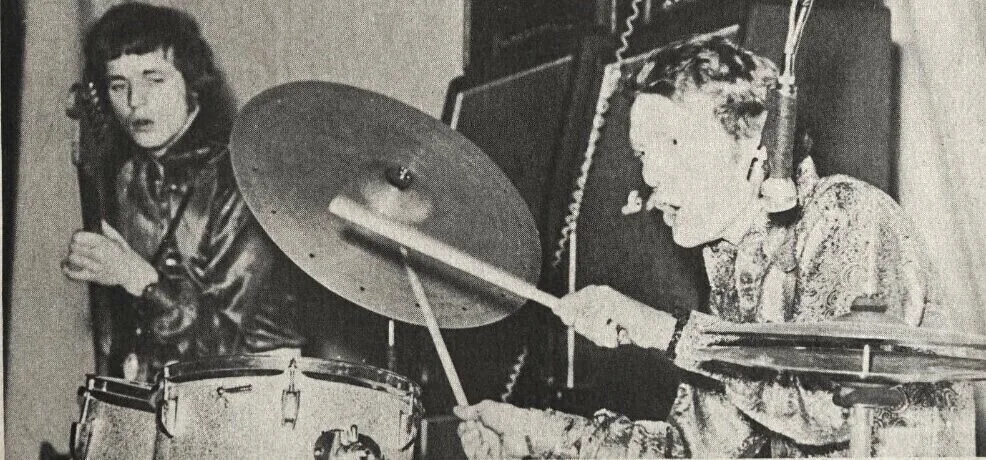
Jack Bruce and Ginger Baker of Cream in 1967.Photo: unknown photographer; retouched by Dcameron814 / Wikimedia Commons · Public domain · WebP conversion
Formation & History
Baker initiated the group and approached Clapton, who agreed on the condition that Bruce play bass. Bruce and Baker had worked together in Blues Incorporated and the Graham Bond Organisation, where their musical rapport coexisted with serious personal conflict. The new trio rehearsed in North London before Windsor and issued the deliberately unrepresentative first single, "Wrapping Paper", in October 1966. Fresh Cream followed in Britain that December.
For Disraeli Gears, recorded in New York in 1967, producer Felix Pappalardi and engineer Tom Dowd helped contain the trio's playing inside shorter, layered arrangements. Bruce's partnership with lyricist Pete Brown supplied much of the writing, while "Sunshine of Your Love" was credited to Bruce, Brown and Clapton. Wheels of Fire expanded the format into one studio disc and one live disc, drawing its concert material from the group's March 1968 American performances.
The members decided to separate during 1968 and completed farewell dates in the United States and at London's Royal Albert Hall in November. Goodbye, released after the split in 1969, combined three live performances with three new studio songs. Cream performed together again at their 1993 Rock & Roll Hall of Fame induction, then reunited for four Royal Albert Hall concerts and three Madison Square Garden concerts in 2005.
Sound & Style
Bruce's bass frequently operates as a countermelodic voice rather than merely doubling Clapton's guitar. Baker's jazz-informed phrasing places accents around the beat and treats cymbals and toms as independent lines; Clapton can answer those movements with bent-note blues phrases, sustained distortion or wah-wah rather than carrying every bar alone. Bruce's singing remains the centre of most of the best-known studio material, with Clapton and Baker taking selected leads.
The studio records use that trio differently from the concerts. Fresh Cream alternates originals with material associated with Willie Dixon, Skip James, Muddy Waters and Robert Johnson. Disraeli Gears uses overdubbing, concise forms and psychedelic imagery on "Strange Brew", "Tales of Brave Ulysses" and "SWLABR". The live "Spoonful" and "Toad" on Wheels of Fire remove those limits, giving bass, drums and guitar room to redirect the performance in real time.
Essential Albums
1967
Disraeli Gears
Reaction · Original 1967 release
Recorded at Atlantic Studios in New York with producer Felix Pappalardi and engineer Tom Dowd, Disraeli Gears compresses Cream into eleven short studio pieces. "Strange Brew" reshapes an earlier blues backing track, "Sunshine of Your Love" anchors a heavy riff with Baker's distinctive pulse, and "Tales of Brave Ulysses" makes Clapton's wah-wah part of the arrangement rather than a decorative solo effect.
Key tracks: Strange Brew · Sunshine of Your Love · Tales of Brave Ulysses
The double album separates studio construction from concert performance. Its first disc ranges from the layered metre changes of "White Room" to Baker and Mike Taylor's "Pressed Rat and Warthog"; the second draws on March 1968 shows and includes the compact "Crossroads" beside the much longer "Spoonful" and "Toad". The format makes Cream's two working methods directly comparable.
Key tracks: White Room · Passing the Time · Crossroads
The debut balances originals by Bruce, Baker and collaborators with blues material including Willie Dixon's "Spoonful", Skip James's "I'm So Glad", Muddy Waters's "Rollin' and Tumblin'" and Robert Johnson's "Four Until Late". "N.S.U." and "Sweet Wine" establish the trio's own writing, while "Toad" gives Baker an extended drum feature already rooted in the live set.
Goodbye is the coda to the original group rather than a conventional fourth studio album. One side documents 1968 concert performances; the other contains three studio pieces, one led by each member. Clapton and George Harrison co-wrote "Badge", with Harrison appearing under the credit "L'Angelo Misterioso".
Live Cream (1970) and Live Cream Volume II (1972) assemble further performances from 1967 and 1968. They are useful companions to the studio albums because they show how familiar material changed in duration and balance from night to night; they should not be mistaken for newly active phases of the band.
Cream's importance can be heard in a specific change of scale. The trio brought musicians already known from British blues and jazz-related groups into a format where bass and drums could redirect an arrangement as forcefully as the guitar. Their concert practice helped make extended, high-volume improvisation a normal expectation for later blues-rock and hard-rock trios, while their studio work demonstrated that the same players could make tightly edited psychedelic singles.
The compact chronology also makes claims about their development testable: Fresh Cream preserves the blues-heavy starting point, Disraeli Gears documents Pappalardi and Dowd's studio role, Wheels of Fire presents studio and stage side by side, and Goodbye records the planned ending. Their 1993 induction performance and 2005 concerts were reunions of that three-person lineup, not evidence of an uninterrupted career.
RetroForge Records publishes original music and independent editorial guides. This historical band guide is not affiliated with the artist, labels or rights holders. No unlicensed album artwork is reproduced.