

Overview
Blue Cheer turned the electric-blues power trio into a study in physical pressure. On Vincebus Eruptum, Dickie Peterson's bass and voice, Leigh Stephens's guitar and Paul Whaley's drums compete for the same crowded space; the overload is not decoration but the record's organising principle.
The group came out of San Francisco's psychedelic scene, yet its blunt attack sits awkwardly beside the era's more ornate studio work. That tension explains why Blue Cheer are variously described as acid rock, blues rock and proto-metal. The last term is useful as a description of their historical impact, not as proof that one band single-handedly invented a genre.
Formation & History
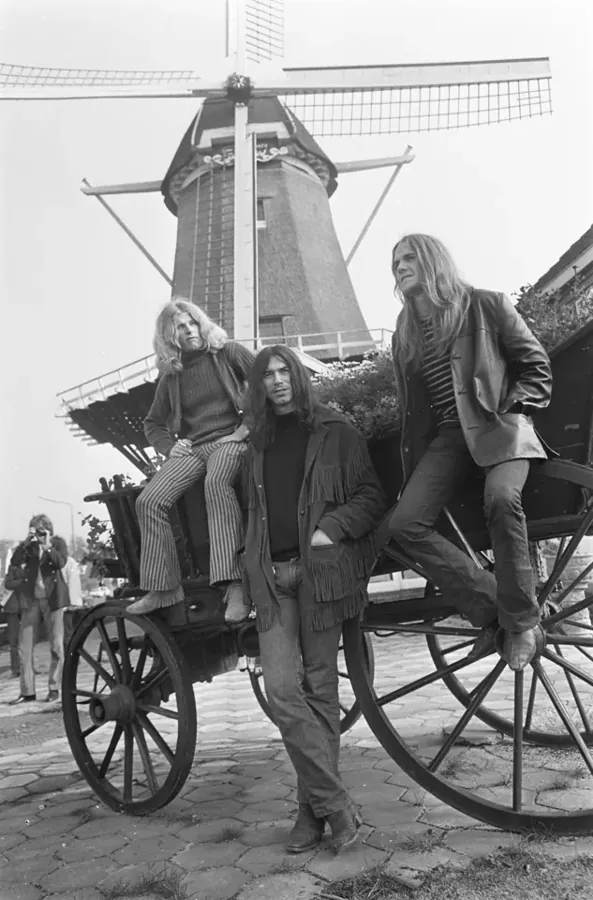
Blue Cheer formed in San Francisco in 1966 and passed through an expanded early lineup before settling on the trio heard on the first two albums: Peterson on bass and vocals, Stephens on guitar and Whaley on drums. Their six-track debut arrived in January 1968. Its opening cover of Eddie Cochran's "Summertime Blues" became a US top-20 single, while the album itself reached the US top 20.
After Outsideinside, the lineup changed rapidly. New! Improved! Blue Cheer preserves two versions of the band: Bruce Stephens and keyboardist Ralph Burns Kellogg appear on the first side, while guitarist Randy Holden drives the trio heard on the second. By the self-titled fourth album, Norman Mayell had replaced Whaley on drums; Gary Lee Yoder became central to the early-1970s lineup. Peterson later revived Blue Cheer in several configurations and remained its constant until his death in 2009.
Sound & Style
The classic trio leaves little empty space. Stephens stretches blues figures into sustained fuzz, Peterson's bass occupies much of the same low-midrange, and Whaley answers with rolling fills and hard cymbal accents. Peterson's strained, high-register singing cuts through because it behaves like another distorted instrument rather than a calm focal point.
Vincebus Eruptum presents that method with minimal relief across three originals and three radically rearranged blues and rock-and-roll songs. Outsideinside broadens the palette with more studio colour, backing vocals and sharper contrasts between compact songs and extended passages. Part of the second album was recorded outdoors after the band was asked to leave Studio 57 over its volume; the outdoor and indoor sessions gave the album its title. The story is striking enough without the unsupported claim that the band destroyed the studio monitors.
Essential Albums
Vincebus Eruptum
1968Six songs and roughly half an hour establish the original trio's entire proposition. "Summertime Blues" turns Eddie Cochran's teenage complaint into a lurching mass of stops, bass distortion and shouted responses; "Doctor Please" and "Second Time Around" give Stephens and Whaley room to stretch the same force over longer forms.
Key tracks: Summertime Blues · Out of Focus · Second Time Around
Open album guide → View on Amazon →Outsideinside
1968The original trio's second and final album was assembled from indoor and outdoor sessions. "Feathers from Your Tree" brings more melodic detail to the heavy foundation, "Just a Little Bit" tightens it into a single, and the closing "Babylon" returns to open-ended, feedback-rich scale.
Key tracks: Feathers From Your Tree · Come and Get It · Babylon
Open album guide → View on Amazon →A transitional record rather than one stable new lineup. Bruce Stephens and Ralph Burns Kellogg shape the first side's shorter, more arranged songs; Randy Holden joins Peterson and Whaley for the second side, where "Peace of Mind" and "Fruit & Icebergs" restore the power trio's extended weight in a different guitar vocabulary.
Key tracks: When It All Gets Old · Peace of Mind · Fruit & Icebergs
Open album guide → View on Amazon →Affiliate note: Amazon links on this page may earn RetroForge Records a small commission, at no extra cost to you.
Deeper Cuts
Blue Cheer
1969The fourth album moves toward a looser, more conventional blues-rock sound. Bruce Stephens and Ralph Burns Kellogg remain, Norman Mayell takes the drum chair, and Gary Lee Yoder contributes before joining the next lineup.
Open album guide → View on Amazon →Gary Lee Yoder's arrival gives the fifth album a clearer songwriting centre, while organ, piano and acoustic textures place more distance between this lineup and the compressed assault of 1968.
Open album guide → View on Amazon →Why They Still Matter
Blue Cheer's importance lies in a repeatable musical idea: a familiar blues or rock-and-roll framework can become radically different when amplification, distortion and ensemble density are pushed to the foreground. Later heavy rock, stoner rock and noise rock could draw on that idea without copying the trio's songs.
The “first heavy metal band” label is therefore less useful than the records themselves. Vincebus Eruptum and Outsideinside retain the looseness, cover repertoire and exploratory scale of late-1960s psychedelia even as their sound points toward heavier forms. Hearing both sides of that identity prevents Blue Cheer from being reduced to a volume contest.
Sources & Further Reading
Release dates, track counts and catalogue context were checked against Apple Music's Vincebus Eruptum edition, its Outsideinside notes and the Blue Cheer artist overview.
For first-hand musical context, see Vintage Guitar's interview with Leigh Stephens and Guitar World's interview with Randy Holden. The classic lineup and Peterson's death are also documented in The Washington Post's obituary.
Connected archive routes
Explore This Band
Continue through the RetroForge knowledge graph
Curated paths into the people, records, events and ideas that give this subject its wider musical context.
Genres and scenes
- Acid Rock
- Psychedelic Rock